Safety first: Portable power stations store a lot of energy and put out household-voltage power that can kill. Follow the maker’s manual and label warnings, keep the unit dry and ventilated, and don’t charge it in a closed compartment or leave a damaged unit in use. Never back-feed power into your RV through a homemade cable, and have a qualified RV technician or licensed electrician install any transfer switch, inlet or other change to your RV’s wiring. See our full disclaimer at the end of this article.
Some links on this page are affiliate links. If you buy through them, we may earn a commission at no extra cost to you. Our verdicts don’t depend on it: where another brand fits better, we say so. As an Amazon Associate, we earn from qualifying purchases.
Quick answer: All three brands now use long-life lithium iron phosphate (LiFePO4) batteries, so the right pick depends on your rig and how you camp, not on the logo.
- Weekend campground trips (lights, fans, coffee maker, phones, a CPAP): a 2 kWh unit is plenty. The BLUETTI Elite 200 V2 gives the most capacity for the money. The Jackery Explorer 2000 v2 is the lightest of the three and has a Quiet Mode rated under 30 dB. The EcoFlow DELTA 3 Max Plus has the most output power and can be expanded later.
- Boondocking for several days (no hookups): pick a unit that takes plenty of solar and can add batteries. The EcoFlow DELTA Pro 3 leads on solar input and size. The BLUETTI Apex 300 and Jackery HomePower 3600 Plus are expandable for less money.
- Running the RV air conditioner: only the big units with a 30-amp RV outlet (TT-30) will do it, and then only for a few hours unless you add batteries or solar. Our shortlist: BLUETTI Elite 300 or Apex 300, EcoFlow DELTA Pro 3 and Jackery HomePower 3000 or 3600 Plus. A soft starter on the air conditioner makes success much more likely.
Below, we compare the current US models side by side, explain what the numbers mean for an RV, and show where each brand wins.
The Short Verdict by RV Type
| Your situation | Best fit | Why |
|---|---|---|
| Small trailer, van or pop-up, mostly campgrounds | BLUETTI Elite 200 V2 or Jackery Explorer 2000 v2 | About 2 kWh runs lights, fans, phones and small kitchen items for a weekend. BLUETTI costs less per watt-hour and takes more solar; Jackery is about 14 pounds lighter. |
| Weekend trips, may want more power later | EcoFlow DELTA 3 Max Plus | 3,000 watts of output and expandable to 10 kWh with extra batteries. |
| 30-amp travel trailer or Class C, wants some air conditioning | BLUETTI Elite 300 or Jackery HomePower 3000 | Both have a TT-30 RV outlet, so you plug the RV’s shore cord straight in. |
| Long boondocking stays with a lot of solar | EcoFlow DELTA Pro 3 | Biggest battery here (4,096 Wh) and up to 2,600 watts of solar input. Also the heaviest. |
| Build a bigger system over time | BLUETTI Apex 300 or Jackery HomePower 3600 Plus | Both add battery packs (Apex 300 up to six B300K packs; HomePower 3600 Plus up to 21 kWh) and both have a TT-30 outlet. |
| 50-amp fifth wheel or Class A | None of these runs the whole rig | They can power the 120-volt circuits through an adapter, but not two air conditioners. See the 30-amp section below. |
Which Models We Compared
Each brand sells a dozen or more power stations, and model names change often. To keep this fair, we picked the current US models that match up in two size classes that make sense for RVs:
- The 2 kWh class (about 2,000 watt-hours): big enough for weekend camping, small enough to lift into a storage bay.
- The “RV-ready” class (about 2,700 to 4,100 watt-hours): units with a 30-amp TT-30 outlet, the same plug you find on a 30-amp campground pedestal.
All specs below come from each brand’s US product page, checked on November 11, 2026 (prices re-checked November 20, 2026), with independent test results where we could find them. Prices change often, especially around Black Friday, so treat the prices as a snapshot and check the brand’s page before you buy.
2 kWh Class: BLUETTI Elite 200 V2 vs EcoFlow DELTA 3 Max Plus vs Jackery Explorer 2000 v2
| Spec | BLUETTI Elite 200 V2 | EcoFlow DELTA 3 Max Plus | Jackery Explorer 2000 v2 |
|---|---|---|---|
| Battery capacity | 2,073.6 Wh | 2,048 Wh | 2,042 Wh |
| Battery type and rated life | LiFePO4, 6,000+ cycles (to 80%) | LiFePO4; no cycle number listed (“about 10 years”) | LiFePO4, 4,000 cycles (to 70%) |
| AC output (continuous / surge) | 2,600 W / not listed† | 3,000 W / 6,000 W | 2,200 W / 4,400 W |
| 30-amp RV outlet (TT-30) | No | No | No |
| Expandable | No | Yes, up to 10 kWh | No |
| Max solar input | 1,000 W | 1,000 W | 400 W |
| Weight | 53.35 lb | About 49.6 lb | 39.5 lb |
| Noise (brand figure) | 16 to 50 dB (user manual) | Not listed | Under 30 dB in Quiet Mode, 45 dB at full load (at 1 m) |
| Warranty | 5 years | 5 years (3 + 2 with app registration) | 3 years + 2 extra when bought from Jackery or an authorized seller |
| UL listing stated | Not stated on product page | Not stated on product page | Not stated on product page |
| App | Yes, Wi-Fi and Bluetooth | Yes, Wi-Fi and Bluetooth | Yes (Jackery App) |
| Price seen Nov 20, 2026 | $899 | $1,149 (list $1,599) | $999 |
| Official page | See Elite 200 V2 | See DELTA 3 Max Plus | See Explorer 2000 v2 |
†BLUETTI lists 3,900 W “Power Lifting” for the Elite 200 V2, but that mode is only for heating-type loads such as kettles and heaters, so we don’t count it as surge power.
What this means in an RV: All three hold roughly the same amount of energy, so they’ll run your lights, water pump, fans, phones and a small fridge for about the same time. The differences are in the details:
- BLUETTI Elite 200 V2 is the best value here: the most watt-hours for the lowest price, plus the longest rated battery life (6,000+ cycles). It’s also the heaviest of the three, and it can’t add batteries later.
- EcoFlow DELTA 3 Max Plus has the strongest output (3,000 watts), so it handles a microwave or an induction cooktop with room to spare, and it’s the only one of the three you can expand. It costs the most, and EcoFlow doesn’t give a cycle rating for it.
- Jackery Explorer 2000 v2 is about 14 pounds lighter than the BLUETTI and has a Quiet Mode rated under 30 dB at 1 meter. Its weak spot for RVers is solar: 400 watts maximum, which makes it slow to recharge from the sun on a long dry-camping trip. If you want a Jackery you can expand, look at the HomePower 2000 Plus v2 (2,048 Wh, expands to 12 kWh, 800 W solar; check Jackery’s page for the current price).
Independent testing backs up the Jackery’s efficiency: The Solar Lab measured about 90% efficiency on the Explorer 2000 v2. Real usable capacity is always a bit below the label, because some energy is lost turning battery power into household power. Plan on roughly 85 to 90% of the rated watt-hours.
RV-Ready Class: Units With a 30-Amp TT-30 RV Outlet
A TT-30 outlet takes the same 30-amp plug as the shore power cord on most travel trailers and Class C motorhomes. That means you can plug the RV straight into the power station, and everything on your 120-volt circuits runs from it, just as it does at a campground pedestal.
| Spec | BLUETTI Elite 300 | BLUETTI Apex 300 | EcoFlow DELTA Pro 3 | Jackery HomePower 3000 | Jackery HomePower 3600 Plus |
|---|---|---|---|---|---|
| Battery capacity | 3,014.4 Wh | 2,764.8 Wh | 4,096 Wh | 3,072 Wh | 3,584 Wh |
| Rated battery life | 6,000+ cycles (to 80%) | 6,000+ cycles (to 80%) | 4,000 cycles (to 80%) | 4,000 cycles (to 70%) | 6,000 cycles (to 70%) |
| AC output (continuous / surge) | 2,400 W / not listed† | 3,840 W / not listed† | 4,000 W / 8,000 W | 3,600 W / 7,200 W | 3,600 W / 7,200 W |
| RV and other big outlets | TT-30 (120 V) plus a 12 V / 30 A DC port | TT-30 and NEMA 14-50 | TT-30, L14-30 and a 240 V outlet | TT-30 (120 V) | TT-30 (120 V) |
| Expandable | No | Yes, up to 6 B300K packs (about 19.4 kWh) | Yes, up to 12 kWh | No | Yes, up to 21 kWh |
| Max solar input | 1,200 W | 2 × 1,200 W | 2,600 W | 1,000 W | 1,000 W |
| Weight | 57.98 lb | 83.78 lb | 113.54 lb | 59.52 lb | 77.16 lb |
| Noise (brand figure) | Not listed | Not listed | “As low as 30 dB” | Not listed | 30 dB (Quiet Mode) |
| Warranty | 5 years | 5 years | 5 years | 3 + 2 years* | 3 + 2 years* |
| UL listing stated | Not stated on product page | “UL” listed, standard not named | UL 9540 (on product page) | Not stated on product page | Not stated on product page |
| App | Yes, Wi-Fi and Bluetooth | Yes, Wi-Fi and Bluetooth | Yes, Wi-Fi and Bluetooth | Not stated | Not stated |
| Price seen Nov 20, 2026 | $1,099 (list $1,199) | $1,699 | $2,799 (list $3,299), sold out | $1,499, sold out | $1,899 (out of stock); $3,309 with an extra battery |
| Official page | See Elite 300 | See Apex 300 | See DELTA Pro 3 | See HomePower 3000 | See HomePower 3600 Plus |
†BLUETTI lists a higher “Power Lifting” figure (Elite 300: 4,800 W; Apex 300: 7,680 W), but that mode is for heating-type loads such as kettles and heaters, not a startup surge rating.
*Jackery’s extra 2 years apply only when you buy from Jackery, a Jackery-branded store or an authorized dealer.
What this means in an RV:
- EcoFlow DELTA Pro 3 is the most capable unit here: the biggest battery, the most solar input (2,600 watts, enough to recharge from a large roof array), 240-volt output and the only UL 9540 listing we found stated on a product page. At over 113 pounds it’s very heavy to lift into an RV, and the base unit was sold out when we checked.
- BLUETTI Apex 300 is the most flexible for growing a system: it has both a TT-30 and a 50-amp-style NEMA 14-50 outlet and takes up to six add-on batteries. It costs about $1,100 less than the DELTA Pro 3, with less battery to start. In Outdoor Life’s test it delivered 2,290 Wh, about 83% of its rating.
- BLUETTI Elite 300 is the lowest-cost way here to get about 3 kWh and a TT-30 outlet ($1,099 when we checked). Its trade-off is output: 2,400 watts continuous, against 3,600 to 4,000 watts for the others, and BLUETTI doesn’t list a surge rating. That is enough for a typical rooftop air conditioner once it’s running, but fit a soft starter and don’t run the microwave at the same time. It can’t add expansion batteries. StorageReview measured 2.67 kWh delivered in testing, about 89% of its rating.
- Jackery HomePower 3000 gives you more battery (3,072 Wh) than the Apex 300 for less money ($1,499 vs $1,699, though it was sold out when we checked), but it can’t be expanded. HomePower 3600 Plus fixes that and lists a 30 dB quiet mode, at a higher price.
One more note: EcoFlow also launched a new DELTA 3800 Gen4 (3,763 Wh, 6,000 cycles, $1,699 early price) with a 30-amp outlet, but its US spec sheet doesn’t yet say which plug type that outlet takes. We’ll add it once EcoFlow confirms it is a TT-30.
Can These Power Stations Run Your RV Air Conditioner?
Yes, the RV-ready units can, but not all night on battery alone. Here is the simple math.
A typical 13,500 BTU (British thermal unit) rooftop air conditioner draws about 12 to 16 amps while running, according to Micro-Air, a soft-starter maker. At 120 volts that is roughly 1,400 to 1,900 watts. Divide the battery’s usable energy by that number:
- A 3,072 Wh unit (Jackery HomePower 3000), about 85% usable: roughly 2,600 Wh ÷ 1,500 W ≈ 1.5 to 2 hours of steady cooling.
- A 4,096 Wh unit (EcoFlow DELTA Pro 3): roughly 3,500 Wh ÷ 1,500 W ≈ 2 to 2.5 hours.
The compressor cycles on and off, so real run time is often longer than this, especially in mild weather. Solar panels, extra batteries and a well-shaded campsite all stretch it further. Before you buy, check your air conditioner’s data plate for its running amps (RLA, rated load amps) and starting amps (LRA, locked rotor amps).
The startup surge is the real test. An air conditioner compressor pulls several times its running power for a split second when it starts. A soft starter smooths that surge; Micro-Air says a soft starter can cut the startup demand by as much as 70%. Many RVers add one, such as the Micro-Air EasyStart Flex soft starter, before relying on a power station or a small generator. Have it installed by a qualified RV technician unless you are confident with 120-volt wiring.
We cover this question in more depth, with run-time tables for each size of air conditioner, in an upcoming guide.
Plugging a Power Station Into Your RV
If your RV has a 30-amp shore cord and the power station has a TT-30 outlet, you simply plug the cord in. Turn off big loads first (air conditioner, electric water heater, microwave), plug in, then switch things back on one at a time so you don’t overload the unit.
A 50-amp RV can run from a TT-30 outlet with a 50-amp-to-30-amp adapter (often called a “dogbone”), such as this RVGUARD 30-amp plug to 50-amp socket adapter (TT-30P to 14-50R). You are then limited to 30 amps on one leg, so you can run one air conditioner at most. The BLUETTI Apex 300’s NEMA 14-50 outlet is the only one in our tables shaped for a 50-amp plug. Check its manual for what it can actually power before you count on running a full 50-amp rig. Our 30-amp vs 50-amp RV guide explains the difference.
Keep a surge protector in mind for campground power. It doesn’t replace the protection built into a power station, but it protects your RV when you plug into a pedestal. See RV surge protector vs EMS.
Solar Charging: How Fast Can You Refill?
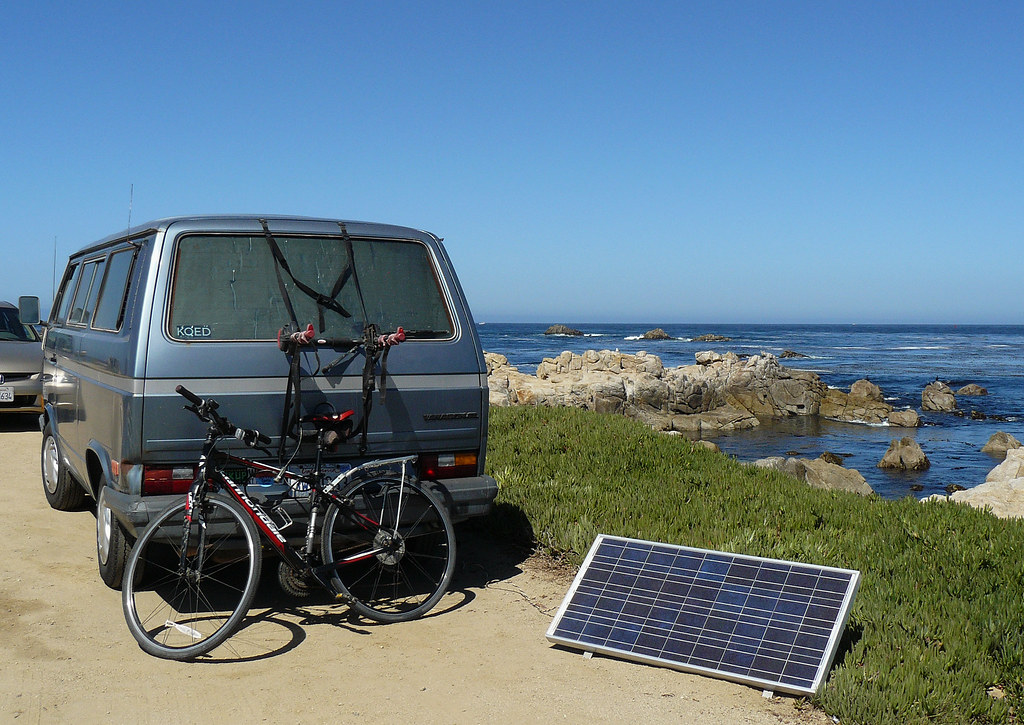
Maximum solar input decides how quickly you recover on a boondocking trip. As a rough guide, panels give about 70 to 80% of their rated watts in good sun. So 400 watts of panels (the Jackery Explorer 2000 v2’s limit) adds about 300 watts per hour of strong sun, which refills a 2 kWh battery in about 7 hours of good sun. With 1,000 watts of input (BLUETTI Elite 200 V2 or EcoFlow DELTA 3 Max Plus), the same battery can refill in about 3 hours.
To size your panels for your own appliances, try our free RV Solar Calculator. Our RV solar systems guide explains portable vs roof-mounted panels, and our Renogy solar guide covers a popular roof-kit option.
Noise: Power Station vs Generator
This is where every power station wins. They have no engine, just cooling fans that speed up under heavy load. Brand figures run from as low as 16 dB (BLUETTI Elite 200 V2 at light load) to around 30 dB in quiet modes and 45 to 50 dB at full load (Jackery and EcoFlow give their figures at 1 meter, about 3 feet). For comparison, Honda rates its popular EU2200i inverter generator at 48 to 57 dBA. Generator and power station noise figures aren’t always measured at the same distance, so compare them loosely. The bigger difference is that a power station has no engine and no exhaust fumes, and it is close to silent at light loads. Many campgrounds and national parks set generator hours and quiet hours; a power station lets you keep the fan or CPAP running without bothering your neighbors.
Battery Life, Warranty and Safety Listings
- Cycle ratings aren’t measured the same way. BLUETTI and EcoFlow rate cycles to 80% of original capacity; Jackery rates to 70%. A “4,000 cycle” Jackery and a “4,000 cycle” EcoFlow are not quite the same promise. Either way, even 3,000 cycles is more than 8 years of daily use.
- Warranty: EcoFlow gives 5 years on these models (on the DELTA 3 Max Plus, 2 of those years need app registration). Jackery gives 3 years plus 2 more only when bought from Jackery or an authorized seller. BLUETTI gives 5 years on all the models we compared. Keep your receipt, and register the unit when you buy it.
- UL listing: UL (Underwriters Laboratories) is a US safety testing company. Look for a stated listing such as UL 2743 (portable power packs) or UL 9540 (energy storage systems). EcoFlow states UL 9540 for the DELTA Pro 3. BLUETTI lists “UL” among the Apex 300’s certifications but doesn’t name the standard. For the others we compared, we didn’t find a specific listing on the US product page, so ask the seller before you buy if this matters to you.
Where Each Brand Wins
- BLUETTI wins on value and RV outlets. The Elite 200 V2 gives the most watt-hours per dollar in the 2 kWh class, the Elite 300 is the cheapest 3 kWh unit with a TT-30 outlet, and the Apex 300 is the only unit here with both a TT-30 and a 14-50 outlet.
- EcoFlow wins on power and solar. The DELTA Pro 3 has the biggest battery, the most solar input and 240-volt output, and the DELTA 3 Max Plus has the strongest output in its class.
- Jackery wins on weight and TT-30 output at 3 kWh. The Explorer 2000 v2 is the lightest 2 kWh unit here, with a Quiet Mode rated under 30 dB. The HomePower 3000 pairs about 3 kWh and a TT-30 outlet with 3,600 watts of output (the BLUETTI Elite 300 costs less but puts out 2,400 watts).
If we had to pick one unit for a typical 30-amp travel trailer that mostly camps at campgrounds and boondocks a few nights at a time, we’d look first at a TT-30 unit around 3 kWh, the BLUETTI Elite 300 or Jackery HomePower 3000, and add a soft starter to the air conditioner. If you plan long off-grid stays, the extra solar input of the EcoFlow DELTA Pro 3 or an expandable unit is worth paying for.
BLUETTI readers can use code AFF5OFF for 5% off at BLUETTI (from BLUETTI’s affiliate program; it may not stack with sale prices). For more on BLUETTI’s RV systems, including the RVSolar built-in kit, see our BLUETTI RV solar power systems guide.
BLUETTI vs EcoFlow vs Jackery: Questions RVers Ask
Which is more reliable, BLUETTI, EcoFlow or Jackery?
All three are large, established brands using LiFePO4 batteries, which are known for long life and good thermal stability. There’s no independent, long-term failure-rate study comparing them, so judge by warranty length, where you buy (for warranty support) and the cycle rating. Buying direct or from an authorized seller keeps the full warranty.
Is BLUETTI better than Jackery for an RV?
For value and RV outlets, often yes: the Elite 200 V2 costs less than the Explorer 2000 v2 for slightly more capacity and takes 1,000 watts of solar instead of 400. Jackery is lighter, and its HomePower 3000 offers a TT-30 outlet with 3 kWh of battery for less than BLUETTI’s Apex 300.
Is EcoFlow better than BLUETTI for an RV?
EcoFlow is stronger on output power and solar input, especially the DELTA Pro 3. BLUETTI usually costs less for the same capacity and offers more RV-shaped outlets on the Apex 300. If you have a big roof solar array, EcoFlow’s higher solar input matters.
Can I plug my RV into a portable power station?
Yes, if the power station has a TT-30 outlet and your RV has a 30-amp cord. A 50-amp RV needs a 50-to-30-amp adapter (or a unit with a 14-50 outlet) and will be limited in what it can run. Never make your own cable to feed power into an RV outlet.
How long will a power station run an RV fridge?
A typical RV compressor fridge uses about 1 to 2 kWh per day, depending on its size and the weather (check the energy label). A 2 kWh power station can run it for about one day, or longer with solar. Absorption fridges that run on electric heat use more power, so switch them to propane when you run on battery.
Is a power station worth it compared with a generator?
For quiet, fume-free power for lights, fans, electronics, a CPAP and short air conditioner runs, yes. For running a 50-amp RV with two air conditioners for days, a generator (or a large built-in lithium and solar system) is still the practical choice. Many RVers use both: the generator for heavy loads, the power station for quiet hours.
Related RV Power and Solar Guides
- BLUETTI RV solar power systems: which one fits your RV?
- RV solar systems: everything you need to know before you buy
- Renogy solar for RVs
- RV boondocking gear: 7 essential off-grid picks
- 30 amp vs 50 amp RV: what’s the difference?
- RV surge protector vs EMS: which do you need?
- How to work remotely from an RV: internet, power and workspace
- Winter RV camping tips
- Best motorhome upgrades: 10 worth doing
- Free RV Solar Calculator
Sources
- BLUETTI US product pages: Elite 200 V2, Elite 300, Apex 300
- EcoFlow US product pages: DELTA 3 Max series, DELTA Pro 3, DELTA 3800 Gen4
- Jackery US product pages: Explorer 2000 v2, HomePower 2000 Plus v2, HomePower 3000, HomePower 3600 Plus
- Independent tests: The Solar Lab, Jackery Explorer 2000 v2; StorageReview, BLUETTI Elite 300; StorageReview, BLUETTI Elite 200 V2; Outdoor Life, BLUETTI Apex 300
- Air conditioner power draw: Micro-Air, how many amps does an RV AC draw
- Generator noise: Honda EU2200i specifications
Acronyms Used in This Article
- AC: alternating current (household-type power)
- BTU: British thermal unit
- CPAP: continuous positive airway pressure (a sleep apnea machine)
- dB: decibel (a measure of loudness); dBA: A-weighted decibels, adjusted to how people hear
- EMS: electrical management system
- kWh: kilowatt-hour (1,000 watt-hours)
- LiFePO4: lithium iron phosphate (a type of lithium battery)
- LRA: locked rotor amps (an air conditioner’s starting current)
- NEMA: National Electrical Manufacturers Association (sets US plug and outlet shapes)
- RLA: rated load amps (an air conditioner’s running current)
- RV: recreational vehicle
- TT-30: the standard 30-amp, 120-volt RV plug and outlet (“TT” stands for travel trailer)
- UL: Underwriters Laboratories (a US product safety testing company)
- US: United States
- W: watt; Wh: watt-hour
Disclaimer
The information provided is for educational purposes only. Before carrying out any maintenance or safety task on your RV, please do your own further research so you are fully confident in each step. If you are ever unsure, consult a qualified RV professional or get a second opinion. Readers are responsible for their own safety, and PreciousRV.com accepts no liability for any injury, loss or damage. Specs and prices are from each brand’s US website and can change. Some links are affiliate links, and as an Amazon Associate, we earn from qualifying purchases. Facts checked in November 2026.
Photos: RV Hive on Flickr, CC BY 2.0, cropped; docentjoyce on Flickr, CC BY 2.0, cropped.