Please note: This guide is general safety information. Always follow your recreational vehicle (RV) manufacturer’s instructions, your owner’s manuals, and the laws of every state you drive through. In an emergency, call 911. See our full disclaimer at the end of this article.
These RV safety tips cover the habits that prevent most problems on the road and at camp: checking your rig before you leave, driving within your RV’s limits, protecting children and pets, and being ready for fire, carbon monoxide and bad weather. None of it takes long, and most of it becomes second nature after a few trips.

Key Takeaways
- Check your RV before every trip: tires, lights, brakes, hitch, propane and anything that slides or swings out.
- Drive within your RV’s limits. Know your height and weight, leave extra braking distance, and remember that many trailer tires are rated for only 65 miles per hour.
- Never let anyone ride in a towed travel trailer or fifth wheel. It is unsafe everywhere and illegal in many states.
- Fire is a real risk. U.S. fire departments respond to thousands of RV fires each year, so carry extinguishers, test your alarms and plan two ways out.
- RVs are not safe in tornadoes. When severe weather is forecast, know where the nearest sturdy building is and go there early.
Free download: RV safety tips
Get our free RV safety tips and printable checklists by email, so you have them ready before your next trip.
Before Every Trip: The RV Safety Check
A ten-minute walk-around before you leave catches most problems while they are still easy to fix. Check:
- Tires: pressure checked while the tires are cold (a reading on hot tires is falsely high), the date code on the sidewall checked so you know how old each tire is, and no cracks or bulges. Tires age and weaken even when the tread still looks good.
- Lights and brakes: headlights, brake lights and turn signals working on both the RV and the tow vehicle, and brakes tested before you pull out. Brakes that drag can overheat and start a fire.
- Hitch and connections: coupler locked, safety chains crossed, breakaway cable attached and the electrical plug connected.
- Propane: tanks secured, no smell of gas, and the valve closed if you are not running appliances while you drive.
- Everything stowed: slide-outs in, awning locked, steps up, antenna down, roof vents closed and loose items secured inside.
- 12-volt wiring: battery and wiring connections tight. Road vibration loosens them, and a loose connection can overheat.
Our RV maintenance checklist by season covers the bigger jobs to do through the year.
Know Your Weight and Height
Every RV has a gross vehicle weight rating (GVWR), the most it can safely weigh fully loaded, and a cargo carrying capacity (CCC) that shows how much you can add. You will find both on a sticker, usually inside a cabinet or near the entry door. An overloaded RV takes longer to stop, handles poorly and is harder on tires. Weigh your loaded rig at a truck scale at least once, and write your RV’s total height on a note near the steering wheel so you can check bridge and overpass clearances.
Check for Recalls
Enter your RV’s 17-character vehicle identification number (VIN) in the National Highway Traffic Safety Administration (NHTSA) recall lookup to see open safety recalls, and check your tow vehicle too. Recall repairs are free at authorized dealers.
Safe RV Driving and Towing
- Slow down and leave space. A heavy RV needs much more distance to stop than a car, so leave a large gap and brake early.
- Respect your tires’ speed rating. Special trailer (ST) tires are generally rated for a maximum of 65 miles per hour unless the sidewall shows a higher speed rating. Check your tires and your owner’s manual.
- Watch the wind. High-profile RVs catch crosswinds. Slow down on open highways and bridges, and wait out strong wind if you can.
- Plan easy driving days. Tired drivers make mistakes. Many RVers follow the 3-3-3 rule: no more than about 300 miles a day, a break every 3 hours, and arrival by 3 PM.
- Use a spotter when backing up, and agree on hand signals or use phones or radios.
- Shut off propane at fuel stops. If your refrigerator runs on propane while you drive, turn it off before you pull into a gas station. Most refrigerators keep food cold for hours without power.
New to driving a big rig? Our first time RV driving guide walks you through practice drills, and an RV driving course is worth considering. Ask your insurer whether completing one lowers your premium.
Never Ride in a Towed Trailer
No one should ride in a travel trailer or fifth wheel while it is being towed. Trailers are not built with crash protection for passengers inside, and riding in them is illegal in many states, including Florida and Ohio. Some states, such as California, allow riders only in a fifth wheel that meets specific conditions. Everyone should ride in the tow vehicle (the truck or car pulling the trailer, where the driver sits), wearing a seat belt.
RV Safety for Children
- Everyone buckles up while a motorhome is moving, in a seat with a seat belt. The dinette and bed are not safe places to ride.
- Car seats go only on forward-facing seats with a proper lap and shoulder belt or lower anchors. Never install a car seat on a side-facing sofa or bench, according to guidance from the Children’s Hospital of Orange County. Check your car seat manual and your RV manual.
- Follow every state’s car seat law. Rules differ from state to state, so check the law for each state on your route.
- Prevent falls from bunks. A bunk bed safety net or rail keeps a sleeping child from rolling out of an upper bunk.
- Teach the exits. Show children where the emergency exit window is and how it opens.
RV Safety for Pets
An RV can heat up fast in the sun, and air conditioners and campground power can fail. Never leave a pet in an RV in hot weather without a backup plan, and use a cellular temperature monitor such as the Waggle RV pet temperature monitor, which alerts your phone if the temperature rises or falls too far. While driving, pets should ride secured in the tow vehicle or motorhome, never in a towed trailer. Our RV travel with pets checklist covers pet safety in detail, and our guide to RV dog ramps and steps helps dogs get in and out safely.
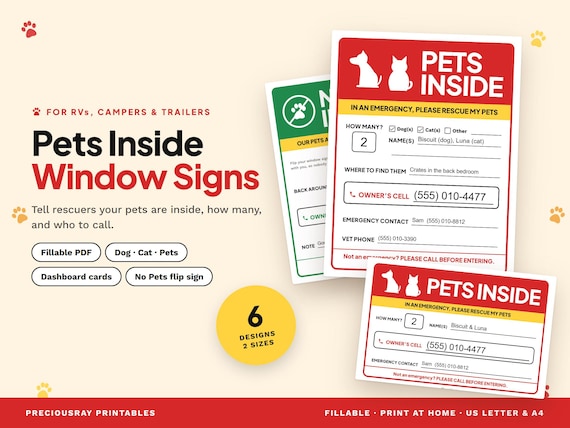
Let rescuers know your pets are inside
If there is ever a fire or another emergency at the campground while you are away, a sign in your window tells firefighters and neighbors at a glance that a pet is inside. The Pets Inside RV Window Signs use bold red and white that is easy to read through glass.
- 6 designs, each in 2 sizes: Pets, Dog, Dogs, Cat and Cats, plus a green “No Pets Inside” flip sign for when your pets are out with you. Each comes as a full-page window sign and a smaller dashboard card.
- Room for what rescuers need: how many pets, their names, where to find them, your cell number, an emergency contact and your vet
- Type it or write it: fill it in with the free Adobe Acrobat Reader, or print it and use a marker. Instant download in US Letter and A4.
Get the Pets Inside RV Window Signs
A sign helps, but it never replaces keeping your RV cool and checking on your pets often. We may earn from purchases made through links on this page.
RV Fire Safety
According to the U.S. Fire Administration (USFA), U.S. fire departments responded to an average of about 4,200 RV fires a year from 2018 to 2020. These numbers count RV fires only, not all fires. Those RV fires caused an average of 15 deaths and 125 injuries each year (USFA RV fire data). The National Park Service (NPS) recommends these steps (NPS RV fire safety):
- Carry three fire extinguishers: one in the kitchen, one in the bedroom, and one outside or in the tow vehicle. A compact multipurpose model such as the Kidde 1-A:10-B:C extinguisher is easy to mount, and everyone should know how to use it.
- Test your smoke alarm before every trip.
- Plan two escape routes and practice opening the emergency exit window.
- Never leave cooking unattended, and keep anything that burns away from the stove.
- Use heavy-duty cords only, do not overload outlets, and never run a cord under a rug.
- Keep fire rings, lanterns and torches well away from all vehicles, and do not park a hot exhaust over dry grass.
- If a fire starts, get everyone out first. Fight only a small fire you can safely put out, never go back inside, and call 911 with your exact location.
Carbon Monoxide and Propane Safety
Carbon monoxide (CO) is an invisible, odorless gas that can come from propane appliances, generators and engine exhaust. Propane, also called liquefied petroleum gas (LP), can leak from tanks and lines.
- Test your CO and LP gas detectors before each trip. Many RV detectors are rated to last about 5 years (some 7), so check the date label and replace yours when it expires. If yours is due, RV propane and CO detectors are designed for the 12-volt system.
- Never ignore an alarm. Get everyone outside into fresh air, turn off the propane at the tank, and call for help if anyone feels unwell.
- Run your generator only where exhaust cannot drift into your RV or your neighbor’s, away from windows, doors and vents.
- Deal with a propane smell immediately. Close the tank valve, put out flames, open windows and do not touch electrical switches until the gas has cleared.
Electrical Safety
Inspect your power cord before each trip and replace it if it is cracked, melted or damaged. A surge protector or electrical management system protects your RV from bad campground power, and our guide to 30 amp vs 50 amp RV power explains adapters and pedestal safety.
Severe Weather Safety
- Watch the forecast and turn on weather alerts on your phone, or carry a weather radio where cell service is weak.
- Tornadoes: the National Weather Service (NWS) warns that mobile homes and vehicles are not safe in a tornado (NWS tornado safety). When you arrive at a campground, ask where the storm shelter or nearest sturdy building is, and go there early when severe storms are forecast, not after the warning.
- High winds: bring in the awning and slide-outs, and park facing into the wind if you can. Awning safety straps or a Carefree awning stabilizer kit help, but they do not make it safe to leave an awning out in a storm.
- Lightning: go inside a sturdy building or a hard-topped metal vehicle such as your tow vehicle, and stay away from water and open ground.
- Flooding: never camp in a dry wash (a dry creek bed or low channel that can fill with fast-moving water within minutes when it rains, even if the storm is miles away), and never drive through flooded roads.
- Cold weather: see our winter RV camping tips for heating and condensation safety.
Safety at the Campsite
- Chock your wheels before you unhitch, and use stabilizers so the RV does not rock or shift. X-style wheel chocks fit between tandem tires (two tires one behind the other on the same side, as on a trailer with two axles).
- Fix wobbly steps. Loose, slippery entry steps cause many falls. Add step covers for grip or upgrade to sturdier steps; our RV ramps and steps guide compares options.
- Do not overload the rear bumper. Many trailer bumpers are not designed to carry heavy loads such as bike racks or generators. SafetyStruts bumper supports add strength, but always check your RV manufacturer’s limits.
- Lock up. Lock doors and storage bays when you leave or go to sleep, keep valuables out of sight, and tell someone your travel plans.
Roadside Help and Emergencies
Breakdowns are a matter of when, not if. Keep a roadside emergency kit (reflective triangles, flashlight, gloves, basic tools and a first aid kit), save your insurer’s claims number in your phone, and consider an RV-specific roadside assistance plan such as Good Sam Roadside Assistance, since some car-focused plans do not cover towing a large RV. Wherever you stop, know your exact location so help can find you.
RV Safety Kit Checklist
| Item | Why you need it |
|---|---|
| Fire extinguishers (3) | To put out a small fire before it spreads. Keep one in the kitchen, one in the bedroom and one outside or in the tow vehicle. |
| Smoke, CO and LP gas alarms | Early warning of fire, carbon monoxide and propane leaks |
| Tire pressure gauge or monitoring system | Catches slow leaks before they become blowouts |
| Wheel chocks and stabilizers | Keep the RV from rolling or shifting at camp |
| First aid kit | To treat cuts, burns, stings and other minor injuries for people and pets, especially when you are far from a clinic or vet. |
| Reflective triangles and flashlight | Roadside breakdowns, especially at night |
| Surge protector | Protects your electrical system from bad campground power |
| Weather radio or alerts | Gives storm and tornado warnings, even where cell service is weak |
| Temperature monitor | Alerts your phone if the RV gets too hot or too cold while pets are inside |
Video: Towing Safety Basics
If you tow a trailer, this short video from RV Education 101 covers the basics of hitching and towing safely.
Frequently Asked Questions
What is the most important RV safety tip?
Do a full safety check before every trip, and make sure working smoke, carbon monoxide and propane alarms and fire extinguishers are on board. Most serious RV problems start with something a quick check would have caught.
Can passengers ride in a travel trailer while it is being towed?
No. Travel trailers and fifth wheels are not built to protect passengers in a crash, and riding in them is illegal in many states. Everyone should ride buckled up in the tow vehicle.
Are RVs safe in a storm?
RVs handle ordinary rain well, but they are not safe in tornadoes or very high winds. When severe storms are forecast, move to a sturdy building or the campground’s storm shelter early.
How often should I replace my RV’s carbon monoxide detector?
Check the date on the detector’s label. Many RV carbon monoxide and propane detectors are rated for about 5 years, and some for 7. Replace yours when it expires, even if it still seems to work.
How fast should I drive when towing an RV?
Slower than you would in a car. Many special trailer tires are rated for 65 miles per hour maximum unless the sidewall shows otherwise, and lower speeds give you more time to stop and better control in wind.
Acronyms Used in This Article
- CCC: cargo carrying capacity
- CO: carbon monoxide
- GVWR: gross vehicle weight rating
- LP: liquefied petroleum (propane) gas
- NHTSA: National Highway Traffic Safety Administration
- NPS: National Park Service
- NWS: National Weather Service
- RV: recreational vehicle
- ST: special trailer (tire type)
- U.S.: United States
- USFA: U.S. Fire Administration
- VIN: vehicle identification number
Disclaimer
This article is general information only and is not professional, legal or medical advice. Follow your RV, tire, detector and car seat manufacturers’ instructions, and check the current laws for each state you travel in. Statistics and recommendations come from the sources linked above. Some links in this article are affiliate links, and we may earn a commission if you buy through them, at no extra cost to you. Facts checked October 2026.