Quick answer: A 30 amp RV uses a single 120V leg providing 3,600 watts total — enough for one air conditioner plus light loads. A 50 amp RV uses two 120V legs for 12,000 watts (240V split-phase), enough to run two air conditioners and a dryer simultaneously. Always match your surge protector to the pedestal you’re plugging into and use the correct dogbone adapter when stepping up or down.
✅ Looking for the gear? Browse popular, RVer-recommended options at RV Tool Haven — organized by category — based on what RV owners commonly recommend.
How to tell which you have
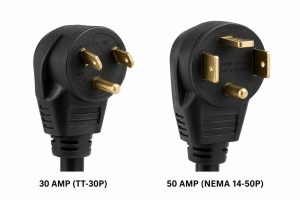
Look at your shore power cord plug. 30 amp has 3 prongs (TT-30); 50 amp has 4 prongs (NEMA 14-50). The 50 amp is much bigger.
Power math you actually need
30 amp = 30A × 120V = 3,600W total
50 amp = 50A × 240V (two 120V legs) = 12,000W total
A 50 amp service is 3.3× the power of a 30 amp, not 1.67× — a common mistake.
Adapters (dogbones)
- 30A male → 50A female: lets you plug a 50A rig into a 30A pedestal (limited to 3,600W total)
- 50A male → 30A female: lets you plug a 30A rig into a 50A pedestal
Use heavy-duty marine-grade dogbones, never cheap molded ones — they melt.
Surge protector must match the pedestal
Buy the surge protector for the pedestal type you’ll plug into most often. EMS (Electrical Management System) units detect open ground, low voltage, and reverse polarity and disconnect automatically.
Power management on 30 amp
Run one AC at a time. Microwave + AC = tripped breaker. Some RVs have built-in load shedding.
Common pedestal problems
Open ground, miswired neutral/hot, and low voltage (under 105V) are everyday occurrences in older parks. An EMS catches all three.
Recommended surge protectors and adapters
Browse popular, highly-rated EMS units and adapters at the RV Tool Haven electrical guide.
Reading the pedestal correctly
A standard RV pedestal has three outlets:
– 20A (looks like a household outlet) — for trickle charging only
– 30A TT-30 (3 prongs in a triangle) — your 30A RV plug
– 50A NEMA 14-50 (4 large prongs) — your 50A RV plug
Always check pedestal voltage with an EMS or plug-in tester before plugging in your rig.
Power management — running the math
For a 30A RV (3,600W total available):
– Air conditioner: 1,500W
– Microwave: 1,200W
– Hair dryer: 1,500W
– Coffee maker: 1,000W
– Converter (charging batteries): 600W
You can run AC alone or AC + microwave but not AC + microwave + hair dryer. Plan accordingly.
For a 50A RV (12,000W total = 6,000W per leg):
– Two air conditioners + microwave + electric water heater + electronics: easily within budget.
Adapters — what’s safe and what’s not
- 30A → 50A (small plug → big socket): only 30A of power is delivered. Safe but limits a 50A rig.
- 50A → 30A (big plug → small socket): standard adapter. The pedestal still limits to 30A so the rig can’t pull more.
- 15A → 30A (household outlet → 30A): only delivers 15A; one AC will trip the breaker. Use only for charging.
Never daisy-chain adapters. Always use marine-grade Camco PowerGrip or equivalent.
What blows up rigs
- Open ground: hot electrical chassis, can shock you.
- Reverse polarity: appliances run backward, fail prematurely.
- Low voltage (below 105V): air conditioner compressor draws excess current and burns out.
- Voltage spike: lightning or grid event, fries everything.
Only an EMS catches all four. A basic surge protector catches only the spike.
Generator sizing
- 30A RV: 3,500W generator minimum (Honda EU3000is, Champion 3500).
- 50A RV: paired 2,200W inverter generators (4,400W combined) or a 7,500W+ standalone.
Always run gens with a built-in inverter or sine-wave output to protect electronics.
Frequently Asked Questions
Can I run two ACs on 30 amp?
No — only one at a time.
Will a 50A→30A adapter damage anything?
No, it just limits available power.
Do I need a different EMS for 30 vs 50 amp?
Yes — they’re not interchangeable.
See the best RV surge protectors →
Find the best-rated, current-price recommendations for every tool mentioned in this article at RV Tool Haven — RV Tools Every RVer Needs.
Related Reads
- Do I Really Need an RV Surge Protector?
- Surge Protector vs EMS for RV: Which Should You Buy?
- The Essential RV Tools Checklist Every RVer Needs
Browse RV gear HERE.
Sources & further reading
- NEC / NEMA receptacle configurations (TT-30 and 14-50)
- Progressive Industries — how an EMS protects your RV
- RV Travel — understanding 30 amp vs 50 amp service
This article was reviewed against manufacturer documentation and industry standards where available. Specific torque values, pressures, and tolerances always defer to your RV and component manufacturer’s manuals.