Please note: This guide is general information, not veterinary advice. Every pet is different, so talk to your veterinarian (vet) before a long trip, especially if your pet is young, old, has a health condition or gets anxious in vehicles. Rules for campgrounds, parks and border crossings change, so always check the official sources we link. See our full disclaimer at the end of this article.
RV (recreational vehicle) travel with pets is one of the best parts of life on the road. Your pet gets new smells, new trails and more time with you, and you skip the worry and cost of a kennel. A little planning makes the difference between a stressful trip and a happy one. This checklist walks you through every step, from the vet visit before you leave to what to do if something goes wrong on the road.
Key Takeaways
- See your vet first. Get a check-up, update vaccines and parasite prevention, and ask for copies of your pet’s records, including the rabies certificate.
- Make sure your pet can be identified. A collar identification (ID) tag plus a registered microchip with your current phone number.
- Restrain your pet while driving. Use a travel harness, crate or carrier, and never let a pet ride in a towed trailer or fifth wheel, even in a harness or crate.
- Never rely on luck with heat. A closed vehicle can get dangerously hot in minutes, and cracking the windows makes no real difference.
- Check pet rules before you book. Campgrounds, national parks and border crossings all have their own rules.
Free download: RV Traveling with Pets Guide
Our free printable guide to RV trips with your dog or cat. Get it, plus our other free RV checklists, by email.
Is RV Travel Right for Your Pet?
Many dogs and cats settle into RV life quickly, because their “home” comes with them: the same bed, the same bowls and the same people. But not every pet enjoys it. Before you plan a long trip, think honestly about your pet’s personality:
- Motion and noise. Some pets get carsick or anxious from engine noise and road vibration. A pet that is calm in your car may still be nervous in a larger, louder RV, and the opposite can happen too.
- New places. Campgrounds are full of new people, dogs, smells and wildlife. A pet that is very fearful or reactive may find this stressful.
- Health and age. Very young, senior, overweight and short-nosed (flat-faced) pets can struggle more with heat and long travel days. Ask your vet whether a trip is a good idea.
If your pet gets motion sickness or anxiety, talk to your vet before you go. There are medicines and calming options that can help, but only your vet can say which are safe for your pet.
Do a few practice runs
Let your pet explore the parked RV first, with treats, praise and their own bed and toys inside. Then take short drives, building up from a few minutes to an hour or more. Short practice trips show you how your pet handles travel before you are hundreds of miles from home. If you are renting an RV, ask whether you can pick it up a little early so your pet can get used to it.
Before You Go: The Vet Visit and Paperwork
Book a vet visit a few weeks before a big trip. That leaves time for any vaccines or tests your pet needs. Ask your vet to:
- Do a general health check and make sure vaccines are up to date.
- Update flea, tick and heartworm prevention, especially if you are heading somewhere warmer or more wooded than home.
- Give you copies of your pet’s records, including the rabies vaccination certificate. Many campgrounds ask to see proof of rabies vaccination, and you will need it at a border crossing.
- Refill any medicines so you have enough for the whole trip plus a few extra days.
Keep paper copies in the RV and photos of every document on your phone. Add a few clear, recent photos of your pet, too. If your pet ever goes missing, a good photo is the fastest way to get help.
Microchip and ID tag: use both
A collar tag with your cell phone number is the quickest way for someone to contact you. A microchip is the backup if the collar comes off. In a large study of stray animals at U.S. shelters, dogs with microchips were returned to their owners about 52% of the time, compared with about 22% for dogs without one. For cats, the difference was even bigger: about 38% versus 2% (American Veterinary Medical Association (AVMA)). The study also found that many chips were never registered or had old contact details, so check that your pet’s microchip is registered and your phone number is current before you leave.
Plan Your Route and Campgrounds
“Pet-friendly” means different things at different campgrounds. Before you book, check the campground’s pet policy, or call and ask:
- How many pets are allowed per site, and is there a pet fee?
- Are any breeds or sizes restricted?
- How long can leashes be, and are there off-leash areas or a fenced dog park?
- Can pets be left alone in the RV, and for how long? Some campgrounds do not allow it at all.
- Do they need to see vaccination records at check-in?
Our guide to the best dog-friendly RV camps is a good place to start looking, and our pet-friendly RV campground finder lets you search by state and dog amenities.
Pets in national parks
Many U.S. national parks welcome pets in developed areas such as campgrounds, parking areas and some trails, but rules vary a lot from park to park (National Park Service (NPS)). Some parks allow leashed pets on many trails, while others do not allow pets on any trails at all. Where pets are allowed, parks commonly require a leash no longer than 6 feet. The NPS sums up the rules with its “B.A.R.K.” motto: Bag your pet’s waste, Always leash your pet, Respect wildlife, and Know where you can go. Always check the “Pets” page of each park’s website before you visit.
Crossing into Canada or back into the U.S.
Border rules for pets have changed in recent years. In 2024, the U.S. Centers for Disease Control and Prevention (CDC) introduced new rules for dogs entering the United States, including dogs returning from a trip to Canada. Canada has its own requirements for dogs and cats entering from the U.S., including proof of rabies vaccination. Because these rules depend on your pet’s age, where it was vaccinated and where it has been, check the official pages well before your trip:
- CDC: Bringing a dog into the United States (use the CDC’s “Dog Importation Navigator”)
- Canadian Food Inspection Agency (CFIA): Travelling with a pet
Packing Checklist for RV Travel With Pets
Pack your pet’s things in one bin so nothing gets left behind. Here is what we recommend:
| Category | What to pack |
|---|---|
| Food and water | Your pet’s usual food (plus a few extra days), treats, collapsible bowls, and a jug of drinking water from home for the first days. Change foods slowly, if at all, to avoid upset stomachs. |
| Sleeping and safety | Their own bed or crate, a travel harness or carrier for driving, familiar blankets and toys. |
| Walking and campsite | A 6-foot leash, a longer lead for supervised time at the site, poop bags, a light-up collar or clip-on light for night walks. |
| ID and records | Collar with ID tag, microchip number, rabies certificate, vaccine records, recent photos, your vet’s phone number. |
| Health | Medicines, flea and tick prevention, a pet first aid kit, a tick remover or fine-tipped tweezers. |
| Cleaning | Old towels for wet or muddy paws, a lint roller, pet-safe cleaning wipes, and for cats, a litter box, litter and scoop. |
| Weather | A cooling mat or shade for hot days, a pet coat or sweater for cold nights if your pet needs one. |
A few products we like for this list: a sturdy folding wire crate, a comfortable Ruffwear Front Range harness for walks, a collapsible travel bowl, a 25-foot wire lead for supervised campsite time, a Road ID pet tag, a Kurgo pet first aid kit and a clip-on collar light. For the full list with our picks, see Must-Have RV Camping Gear for Pets.
Want all of this in one place?
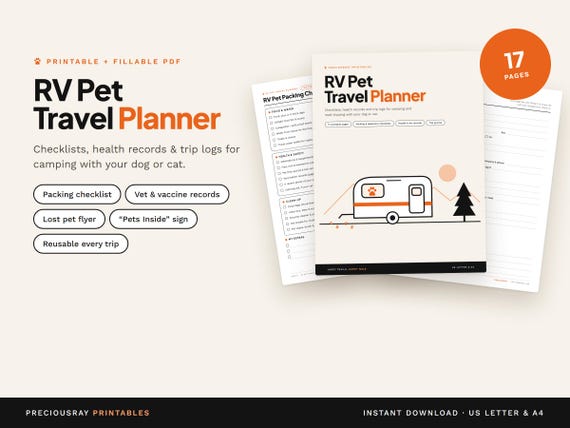
The RV Pet Travel Planner keeps everything from this guide in one printable, fillable file, so your pet’s details are ready when a campground asks for vaccine records, a vet needs a medical history, or your pet slips out the door.
- 17 pages: pet profile, vaccine and health records, a 40+ item packing checklist, departure and arrival checklists, an emergency vet list for your route, a lost pet flyer and a “Pets Inside” window sign
- Fill it in on your computer or print it. Your pet’s permanent details are kept, and one click clears the trip pages for your next adventure.
- Instant download in US Letter and A4 sizes
We may earn from purchases made through links on this page.
On the Road: Keep Your Pet Safe While Driving
The AVMA advises that pets should always be properly restrained in a moving vehicle, using a safety harness, crate or carrier (AVMA). A loose pet can get under the brake pedal, block your view, or be thrown forward or hit by an airbag in a sudden stop or crash. In a motorhome, that means:
- Secure crates and carriers so they cannot slide or tip. Strap them down or use a seat belt.
- Keep pets out of the front passenger seat, where an airbag could injure them.
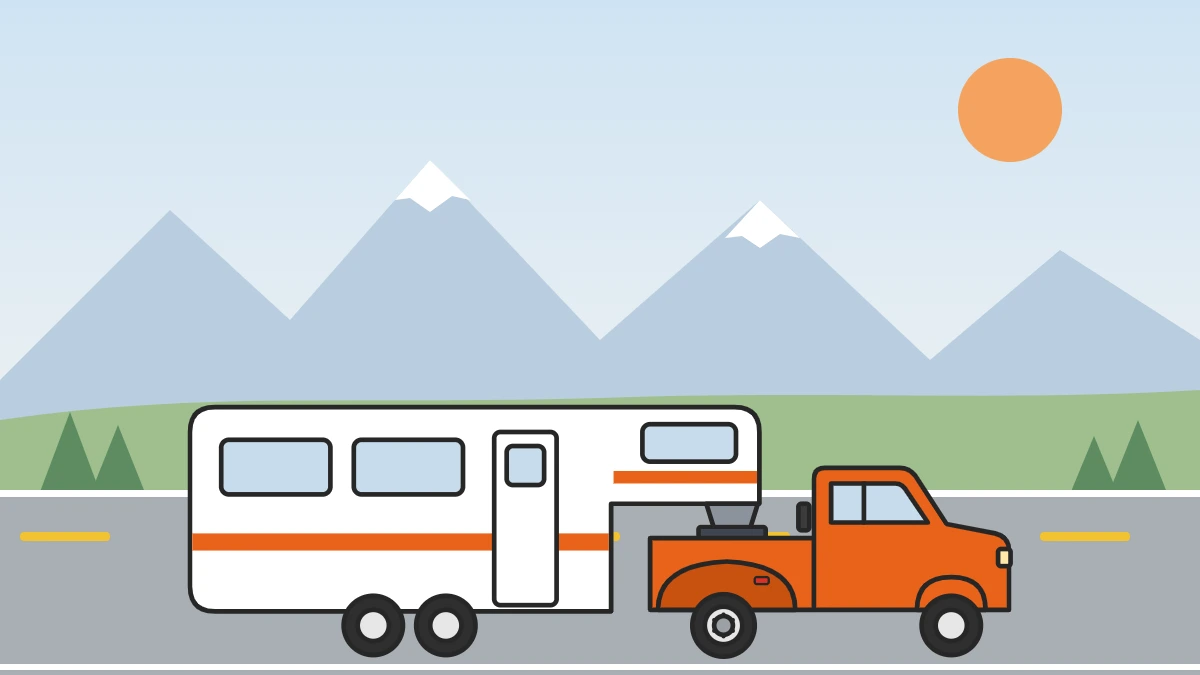
- Never let pets ride in a towed travel trailer or fifth wheel, even in a harness or crate. Your pet should ride with you in the tow vehicle (the truck or sport utility vehicle (SUV) pulling the trailer), secured in the back seat with a crash-tested harness clipped to a seat belt tether (always attach it to the harness, never the collar), or in a crate that is strapped down. The cab stays heated or cooled, and you can check on your pet at every stop. In a motorhome, secure your pet the same way in a seat or crate that will not move.
- Look for crash-tested gear. The Center for Pet Safety, a non-profit, crash-tests pet harnesses, crates and carriers and lists the ones that pass.
Stop regularly so your pet can drink, stretch and go to the bathroom, always on a leash, and away from busy traffic. Try to keep feeding and walk times close to your routine at home. A predictable day helps pets feel safe.
Heat, Cold and Leaving Your Pet in the RV
Heat is one of the biggest dangers for traveling pets. According to the AVMA, the temperature inside a closed vehicle rises quickly, even on a mild day and even in the shade, and cracking the windows makes no real difference:
| Time parked | How much hotter it can get inside |
|---|---|
| 10 minutes | About 19°F hotter |
| 20 minutes | About 29°F hotter |
| 30 minutes | About 34°F hotter |
| 60 minutes | About 43°F hotter |
Source: AVMA, Pet safety in vehicles. On a 70°F day, that can mean more than 110°F inside after an hour.
An RV is bigger than a car, but the same physics apply. Air conditioning helps only while it is running, and campground power can go out, a generator can shut off, or an air conditioner can fail. If you must leave your pet in the RV for a short time:
- Check the campground’s rules first. Some do not allow pets to be left alone.
- Never leave a pet in an RV on a hot day without working air conditioning, and keep the time short.
- Consider a remote temperature monitor that sends alerts to your phone, such as the Necto cellular temperature monitor, which needs no Wi-Fi and also alerts you if the RV loses power. Monitors like this work over the cell network, so check the coverage where you are camping and whether a monthly service plan is needed. Treat it as a backup, not a reason to stay away longer.
- Put a “Pets Inside” sign in a window so neighbors and first responders know to check.
Cold matters too. The AVMA warns that young, old, ill or thin pets are especially at risk in a cold vehicle. If you camp in winter, our guide to winter RV camping with pets covers cold limits, paw care, road salt and antifreeze, and what to do if the heat or power fails.
At the Campsite
Leashes, tie-outs and good manners
- Follow the leash rules. Many campgrounds and parks require a leash no longer than 6 feet. A longer lead is handy at your own site, but only where it is allowed.
- Never leave a pet tied out alone. A tied-up pet can tangle, choke, or be cornered by wildlife or another dog.
- Pick up every time and put waste bags in the trash, not in the fire ring or bushes.
- Keep barking to a minimum. Campgrounds are close quarters, and repeated noise complaints can get you asked to leave.
- Watch for wildlife. Keep pets close at dawn and dusk, and do not leave pet food outside, where it attracts animals.
Check your site for hazards
Walk your site before your pet does. Look for broken glass, sharp metal, food scraps and spilled liquids. Keep RV chemicals out of reach. Even products sold as “non-toxic”, such as RV antifreeze, are not meant for drinking by people or pets. Follow the label warnings and store all chemicals securely, away from children and pets. If you level your RV with blocks or set up steps, check that your pet cannot get trapped or stuck behind them. For senior or small dogs, a dog ramp or pet stairs saves their joints on high RV steps.
Ticks and harmful algae
Check your pet (and yourself) for ticks after walks in grass or woods. The CDC recommends removing a tick with clean, fine-tipped tweezers: grab it as close to the skin as possible and pull upward with steady, even pressure, without twisting. Then clean the bite and your hands (CDC). A small kit such as the TickCheck tick remover, which includes fine-tipped tweezers, fits easily in your pet’s first aid kit.
Before your dog swims, look at the water. Harmful algae can make animals very sick, and pets can become ill within hours. The CDC advises staying out of water that looks discolored, has scum on top or smells bad. If your pet goes in, rinse it off with clean water right away, and call a vet if it seems unwell (CDC).
Traveling With a Cat in an RV
Cats can be great RV travelers, but they need a slightly different plan:
- Travel in a secured carrier. A loose cat can hide under pedals or in small spaces while you drive.
- Give the litter box a fixed spot on the floor, away from where you cook and eat, such as a bathroom corner or an open space under a bench seat. Put a litter mat under it, choose a covered or top-entry litter box to keep litter in, and secure it so it cannot slide while you drive.
- Know where your cat is before you open doors, move slide-outs or drive away. Cats love tight hiding places.
- Harness-train at home first if you want your cat to spend time outside. Start indoors with short sessions and lots of treats.
- Keep the same food, litter and bedding as at home, so the RV smells familiar.
If Something Goes Wrong
Before each travel day, look up an emergency vet near your next stop and save the number in your phone. Also save these 24/7 animal poison hotlines (a consultation fee may apply):
- American Society for the Prevention of Cruelty to Animals (ASPCA) Animal Poison Control Center: (888) 426-4435
- Pet Poison Helpline: (855) 764-7661
If your pet goes missing, search the campground right away, tell the office and your neighbors, call nearby shelters and vets, and share a recent photo. Contact your microchip company so your pet is flagged as lost. A ready-made lost pet flyer saves precious time.
Frequently Asked Questions
Can I leave my dog alone in the RV?
Only if the campground allows it, the weather is mild or the air conditioning is working reliably, and only for a short time. Heat can build up quickly if the power or air conditioning fails, so a remote temperature monitor and a “Pets Inside” window sign (the RV Pet Travel Planner above includes a printable one) are good extra precautions. When in doubt, take your dog with you or stay together.
Do RV campgrounds ask for vaccination records?
Many do, especially proof of rabies vaccination. Keep paper copies in the RV and photos on your phone so you can show them at check-in.
Can my pet ride in the travel trailer while I tow it?
No, not even in a harness or crate. A towed trailer or fifth wheel is not a safe place for a pet while moving. Your pet cannot be seen or helped, the temperature is not controlled, and loose items can shift. Keep your pet with you in the tow vehicle (the truck or SUV pulling the trailer), secured in the back seat with a crash-tested harness or a strapped-down crate.
Are dogs allowed in U.S. national parks?
Usually in developed areas like campgrounds and parking areas, on a leash no longer than 6 feet, but trail rules vary a lot by park. Check each park’s “Pets” page on the NPS website before you go.
How do I keep my pet calm on travel days?
Do practice drives first, bring familiar bedding and toys, stick to normal feeding times, and take regular breaks. If your pet still gets very anxious or carsick, ask your vet about safe options.
Acronyms Used in This Article
- ASPCA: American Society for the Prevention of Cruelty to Animals
- AVMA: American Veterinary Medical Association
- B.A.R.K.: the National Park Service’s pet rules motto (Bag your pet’s waste, Always leash your pet, Respect wildlife, Know where you can go)
- CDC: U.S. Centers for Disease Control and Prevention
- CFIA: Canadian Food Inspection Agency
- ID: identification
- NPS: National Park Service
- RV: recreational vehicle
- SUV: sport utility vehicle
- U.S.: United States
Disclaimer
The information provided is for educational purposes only. Before carrying out any maintenance or safety task on your RV, please do your own further research so you are fully confident in each step. If you are ever unsure, consult a qualified RV professional or get a second opinion. Readers are responsible for their own safety, and PreciousRV.com accepts no liability for any injury, loss or damage.
This article is not veterinary advice. Always ask your veterinarian about your own pet’s health, medicines and travel plans. Campground, park and border rules change often, so please confirm current rules with the official sources linked above. Facts in this article were checked in October 2026.