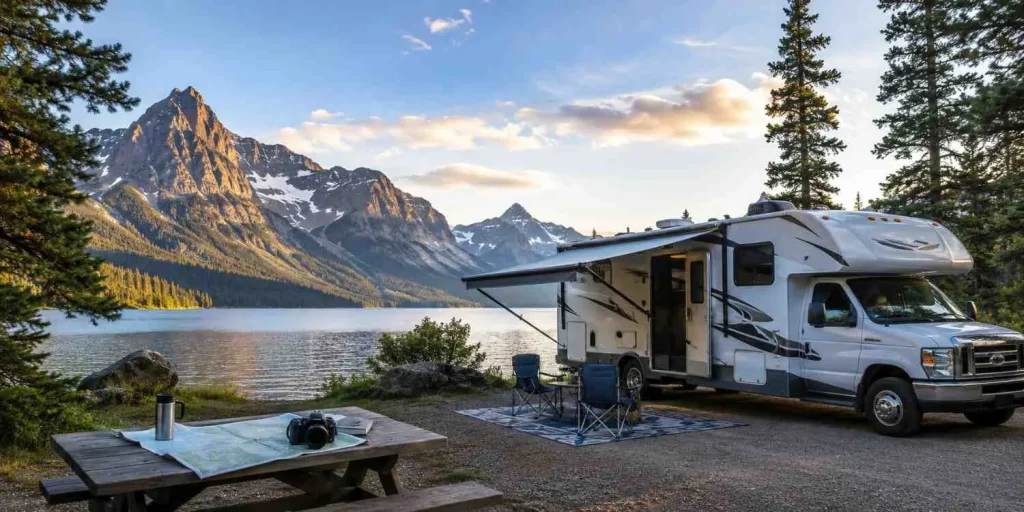
There is something about the open road that calls to people in a way no airline ticket ever could. When you are behind the wheel of an RV, America does not feel like a series of destinations. It feels like one long, beautiful experience you get to shape on your own terms.
But here is the truth most first-timers learn the hard way: a great RV trip does not happen by accident. It takes real planning, the right mindset, and a solid understanding of what lies ahead. Whether you are a couple dreaming of a coastal road trip or a family ready to hit the national parks circuit, good RV trip planning is what separates a smooth adventure from a stressful one.
This guide covers everything, from choosing your rig and mapping your route to budgeting, campground reservations, and packing smart. By the end, you will have a clear picture of how to plan an RV trip that actually works.
Why RV Travel Is Worth the Effort
Before diving into the logistics, it helps to understand why millions of Americans choose RV travel every year.
According to the RV Industry Association, over 11 million households in the U.S. own an RV, and that number keeps climbing. The appeal is simple: you bring your home with you. You are not paying for hotels, you are not eating overpriced airport food, and you are not stuck on someone else’s schedule.
Planning an RV trip also gives you access to places that traditional vacationers simply cannot reach. Remote canyon trails, lakeside campsites with no cell service, coastal bluffs at sunset. These experiences require wheels and flexibility, not a booking confirmation email.
The effort you put into planning pays off every single day of your trip.
Step 1: Choose the Right RV for Your Trip
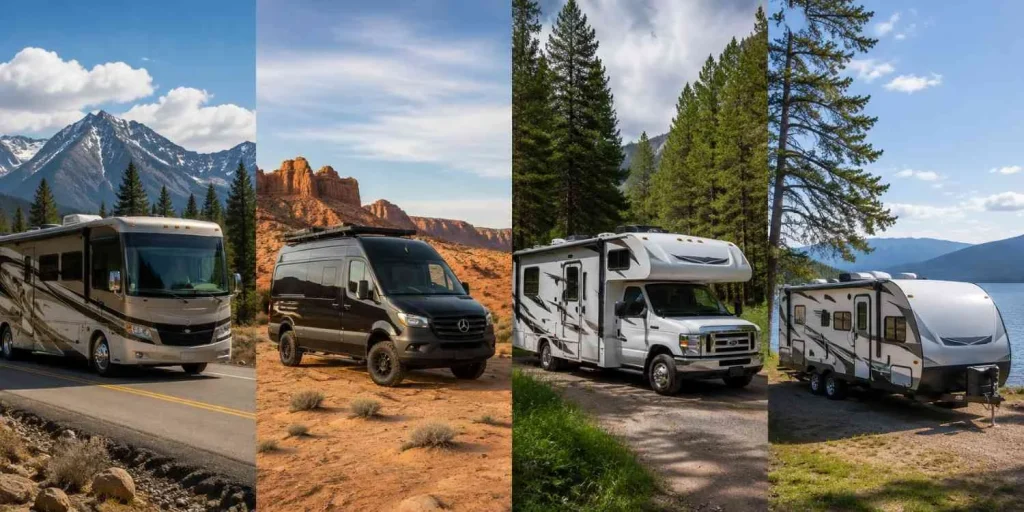
Your RV is not just a vehicle. It is your bedroom, kitchen, bathroom, and living room on wheels. Picking the wrong one can ruin a trip that had all the right ingredients.
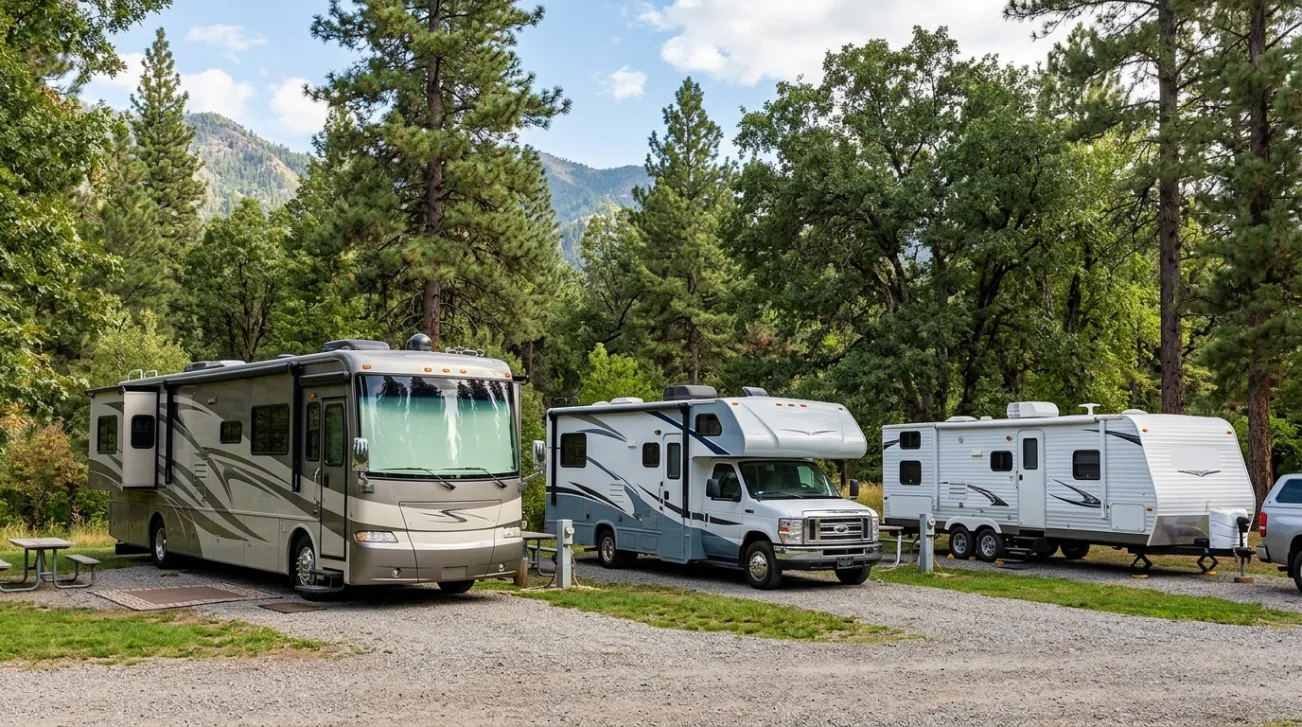
Class A Motorhomes
These are the large, bus-style rigs you see cruising down the interstate. They offer the most space and amenities, making them ideal for long trips or full-time living. The trade-off is fuel cost and maneuverability in tight campgrounds.
Class B Campervans
Think of these as the nimble option. A Class B van fits in a standard parking space and gets better gas mileage. They are perfect for solo travelers or couples who want to explore off-the-beaten-path spots. Storage space is limited, though.
Class C Motorhomes
A strong middle ground between Class A and Class B. They typically feature an over-cab sleeping area and enough room for families without the overwhelming size of a Class A.
Travel Trailers and Fifth Wheels
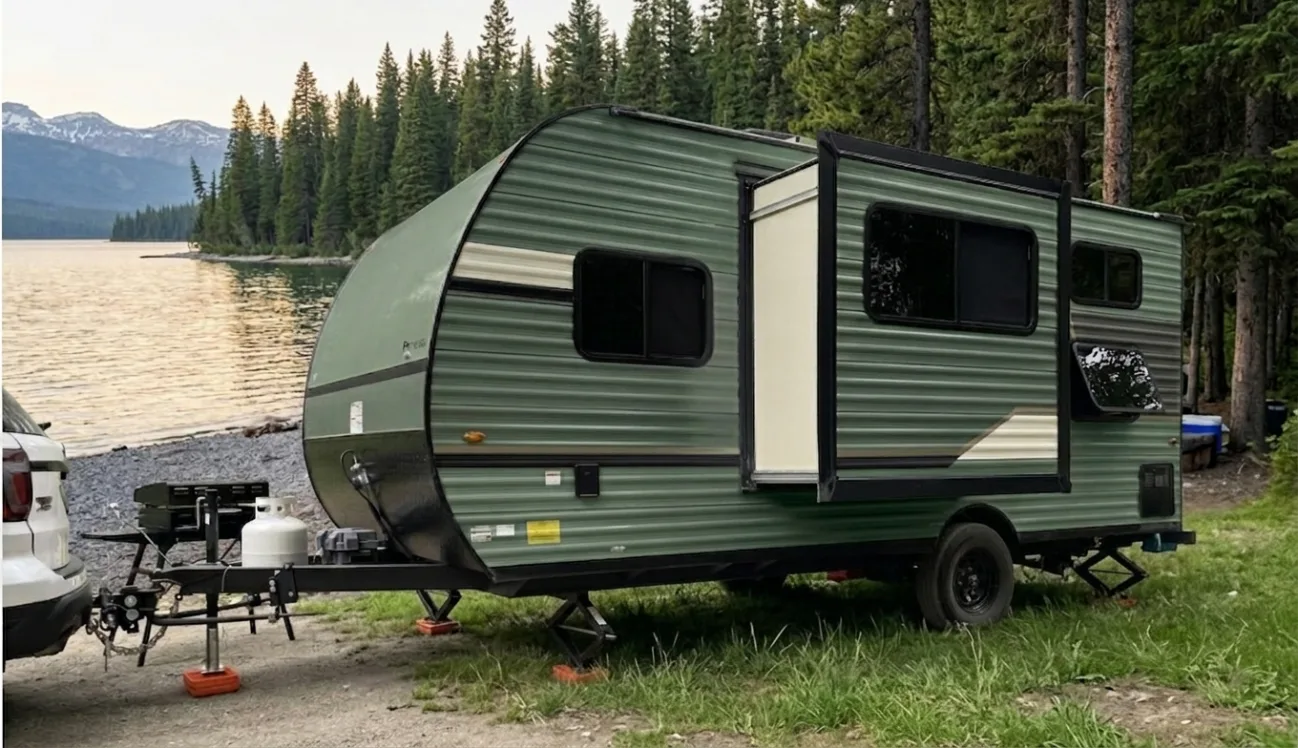
If you already have a capable tow vehicle, a travel trailer or fifth wheel gives you a lot of living space for the money. The big benefit here is that you can unhitch and use your truck or SUV to explore without dragging the whole rig.
Pro Tip: If this is your first RV trip, consider renting before buying. Platforms like Outdoorsy and RVshare let you rent from private owners across the country, giving you a real feel for what size and type suits your travel style. If you are just getting started, our RV Beginner’s Guide walks you through everything you need to know before hitting the road for the first time.
Step 2: Plan Your Route Strategically
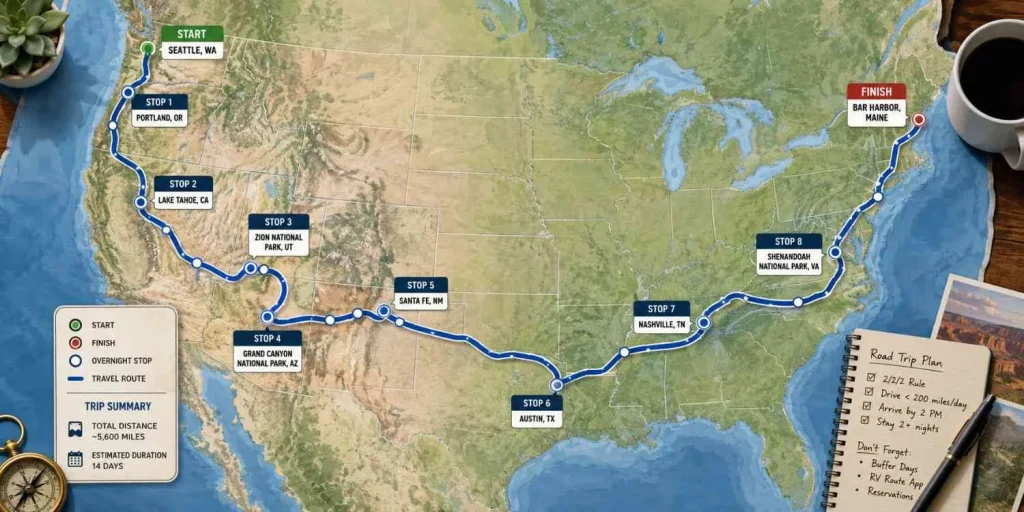
Route planning is where RV trip planning starts to feel real. A good route is not just a list of places. It is a pace, a rhythm, and a series of choices that balance driving time with experience time.
Start With Your Anchor Destinations
Pick two to four places you absolutely want to visit. These are your anchors. Everything else fills in around them. If you want to see Zion National Park and the Grand Canyon, your route will naturally flow through the Southwest. If Acadia National Park and Cape Cod are the goal, you are heading Northeast.
Follow the 2/2/2 Rule
Experienced RVers swear by the 2/2/2 rule: drive no more than 200 miles per day, arrive by 2 PM, and stay at least 2 nights in each location. This keeps the trip from turning into a driving marathon and gives you time to actually explore each stop.
Use Dedicated RV Routing Tools
Standard GPS apps like Google Maps do not account for bridge heights, weight limits, or road width restrictions. Use apps like CoPilot RV, Garmin RV GPS, or The Dyrt to plan routes that are actually safe for your rig’s dimensions.
Plan Your Whole Route in One Place with RV Trip Wizard
Most RV trip planning ends up spread across a dozen browser tabs: one for campgrounds, one for fuel prices, one for road restrictions, and one for your club discounts. RV Trip Wizard, from RV LIFE, pulls those pieces into a single planner built for RVs, so your route, stops, and budget stay in sync.
- RV-safe routing based on your rig’s height, length, and weight
- A large campground database with reviews from other RVers
- Fuel cost and driving-day estimates so your budget matches your route
- Membership filters to find campgrounds that honor clubs like Good Sam, Passport America, and KOA
- Send your trip to the RV LIFE app for turn-by-turn navigation on the road
It also pairs well with the 2/2/2 rule. Set your maximum daily miles, and the planner helps you space out stops so no driving day runs too long.
Ready to map your next RV trip?
We may earn a commission if you sign up through this link, at no extra cost to you.
For the safety side of planning, including tire monitors, weather alerts, and emergency gear, see our guide to RV trip safety tools.
Build In Buffer Days
Things go wrong on road trips. A tire blows. A rainstorm rolls in. You find a small town so charming that you want to stay an extra night. Build one or two buffer days into your trip so these moments feel like gifts, not problems.
Step 3: Book Campgrounds Early
One of the biggest mistakes people make when planning an RV trip is treating campground reservations as an afterthought. Popular sites at national parks and state parks can book up months in advance, especially in summer. For a deeper look at top-rated options across the country, browse our RV Campgrounds and Parks guide to find spots that match your travel style.
Types of Campgrounds to Know
Full Hookup Sites offer water, electric, and sewer connections. These are the most convenient and the most in-demand. If you need to run air conditioning or charge multiple devices, prioritize these.
Partial Hookup Sites usually offer water and electric but no sewer. You will need to manage your gray and black water tanks and plan dump station stops.
Dry Camping (Boondocking) means no hookups at all. This style of camping is popular with experienced RVers who use solar panels and conserve water carefully. Bureau of Land Management (BLM) land across the West offers free boondocking with stunning scenery.
Best Booking Platforms
Recreation.gov for federal campgrounds including national parks
Reserve America for many state park campgrounds
Campspot for private campground reservations
The Dyrt for user reviews and discovery
Harvest Hosts for a membership program that lets you camp at wineries, farms, and breweries
Important: Check cancellation policies before booking. Flexibility matters when weather or plans change.
Step 4: Build a Realistic RV Trip Budget
People often underestimate what an RV trip costs. Planning an RV trip with an honest budget prevents the kind of financial stress that ruins the experience.
Fuel
Fuel is typically your biggest variable expense. A Class A motorhome averages 7-10 miles per gallon. A Class C gets closer to 12-15 mpg. A travel trailer towed by a pickup truck will reduce that truck’s mileage significantly, usually to the 12-15 mpg range.
Calculate your total estimated miles, divide by your RV’s fuel economy, and multiply by the current price per gallon in the states you will be traveling through. Use apps like GasBuddy to find the cheapest fuel along your route.
Campground Fees
National park campgrounds typically run $25 to $50 per night. Private campgrounds with full hookups can run $50 to $100 or more per night, especially in popular areas. If you camp frequently, an America the Beautiful Annual Pass ($80/year) covers entrance fees at national parks and federal recreation areas.
Food and Groceries
One of the hidden financial benefits of RV travel is cooking your own meals. Even so, budget realistically. A family of four eating mostly cooked meals might spend $100 to $150 per week on groceries. Add restaurant meals and that number climbs fast.
Maintenance and Emergency Fund
Set aside at least $500 to $1,000 as an RV emergency fund. Tires, belts, minor plumbing issues, and generator problems can appear without warning. Being financially prepared keeps a mechanical hiccup from ruining your trip.
Activities and Entrance Fees
National park entrance fees, guided tours, kayak rentals, zip lines, and similar activities add up. Research your anchor destinations and budget accordingly.
Step 5: Learn Your RV Before You Leave
Nothing is more stressful than figuring out how your black water tank works for the first time at a full campground. Practice at home. Before every departure, it also pays to run through a full safety check. Our RV Pre-Departure Safety Checklist covers every system you need to verify before you pull out of the driveway.
Essential Skills to Master Before Your Trip
Driving and Backing Up: Spend a few hours practicing in an empty parking lot. Get comfortable with wide turns, backing into sites, and judging clearance. Backing a trailer is a separate skill entirely and requires real practice.
Leveling: Most RVs need to be level for appliances like the refrigerator to work properly. Practice with leveling blocks and understand how your leveling system works.
Water and Sewer Connections: Know how to connect to a water hookup, how to empty your gray and black tanks at a dump station, and how to avoid the kind of sewer mistakes that veterans still cringe at.
Generator and Power System: Understand how long your batteries last without hookups, how to operate the generator, and how your solar system (if you have one) charges your battery bank.
Propane: Know how to safely connect and disconnect propane tanks and when to get them refilled.
Step 6: Pack Smart for Life on the Road
Space is finite in an RV. Overpacking is one of the most common first-timer mistakes. Every pound you add affects fuel economy and performance.
RV Essentials Checklist
Safety and Setup:
Surge protector (30-amp or 50-amp depending on your RV)
Freshwater hose (dedicated RV hose, not a garden hose)
Sewer hose and fittings
Leveling blocks
Wheel chocks
Tire pressure gauge and inflator
Tools and Maintenance:
Basic toolkit (screwdrivers, pliers, adjustable wrench)
Duct tape and gorilla tape
WD-40
Extra fuses and lightbulbs
Tire repair kit
Kitchen and Living:
Non-slip drawer liners to keep items in place while driving
Lightweight cookware
Collapsible items (colanders, bowls, cups)
Spice organizer designed for small spaces
Outdoor Gear:
Camp chairs and a compact table
Outdoor mat for the entry area
Lantern or string lights
Firewood gathering bag or small hatchet
Documents:
Driver’s license and insurance cards
RV rental agreement or registration
Roadside assistance membership (Good Sam, AAA, or Coach-Net)
Campground reservation confirmations
Step 7: Stay Connected and Safe on the Road
Cell service is not guaranteed in every beautiful place you will park your RV. Planning for connectivity gaps keeps you informed and safe.
Cell Signal Boosters
Devices like the WeBoost Drive Reach RV or the Cel-Fi GO X can dramatically improve your signal in rural areas. If you work remotely while traveling, this is a worthwhile investment.
Wi-Fi Options
Many campgrounds offer Wi-Fi, but quality varies widely. A mobile hotspot from Verizon, AT&T, or T-Mobile gives you a more reliable backup. Many full-time RVers use multiple carriers for maximum coverage.
Emergency Preparedness
Download offline maps (Google Maps and Maps.me both support this) before entering areas with no cell service
Share your itinerary and campsite bookings with someone at home
Carry a first aid kit stocked for outdoor activities
Know the nearest hospital or urgent care in each area you will be visiting
Consider a personal locator beacon (PLB) like a Garmin inReach if you plan to venture into truly remote areas
Best RV Destinations in the USA
Part of great RV trip planning is choosing destinations that reward the RV experience. Here are some of the top choices across the country.
Yellowstone and Grand Teton National Parks, Wyoming
This is arguably the crown jewel of American RV travel. Yellowstone’s campgrounds put you steps from geysers, hot springs, and wildlife. Grand Teton’s String Lake area is one of the most photogenic campgrounds in the country.
Pacific Coast Highway, California
Highway 1 along the California coast is one of the world’s great drives. Campgrounds at Julia Pfeiffer Burns State Park, Plaskett Creek, and Kirk Creek perch above the Pacific with views that feel unreal.
Great Smoky Mountains, Tennessee and North Carolina
The most visited national park in the U.S. draws RVers with its lush forest, mountain streams, and rich Appalachian culture. Cades Cove and Elkmont campgrounds fill up fast, so plan well ahead.
Florida Keys
The Overseas Highway from Miami to Key West is one of those drives that sticks with you forever. Bahia Honda State Park offers some of the most beautiful waterfront camping on the East Coast.
Colorado Rockies
Rocky Mountain National Park, Mesa Verde, and the San Juan Skyway combine to make Colorado one of the best RV states in the country. Fall colors in late September are extraordinary.
Olympic National Park, Washington
Few parks let you go from ocean beaches to mountain ridges to the mossy Hoh Rain Forest in a single day. Several park campgrounds can fit RVs, but many have length limits and some are first come, first served, so check site sizes on the National Park Service website and plan to arrive early.
Moab, Utah
Moab puts you between two national parks, Arches and Canyonlands, with red rock scenery, hiking, and off-road trails in every direction. The town has plenty of RV parks for a comfortable base camp. Our Arches National Park RV camping guide covers where to stay and what to see.
Acadia National Park, Maine
Acadia mixes rocky Atlantic coastline with mountain hikes and quiet carriage roads. RV sites inside the park and around Bar Harbor are limited and fill quickly in summer and fall, so book early. For more options, see our Maine RV campgrounds guide and our New England RV travel guide.
Blue Ridge Parkway, North Carolina to Virginia
This slow, scenic road links Great Smoky Mountains National Park with Shenandoah National Park, with campgrounds and overlooks along the way. Several tunnels, mostly in North Carolina, have low clearances, so compare your rig’s height with the tunnel list on the National Park Service website before you go.
Marquette, Michigan and Door County, Wisconsin
For a cooler summer trip, the Great Lakes deliver. Marquette sits on the shore of Lake Superior with beaches, trails, and a lively downtown. Door County, a peninsula on Lake Michigan, offers RV parks, orchards, wineries, and quiet lakeside towns. The two pair well on one Upper Midwest loop.
Common RV Trip Planning Mistakes to Avoid
Even experienced travelers make avoidable mistakes. Here are the most common ones when planning an RV trip.
Overplanning your driving days. Driving 400 miles a day in an RV is not the same as doing it in a car. Fatigue sets in faster and setup time at each campsite takes real effort. Keep daily driving under 250 miles whenever possible.
Not checking campsite dimensions. A 70-foot pull-through site and a 25-foot back-in site are very different things. Always check the maximum rig length a campsite allows before booking.
Skipping the pre-trip inspection. Roof seals, tire condition, brake function, and slide-out operation should all be checked before departure. A problem caught at home costs far less than one caught on the road.
Underestimating water and tank capacity. Know how many gallons your freshwater tank holds, how long it lasts with your group, and where you will refill or dump along your route.
Forgetting about slide-out clearance. Extending your slide-outs at a campsite is one of the first things you do after parking. If a tree, post, or neighboring rig is in the way, you have a problem. Always walk the site before extending slides.
FAQ Section
What is the best way to start RV trip planning for beginners?
Start simple. Choose a destination within a few hours of home for your first trip. This allows you to get comfortable with driving, setup, and daily RV life without the pressure of a long cross-country journey. Use a rental RV to test the waters before committing to a purchase.
How far in advance should I book campgrounds when planning an RV trip?
For national park campgrounds during peak season (May through September), book as early as six months in advance. Recreation.gov opens reservations six months before the availability date, and popular sites like Yosemite Valley and Yellowstone fill within minutes of release. Private campgrounds are generally easier to book, but popular coastal and mountain destinations still warrant two to four months of lead time.
What apps are most helpful for RV trip planning?
The most useful apps for planning an RV trip include The Dyrt (campground discovery and reviews), Campspot (private campground booking), Recreation.gov (federal campground reservations), GasBuddy (fuel price comparison), CoPilot RV (RV-safe GPS routing), and iOverlander (for boondocking spots). For weather, Windy is excellent for understanding conditions in mountain and coastal areas.
How much does an RV trip cost per day on average?
Costs vary widely depending on your rig, destination, and travel style. A reasonable average for a couple traveling in a mid-size RV is $150 to $250 per day, including fuel, campground fees, food, and activities. Full-hookup sites at premium destinations and high fuel prices can push that higher. Boondocking on BLM land and cooking every meal can bring it down significantly.
Is it safe to travel alone in an RV?
Solo RV travel is increasingly popular and generally very safe with good preparation. Choose well-reviewed campgrounds rather than isolated spots, especially as a new solo traveler. Let someone know your itinerary. Keep your RV’s entry door locked at night, invest in a good motion-sensing light for the exterior, and trust your instincts about any campsite that does not feel right.
What is the 2/2/2 rule in RV travel?
The 2/2/2 rule is a popular guideline among RVers: drive no more than 200 miles in a single day, arrive at your campsite by 2 PM, and stay at least 2 nights in each location. It prevents exhaustion from long driving days, gives you time to set up before dark, and ensures you actually experience each destination rather than just passing through.
Do I need a special driver’s license to drive an RV?
In most U.S. states, a standard Class C driver’s license is sufficient for motorhomes under a certain weight, typically 26,000 pounds. Very large Class A diesel pushers may require a non-commercial Class A or B license in some states. Towing a travel trailer with a vehicle you already own generally requires no special licensing. Always check the specific requirements for the states you will be driving through, especially California and a few others with specific towing regulations.
Conclusion
RV trip planning is not about building a perfect itinerary. It is about building a smart foundation so that when the unexpected happens, and it will, you are prepared to roll with it rather than stress over it.
Start with the right RV for your needs. Build a thoughtful route using the 2/2/2 rule. Book campgrounds early, budget honestly, practice your driving skills, and pack with intention. Do those things, and the open road will take care of the rest.
The best RV trips are not the ones that go exactly as planned. They are the ones where you are ready for anything. That readiness starts with good planning an RV trip from the very beginning.
Now it is time to stop reading and start planning. Your next great American road trip is waiting.