Quick answer: an RV (recreational vehicle) surge protector only guards against power spikes, such as a lightning strike on the campground’s lines. An EMS (electrical management system) does that too, but it also watches the power all the time and shuts it off if the voltage drops too low, climbs too high, or the campground outlet is wired wrong. Low voltage at busy campgrounds is a common way air conditioners get damaged, so for most RVers we recommend an EMS. A basic surge protector is still much better than nothing.
Safety first: RV electrical systems can carry enough power to injure or kill. Follow your RV manual and the maker’s instructions for your protector. Turn the campground breaker off before you plug in or unplug, and never open a pedestal or your RV’s electrical panel yourself. If anything looks burnt, smells hot, or keeps tripping, stop and call the campground or a qualified RV technician.
RV Surge Protector vs EMS at a Glance
| What it does | Basic surge protector | EMS (electrical management system) |
|---|---|---|
| Absorbs power spikes (surges) | ✅ Yes | ✅ Yes |
| Checks the outlet’s wiring when you plug in | ✅ Usually, with indicator lights | ✅ Yes, with a display or error codes |
| Cuts the power if the outlet is wired wrong | ❌ Most only warn you | ✅ Yes |
| Cuts the power if the voltage is too low or too high | ❌ No | ✅ Yes |
| Waits before turning power back on (protects the air conditioner) | ❌ No | ✅ Yes |
| Shows live voltage and amps | ❌ Usually not | ✅ Most models |
| Price | Lower | Higher |
What Is an RV Surge Protector?
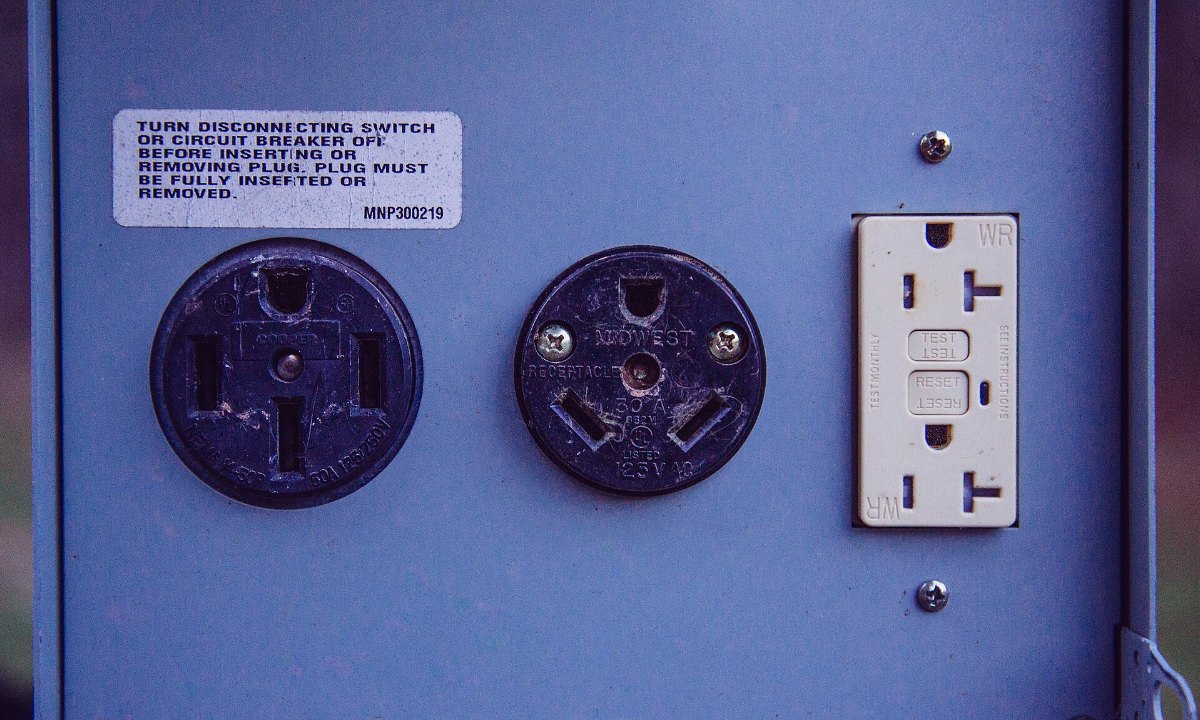
A surge protector sits between the campground’s power pedestal (the metal post with the outlets) and your RV’s power cord. Inside it are parts that soak up sudden spikes of extra power, so they don’t reach your RV’s appliances and electronics.
Surge protectors are rated in joules, a measure of how much energy they can absorb. A higher number means more protection. For example, Progressive Industries lists its 30 amp (30A) Smart Surge Protector at 825 joules and its 50 amp model at 1,650 joules (Progressive Industries operating guide).
Many surge protectors also have lights that show whether the outlet is wired correctly. But here’s the key point: most only warn you. Progressive’s own guide for that model says the unit keeps working during a wiring problem and that the problem should be fixed by the campground before use. If you don’t notice the warning light, power keeps flowing into your RV.
What Is an EMS (Electrical Management System)?
An EMS is a surge protector with a small computer inside. It checks the power the whole time you’re plugged in. If something goes wrong, it switches the power off to your RV, then turns it back on only after the problem has cleared.
Using Progressive Industries’ portable EMS as an example, the maker’s product sheet says it cuts power when (Progressive Industries product sheet):
- Voltage drops below 104 volts. Low voltage makes motors, like your air conditioner’s compressor, work harder and run hotter.
- Voltage rises above 132 volts. Too much voltage can damage electronics and appliances.
- The outlet has reverse polarity. This means the “hot” and “neutral” wires are swapped.
- There is an open ground or open neutral. This means a safety wire isn’t connected. An open neutral can send the wrong voltage into a 50 amp RV.
- The power’s frequency is wrong. This happens most often on generators. The frequency is how many times per second the power cycles, and in the U.S. (United States) it should be about 60 hertz.
The same sheet lists 1,790 joules of surge protection for the 30 amp portable model and 3,580 joules for the 50 amp model, so an EMS also absorbs bigger spikes than the basic units mentioned above.
Why Low Voltage Matters More Than Lightning
Lightning gets the attention, but low voltage is the everyday problem. On a hot afternoon at a full campground, every RV is running its air conditioner at once, and the voltage at your pedestal can sag. A basic surge protector does nothing about this. An EMS shuts the power off before the voltage gets low enough to harm your air conditioner, and it waits before switching back on so the compressor isn’t restarted too quickly.
Old or poorly kept campgrounds can also have miswired outlets. An EMS refuses to pass that power to your RV. A surge protector usually just shows a warning light.
Which one should you buy?
- Get an EMS if you camp at busy or older campgrounds, travel in summer heat, run air conditioning, or live in your RV full time.
- A basic surge protector is a reasonable start if you camp only a few nights a year, mostly at newer campgrounds, and your budget is tight. Check the indicator lights every time you plug in.
- Either one is far better than nothing. Plugging straight into the pedestal leaves your RV with no protection.
Portable vs Hardwired: Which Type?
Portable units plug into the pedestal, and your RV cord plugs into them. They’re easy to use and easy to move to your next RV. The downsides: they sit outside, so they can be stolen, and they must be set up the right way. Progressive’s portable EMS comes with a locking bracket and warns that it is meant to be used upright, not lying on the ground.
Hardwired units are installed inside your RV, between the power cord and the electrical panel. They’re protected from weather and theft, and most come with a small display you mount indoors. Installing one means working on your RV’s main power wiring, so have a qualified RV technician install it.
30 Amp or 50 Amp: Match Your RV
Buy the protector that matches your RV’s power cord. A 30 amp RV has a three-prong plug, and a 50 amp RV has a large four-prong plug. A 30 amp protector on a 50 amp RV only protects one of the two power “legs”. If you’re not sure which you have, our guide to 30 amp vs 50 amp RV power explains how to tell.
If you sometimes plug into a different-size outlet, you’ll need a heavy-duty RV power adapter. It’s a short cable with a 30 amp plug on one end and a 50 amp socket on the other (or the reverse). Follow your protector maker’s instructions on where the adapter goes.
What to Look For When You Buy
- Cuts power, not just warns you. This is the real difference between an EMS and a basic surge protector.
- A clear display or error codes. When the power goes off, you’ll want to know why so you can tell the campground.
- A high joule rating. More joules means more surge protection.
- Safety certification. Look for a UL (Underwriters Laboratories) or ETL (Intertek) listing, which means the product has been safety-tested.
- A replaceable surge module. Some EMS units let you replace just the surge part after a big spike, instead of the whole unit.
- Warranty. Read what it covers. Progressive offers a lifetime warranty on its EMS and surge protector models, but it excludes the weather shield on the portable EMS.
- Theft protection for portable units, such as a locking bracket or a hole for a padlock.
Products We’d Look At
These are well-known, widely sold models. Check the model number and your RV’s amp rating before you buy.
- Progressive Industries EMS-PT30X (portable EMS, 30 amp): see it on Amazon
- Progressive Industries EMS-PT50X (portable EMS, 50 amp): see it on Amazon
- Progressive Industries SSP-30XL (basic surge protector, 30 amp): see it on Amazon
- Progressive Industries SSP-50XL (basic surge protector, 50 amp): see it on Amazon
We may earn a commission if you buy through these links, at no extra cost to you.
How to Plug In Safely, Step by Step
- Turn the pedestal breaker off before plugging anything in.
- Plug in the protector first, without your RV cord. Turn the breaker on and read the lights or display. If it shows a wiring fault, turn the breaker off and tell the campground office. Don’t plug in your RV.
- Breaker off again, then plug your RV cord into the protector.
- Breaker on, and wait. An EMS waits a short time before passing power through.
- Lock up a portable unit if it has a bracket or padlock hole.
- Unplug in the reverse order, with the breaker off.
Frequently Asked Questions
Do I really need a surge protector for my RV?
Yes. A single bad pedestal or power spike can damage your air conditioner, refrigerator, converter or electronics, and those repairs usually cost far more than a protector.
Is an EMS worth the extra money?
For most RVers, yes. Low voltage and miswired outlets are much more common than lightning, and a basic surge protector doesn’t cut the power for either.
Does a surge protector protect against low voltage?
A basic one doesn’t. You need an EMS, which shuts the power off when the voltage falls too low (below 104 volts on the Progressive models in this guide).
Can I use a 30 amp surge protector on a 50 amp RV?
Not properly. Match the protector to your RV’s power cord. A 50 amp RV needs a 50 amp protector so both power legs are watched.
Should I use my EMS with a generator?
Many RVers do, because an EMS also checks voltage and frequency, and generators can drift. Read your EMS and generator manuals first.
Do rental RVs come with a surge protector?
Some do and some don’t. Ask before you book. Our guide on how to rent an RV lists more questions to ask the owner.
Related Guides
- 30 Amp vs 50 Amp RV: What’s the Difference?
- RV Safety Tips: How to Stay Safe on the Road and at Camp
- RV Maintenance Checklist by Season
- RV Tire Safety
Acronyms Used in This Article
- A: amps (amperes), how much electric current flows
- EMS: electrical management system
- ETL: Electrical Testing Laboratories, a safety mark now run by Intertek
- RV: recreational vehicle
- U.S.: United States
- UL: Underwriters Laboratories, a product safety-testing company
Disclaimer
The information provided is for educational purposes only. Before carrying out any maintenance or safety task on your RV, please do your own further research so you are fully confident in each step. If you are ever unsure, consult a qualified RV professional or get a second opinion. Readers are responsible for their own safety, and PreciousRV.com accepts no liability for any injury, loss or damage.
Facts checked in November 2026.