Please note: Tire limits are set by the tire maker and your RV’s manufacturer. Always follow the load and inflation information on your own tires, on your RV’s tire label and in the tire maker’s guidance. See our full disclaimer at the end of this article.
We may earn from purchases made through links on this page.
RV tire safety comes down to three checks: how old your tires are, whether they hold the right pressure for the load, and whether you drive within their speed rating. RV tires often age out before they wear out, because many RVs sit parked for months. This guide shows how to read the date code on a tire, when to replace recreational vehicle (RV) tires, how to set tire pressure, and how to store tires so they last.
Key Takeaways
- Find the date code. The last four digits of the code on the sidewall show the week and year the tire was made.
- Age matters as much as tread. Goodyear recommends replacing any RV tire in service that was made more than 6 years ago, even if the tread looks good.
- Check pressure cold, before every travel day. Never let air out of a hot tire.
- Most trailer tires are rated for 65 mph. Special trailer (ST) tires are designed around a 65 mph top speed unless the sidewall shows a higher rating.
- Weigh your RV loaded for travel so you know each tire is carrying no more than it is rated for.
How to Read the Date Code on an RV Tire
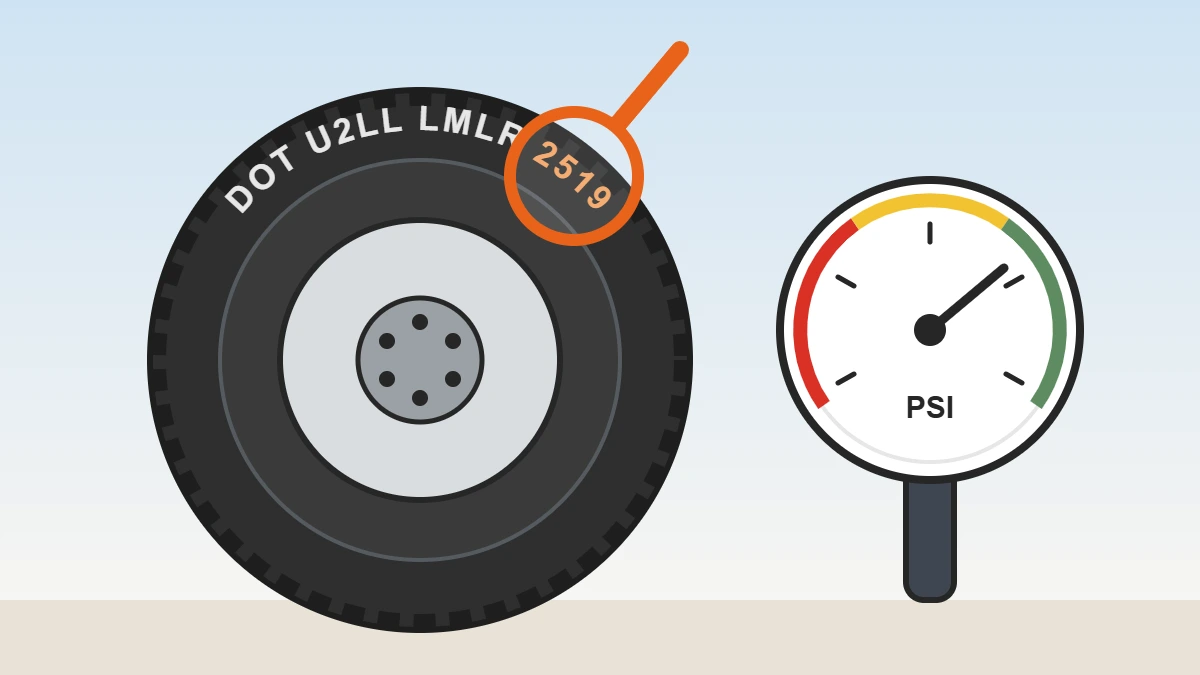
Every tire sold in the United States has a tire identification number on its sidewall, starting with the letters DOT, for Department of Transportation. The last four digits of that number tell you when the tire was made, according to the National Highway Traffic Safety Administration (NHTSA).
- The first two digits are the week. They run from 01 to 52.
- The last two digits are the year.
- Example: a code ending in 2519 means the tire was made in the 25th week of 2019.
The full number is sometimes printed on only one side of the tire, so check the inside of the sidewall if you can’t find it on the outside. A tire’s age starts from that date, not from the day it was installed, so a tire can already be a year or two old when it is new to you.
How Old Is Too Old for RV Tires?
Goodyear’s RV tire guidance says no one can predict exactly when an RV tire will need replacing from its age alone, because heat, sunlight, load and storage all play a part. It still recommends replacing any RV tire in service that was made more than 6 years earlier, based on the date code, and says most RV tires will need replacing sooner.
Replace a tire right away, whatever its age, if you see any of these:
- Cracks in the sidewall or between the tread blocks
- Bulges, blisters or bumps
- Cuts or punctures in the sidewall
- Tread worn down to the wear bars, the small raised bars across the bottom of the tread grooves
- Uneven wear, which can also point to an alignment, axle or inflation problem worth checking
Never buy used RV tires. You can’t know how they were stored, loaded or driven.
Free download: RV checklists for beginners
Get our free printable RV guides and checklists by email, including a pre-trip checklist with tire checks.
RV Tire Pressure: How to Get It Right
Low pressure is one of the most common causes of tire failure. An underinflated tire flexes more, builds up heat and can fail suddenly.
- Find the recommended pressure. Use the tire and loading information label on your RV, often near the driver’s seat in a motorhome or on the front left side of a trailer. For a more exact number, weigh your RV and use the tire maker’s load and inflation table.
- Check when the tires are cold, before you drive in the morning or after the RV has been parked for a few hours.
- Use a good tire pressure gauge that reads up to the pressures your tires need. RV tires often need much higher pressure than car tires.
- Never let air out of a hot tire. Pressure rises as tires warm up, and that is normal. Letting air out leaves the tire underinflated once it cools.
- Check every tire, including inner duals on motorhomes and trucks with dual rear wheels. Keep both tires in a dual pair at the same pressure.
A tire pressure monitoring system (TPMS) with sensors on each wheel warns you while you drive if a tire starts losing air or gets too hot. It is one of the most useful safety add-ons for any RV. The TST 507 TPMS is one system made for RVs and towed trailers.
Weigh Your RV to Protect Your Tires
A tire can be at the right pressure and still be overloaded. RVs are often heavier on one side than the other because of the kitchen, slide-outs and storage. Weigh your RV loaded for travel at a truck stop scale, which weighs each axle for a small fee. Some RV rallies and weighing services can weigh each wheel position, which shows if one side is carrying more than its tires are rated for. Compare the results with the maximum load printed on each tire’s sidewall.
Towing a fifth wheel? Our guide Do I need a dually to tow a fifth wheel? explains how to check your truck’s payload and axle ratings too.
Speed Ratings and Special Trailer (ST) Tires
| Tire type | Used on | What to know |
|---|---|---|
| ST (special trailer) | Travel trailers and fifth wheels | Built to carry heavy loads on trailer axles. The industry load tables are based on a 65 mph top speed unless the sidewall shows a higher speed rating. |
| LT (light truck) | Some trailers, pickups and smaller motorhomes | Can be used on some trailers, but often carries less load than an ST tire of the same size. Only switch if the tire’s load rating covers your trailer’s weight. |
| Commercial truck tires | Class A and many Class C motorhomes | Rated for the motorhome’s heavier loads. Follow the motorhome maker’s tire label and the tire maker’s inflation tables. |
Even when a tire allows a higher speed, driving slower keeps tires cooler and gives you more time to react, especially in hot weather and on long grades.
Storing RV Tires So They Last Longer
- Cover the tires with UV-resistant tire covers to block sunlight, which breaks down the rubber over time.
- Keep them at full pressure while the RV is parked, and check them before you leave.
- Park on a firm, clean surface, such as concrete or wood planks, rather than grass, dirt or asphalt in strong sun.
- Move the RV every few weeks during long storage, if you can, so the tires don’t sit on the same spot.
- Clean tires with mild soap and water. Avoid tire shine products that contain petroleum solvents, which can dry out the rubber.
Our RV storage guide covers storage choices and a full preparation checklist.
What to Do If an RV Tire Blows Out
- Hold the steering wheel firmly with both hands and keep the RV straight in its lane.
- Don’t brake hard. Ease off the accelerator and let the RV slow down gradually.
- Brake gently once the RV is under control and moving slower.
- Signal and pull well off the road, turn on your hazard lights and set out warning triangles if you have them.
- Call roadside assistance for large RV tires. They are heavy and need the right jack and tools. An RV roadside plan such as Good Sam Roadside Assistance can send help sized for your RV.
RV Tire Safety Checklist Before Every Trip
- Check the pressure of every tire when cold, including inner duals and the spare.
- Look for cracks, bulges, cuts and uneven wear.
- Read the date codes and plan to replace tires approaching 6 years old.
- Check that the valve stems and valve caps are in good shape.
- Check that the lug nuts are tight, using the torque listed by your RV or axle maker.
- Stay within the speed rating of your tires.
Related Guides
- RV safety tips
- RV maintenance checklist by trip, month and season
- First time RV driving tips
- Do I need a dually to tow a fifth wheel?
Frequently Asked Questions
How often should RV tires be replaced?
Replace RV tires when they are worn or damaged, and no later than about 6 years after the date they were made, as Goodyear recommends. Many RV tires need replacing sooner because of sun, heat and long periods parked.
How do I tell how old my RV tires are?
Look for the code starting with DOT on the sidewall. The last four digits are the week and year the tire was made. For example, 3221 means the 32nd week of 2021.
Should I check RV tire pressure hot or cold?
Check it cold, before you drive. Pressure rises as tires heat up, so a hot reading looks higher than it really is. Never let air out of a hot tire.
How fast can I drive on trailer tires?
Most special trailer (ST) tires are rated for 65 mph. Some newer ST tires have higher speed ratings, which are printed on the sidewall. Driving slower keeps tires cooler.
Do RV tires need covers?
Covers are a good idea when the RV is parked. They block sunlight, which slowly breaks down the rubber and leads to sidewall cracks.
Acronyms Used in This Article
- DOT: Department of Transportation (the letters that start a tire identification number)
- LT: light truck
- NHTSA: National Highway Traffic Safety Administration
- RV: recreational vehicle
- ST: special trailer
- TPMS: tire pressure monitoring system
Disclaimer
This article is general information only, not professional advice. Tire ratings, pressures and replacement advice differ by tire and by RV, and they change. Always follow the information on your tires, your RV’s tire and loading label, and the tire maker’s guidance, and ask a qualified tire professional if you are unsure. Some links in this article are affiliate links, including Amazon and Good Sam links, and we may earn a commission if you buy through them, at no extra cost to you. Facts checked October 2026.