This post contains affiliate links. If you buy through them, we may earn a small commission at no extra cost to you. Learn more.
Safety note: Preparing an RV for storage involves batteries, fuel, propane and chemicals. Always follow your owner’s manual, the manufacturers’ instructions and product label warnings, and use a qualified RV technician for any job you are not trained and equipped to do safely. See our full disclaimer at the end of this article.
Looking for ways to organize the inside of your RV instead? See our 30 smart RV storage ideas for small spaces.
- Choosing the right RV (recreational vehicle) storage type — outdoor, covered, or indoor — directly impacts how much you spend on repairs and maintenance long-term.
- Indoor climate-controlled storage is the gold standard for protecting your RV from weather damage, but it comes at a premium cost that isn’t always necessary depending on your climate.
- Home storage seems free, but HOA (Homeowners Associations) rules, zoning laws, and security risks make it a complicated option that many RV owners overlook until it’s too late.
- Preparing your RV properly before storage — including winterizing plumbing, protecting the battery, and stabilizing tires — is just as important as where you store it.
- Monthly RV storage costs vary widely from around $50 for basic outdoor spots to $500+ for premium indoor climate-controlled units — keep reading to find out which is worth it for your situation.
The wrong storage decision can cost you thousands in preventable RV damage — here’s how to get it right.
Comparing RV storage options? Whether you’re parking your rig for the winter or just need somewhere safe between trips, storage isn’t a one-size-fits-all decision. The type of RV you own, where you live, how often you hit the road, and what you’re willing to spend all play a role in finding the best fit. SpareFoot specializes in RV and vehicle storage solutions and is a trusted resource for owners navigating exactly these kinds of decisions.
The Right RV Storage Options Save You Money and Headaches
Leaving your RV exposed to the elements — sun, rain, snow, or extreme heat — isn’t just inconvenient. It accelerates roof deterioration, fades exterior finishes, warps seals, and can lead to costly water intrusion damage. Proper storage is one of the smartest investments you can make in the longevity of your vehicle.
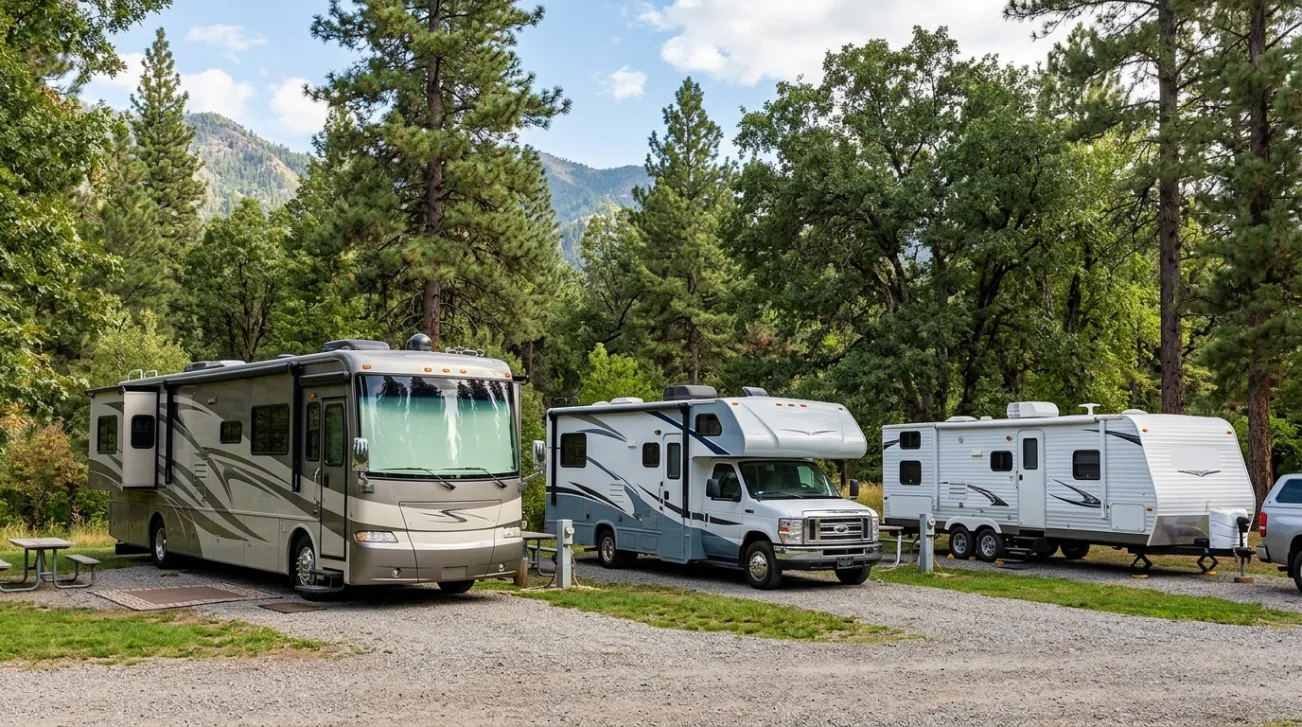
The three main professional RV storage options are outdoor, covered, and indoor. Each comes with a different price point and level of protection. Beyond that, some RV owners store at home — which has its own set of trade-offs. Understanding all of these options clearly is what separates informed owners from those stuck with surprise repair bills.
Outdoor RV Storage
Outdoor storage is the most widely available and most affordable option for RV owners. You’re essentially renting a designated parking space within a secured lot, with your RV exposed to open air. It’s a practical choice for many owners, particularly those in mild climates or those who access their RV frequently throughout the year.
What Outdoor Storage Actually Protects Against
Don’t underestimate what a secured outdoor lot still offers. While your RV won’t be shielded from rain or the sun’s ultraviolet (UV) rays, it is protected from unauthorized access, vandalism, and the risks that come with street parking or unsecured home storage. A quality outdoor facility uses perimeter fencing, electronic gate access, and surveillance cameras to keep your vehicle safe.
That said, prolonged sun exposure remains one of the biggest threats to RVs in outdoor storage. UV rays degrade rubber roof membranes, oxidize paint, and crack exterior caulking over time. Using a breathable, UV-resistant RV cover is a smart add-on that significantly extends the life of your exterior when using outdoor storage.
When Outdoor Storage Makes Sense for Your RV
Outdoor storage is a practical fit when you’re in a region with mild, dry weather and plan to use your RV regularly. If you’re taking the rig out every few weeks, the convenience of easy access and lower cost typically outweighs the lack of weatherproofing. It also works well for newer RVs that still have strong seals and weatherproof coatings that can handle some exposure.
Security Features to Look for in Outdoor Storage Facilities
Not all outdoor facilities are created equal. When evaluating an outdoor storage lot, prioritize these security features:
- Electronic gate access with personal PIN (personal identification number) code or key fob entry
- 24/7 surveillance cameras covering all rows and entry points
- On-site staff or security personnel during business hours
- Perimeter fencing — chain-link minimum, solid wall preferred
- Lighting throughout the lot for nighttime visibility and deterrence
- Individual unit monitoring or alarm systems where available
Covered RV Storage
Covered storage sits in the middle ground between fully exposed outdoor parking and a fully enclosed indoor unit. Your RV is parked under a roof structure — typically a metal carport-style canopy — but the sides remain open to airflow. It’s a popular choice because it offers meaningful weather protection at a cost closer to outdoor storage than indoor.
How Covered Storage Differs from Fully Enclosed Options
The key distinction is that covered storage shields your RV from direct sun and rain from above, but does not protect against wind-driven rain, blowing debris, or temperature extremes. You won’t get the climate regulation of an indoor unit, but you will dramatically reduce UV exposure and the risk of rain pooling on your roof. For many RV owners, that’s the sweet spot between cost and protection.
Types of Covered Storage Structures
Covered storage facilities use a few different structure types, and the quality varies. The most common include open-sided metal canopies arranged in rows over individual spaces. Some facilities use more robust structures with partial side walls that block wind and additional debris. A smaller number offer individual covered bays with lockable roll-up doors — which starts to approach indoor storage in terms of protection.
When touring a covered facility, ask specifically about the roof material, the height clearance (critical for taller Class A or Class C motorhomes), and whether the space is assigned or shared.
Indoor RV Storage
Indoor storage is the highest level of protection available for your RV and the most expensive. Your vehicle is stored inside a fully enclosed building — either in a shared warehouse-style facility or in its own private unit with a roll-up door. This eliminates exposure to weather, UV rays, pests, and airborne debris entirely.
For RV owners storing long-term, keeping a high-value motorhome, or living in regions with harsh winters or intense summer heat, indoor storage is often the only option that makes financial sense when you factor in the cost of weather-related repairs.
Climate-Controlled vs. Standard Indoor Storage
Standard indoor storage keeps your RV enclosed and dry but doesn’t regulate temperature or humidity. Climate-controlled indoor storage adds HVAC (heating, ventilation and air conditioning) systems that maintain consistent temperature and humidity levels year-round. The difference matters most in extreme climates — freezing winters can crack pipes and damage seals, while high humidity encourages mold growth inside the RV’s interior.
If you’re in a region that regularly hits below freezing in winter or above 100°F in summer, climate control is worth the premium. In more temperate regions, standard indoor storage may be entirely sufficient and costs notably less per month.
What Size Unit You Actually Need
Getting the right size unit is critical — too small and your RV won’t fit, too large and you’re paying for wasted space. RV lengths vary dramatically by class.
| RV Type | Typical Length | Recommended Unit Size |
|---|---|---|
| Travel Trailer (small) | 15–20 ft | 20–25 ft unit |
| Travel Trailer (large) | 25–35 ft | 30–40 ft unit |
| Class B Motorhome | 17–24 ft | 25 ft unit |
| Class C Motorhome | 20–33 ft | 30–35 ft unit |
| Class A Motorhome | 26–45 ft | 40–50 ft unit |
| Fifth Wheel | 22–40 ft | 30–45 ft unit |
Always add a few feet of buffer to your RV’s actual length when selecting a unit. You’ll need clearance to open doors, access storage bays, and maneuver safely inside the facility.
Why Indoor Storage Is the Gold Standard for Long-Term Protection
When you’re storing a vehicle worth anywhere from $30,000 to well over $300,000, the case for indoor storage becomes straightforward. A fully enclosed unit eliminates virtually every environmental threat — UV degradation, water intrusion, pest nesting, freeze-thaw damage — in a single solution. The monthly premium over outdoor storage is almost always less than the cost of a single weather-related repair.
Beyond protection, indoor storage also gives you peace of mind that’s hard to quantify. Knowing your rig is locked inside a secured building rather than sitting in an open lot means one less thing to worry about between trips. Many full-time and seasonal RV owners consider indoor storage non-negotiable once they’ve experienced the difference firsthand.
Storing Your RV at Home
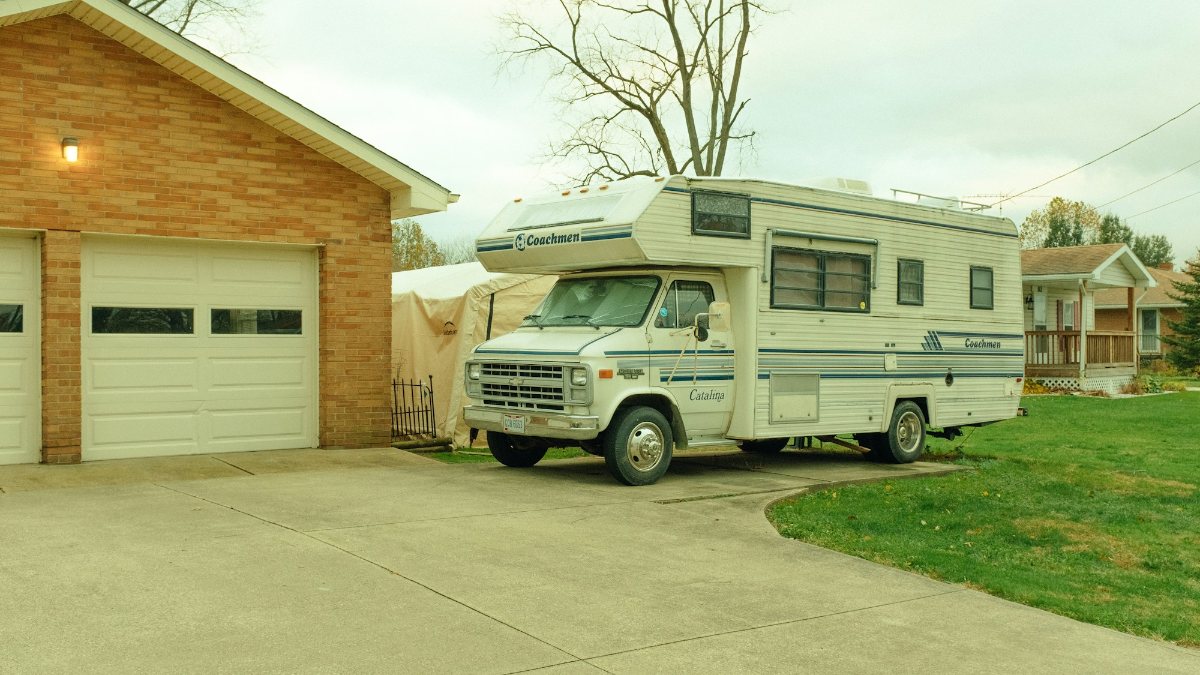
Home storage is the first option most RV owners consider, and on the surface, it makes sense — no monthly fees, your vehicle is right there when you need it, and you have full control over access. But the reality is more complicated than it appears, and for a large number of RV owners, home storage isn’t actually an option at all.
HOA Rules and Local Zoning Laws That May Block This Option
A significant percentage of residential neighborhoods either prohibit RV storage outright or impose strict limitations on where and how long an RV can be parked on a property. Homeowners associations frequently ban RV parking in driveways or require vehicles to be fully concealed from street view. Local municipal zoning codes may restrict the length of vehicle permitted on a residential lot or limit street parking to 72 hours. Before assuming you can park at home, check both your HOA bylaws and your local municipality’s code — violations can result in fines or mandatory removal.
Driveway vs. Backyard Storage Considerations
If home storage is permitted in your area, your two realistic options are the driveway or the backyard. Driveway storage is the most convenient for access but keeps the RV highly visible — both to neighbors and to potential thieves. It also takes up the full driveway in most cases, which creates daily inconvenience for the rest of the household.
Backyard storage offers more privacy and security through obscurity, but comes with its own challenges. Getting a large Class A motorhome or 40-foot fifth wheel through a side gate and into a backyard requires adequate clearance — both width and overhead. Ground conditions matter too; soft or uneven ground can cause tire sinkage and frame stress over time. A gravel or concrete pad is the ideal surface for long-term home storage.
Home Storage Security Measures Worth Investing In
If you’re storing at home, don’t rely on your neighborhood or property fence to do all the work. A few targeted investments significantly reduce risk. A quality hitch lock or kingpin lock makes towing the RV off your property far more difficult. Wheel boots add another layer of deterrent. A motion-activated floodlight system covering your storage area discourages nighttime access attempts, and a dedicated RV GPS (Global Positioning System) tracker gives you real-time location data if the worst happens.
For added protection, consider a visible security camera pointed directly at the RV — both for actual monitoring and as a visual deterrent. Visible security can discourage thieves, and your RV is a high-value, mobile target that warrants the investment.
How to Pick Between RV Storage Options
The best RV storage solution is the one that balances your protection needs, access habits, and budget without overcomplicating the decision. There’s no universal right answer — a weekender with a compact travel trailer in Arizona has completely different needs than someone storing a Class A diesel pusher through a Minnesota winter.
Run through three key questions before committing: How large is my RV? How often will I need to access it? And what’s my realistic monthly budget for storage? Your answers will naturally point you toward the right option.
Match Storage Type to Your RV Size
Smaller rigs — pop-up campers, teardrop trailers, and compact travel trailers under 20 feet — are flexible enough to fit in most storage types, including home garages with standard clearance. Mid-size travel trailers and Class C motorhomes are the sweet spot for covered storage. Class A motorhomes, large fifth wheels, and extended travel trailers over 35 feet often require facilities specifically designed for oversized vehicles — not every indoor or covered facility can accommodate them. Always confirm ceiling height, entry door dimensions, and bay length before booking.
How Often You Access Your RV Changes Everything
Access frequency is an underrated factor in storage decisions. If you’re pulling the RV out every two to three weeks, a facility with 24/7 gate access close to your home makes far more sense than a premium indoor facility 45 minutes away. On the other hand, if you’re storing the RV for a six-month winter season, the convenience of nearby access matters much less — and maximizing protection becomes the priority.
Budget Breakdown: What Each Storage Type Typically Costs
Storage costs vary by location, facility quality, and RV size, but here are rough monthly ranges to plan around:
| Storage type | Typical monthly cost* |
|---|---|
| Outdoor (uncovered) | About $50 to $150 |
| Covered | About $100 to $250 |
| Indoor (standard) | About $200 to $400 |
| Indoor (climate-controlled) | About $300 to $500 or more |
| At home | Little direct cost, but budget for security upgrades and check HOA rules to avoid fines |
*Rough ranges only. Prices vary widely by location, RV length and facility, so always get local quotes.
How to Prepare Your RV for Storage
Where you store your RV matters — but so does how you store it. Skipping proper preparation is one of the most common and costly mistakes RV owners make. An RV that goes into storage dirty, with a weak battery, unprotected plumbing, and under-inflated tires can come out in significantly worse condition than when it went in — regardless of whether it was stored indoors or out.
Think of pre-storage prep as a checklist that protects your investment from the inside out. Each step addresses a specific vulnerability that time and environmental conditions will exploit if left unchecked.
1. Clean and Inspect Before Storing
Start with a thorough exterior wash to remove road grime, bird droppings, tree sap, and bug residue — all of which become increasingly difficult to remove and can damage the finish the longer they sit. While washing, inspect the roof seams, window seals, and slide-out gaskets for any cracks or gaps. Even a small breach in a roof seal can allow water intrusion that leads to delamination and mold over a storage period. Catching it before storage means a $15 tube of lap sealant instead of a $3,000 repair later.
2. Protect the Engine, Battery, and Fuel System
For motorhomes, add a fuel stabilizer like STA-BIL 360 Protection directly to the gas tank before storage — this prevents fuel degradation and gum buildup in the fuel lines and carburetor that occurs when gasoline sits for 30 days or more. Run the engine for 10 minutes after adding stabilizer so it circulates through the entire fuel system. Change the oil before storage as well; used oil contains combustion byproducts that become acidic over time and accelerate engine wear while sitting.
Disconnect the house batteries (or switch off the battery disconnect switch) and keep them charged with a smart battery maintainer (a charger that keeps the battery full without overcharging it) like the NOCO GENIUS10 to maintain optimal charge levels without overcharging. A fully discharged battery left in storage will sulfate and lose permanent capacity — sometimes failing entirely by spring. For chassis batteries on motorhomes, a battery disconnect switch prevents parasitic drain from electronics and alarms during the storage period.
3. Winterize the Plumbing if Needed
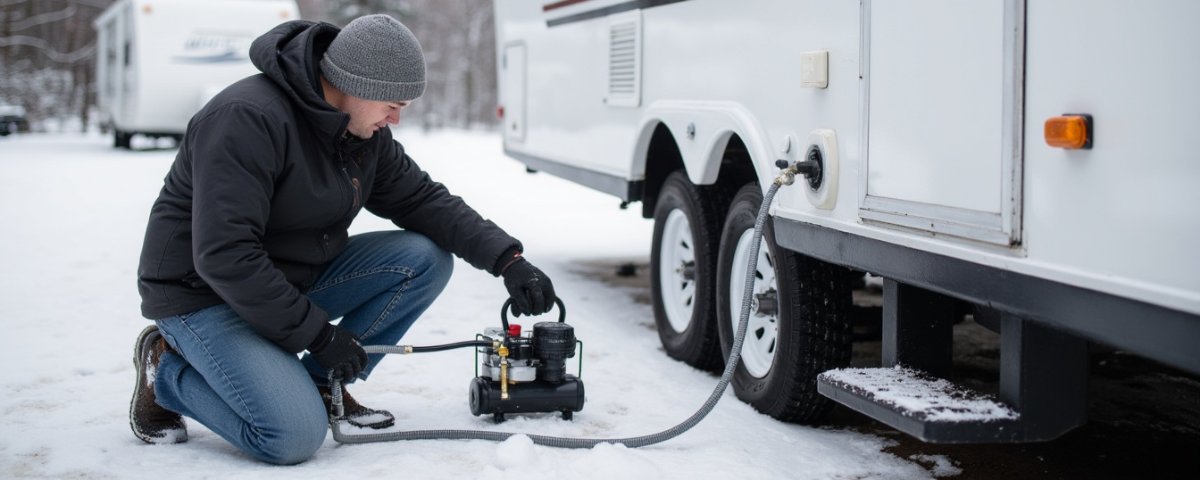
If temperatures at your storage location will drop below 32°F at any point during storage, winterizing the plumbing system is non-negotiable. Water expands when it freezes, and any water left in pipes, the fresh water tank, the water heater, or the pump can cause cracks and ruptures that cost hundreds to thousands of dollars to repair. The two accepted winterization methods are compressed air blow-out and non-toxic RV antifreeze — specifically propylene glycol-based antifreeze rated for potable water systems, such as Camco RV Antifreeze. Never use automotive antifreeze in an RV plumbing system; it is toxic and will contaminate the entire water supply. RV antifreeze is considered non-toxic, but it is still not meant for drinking: follow the label warnings and store it out of reach of children and pets. For step-by-step instructions, see the winterizing section of our RV maintenance checklist.
4. Use a Quality RV Cover for Added Protection
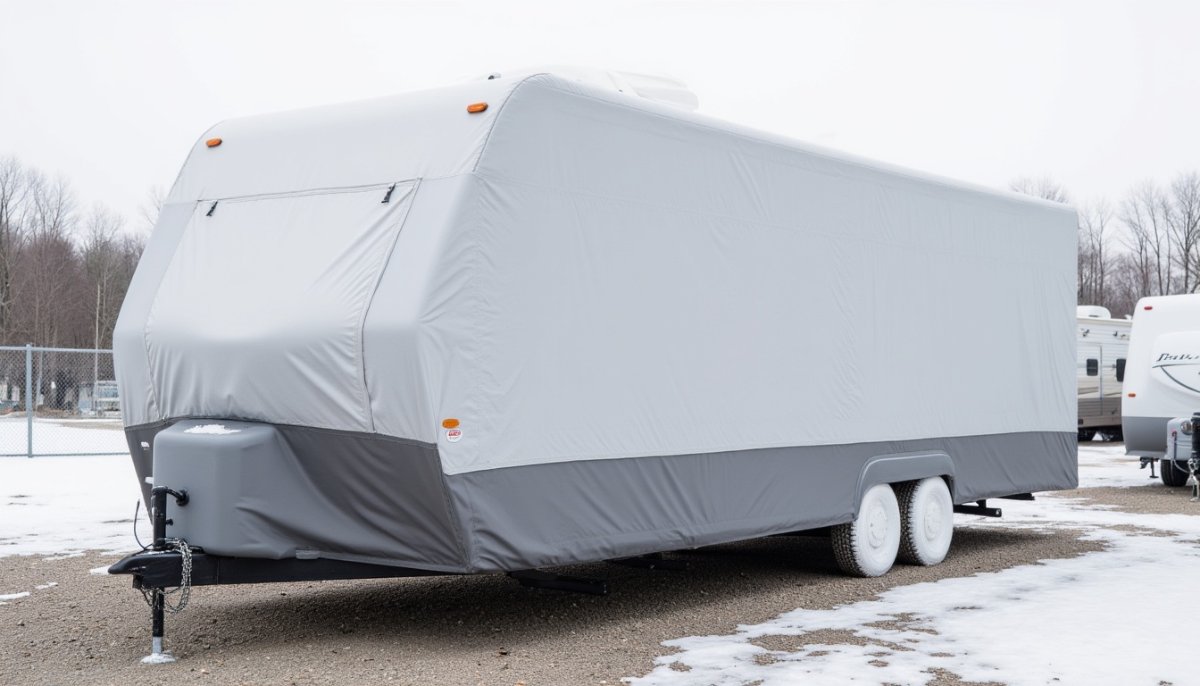
Even in covered or indoor storage, a quality RV cover adds a meaningful layer of protection against dust accumulation, UV light that may enter through windows or gaps, and moisture. For outdoor storage, a cover is essential. Look for covers made from breathable, multi-layer polypropylene fabric — products like the Classic Accessories Polypro III or ADCO Designer Series SFS AquaShed are specifically engineered to allow moisture vapor to escape while blocking rain and UV rays. Avoid non-breathable plastic tarps entirely; they trap condensation underneath, which accelerates mold growth and surface oxidation faster than no cover at all.
5. Check Tires and Stabilize the RV
Tires are one of the most overlooked components in RV storage preparation. A stationary RV puts sustained pressure on one section of each tire, which can cause flat spotting — a permanent deformation that creates vibration and handling issues when the RV is back on the road. Inflate tires to the manufacturer’s maximum cold inflation pressure listed on the sidewall before storage to minimize flat spotting risk, and place UV-resistant tire covers on each tire to prevent ozone cracking from sun and air exposure.
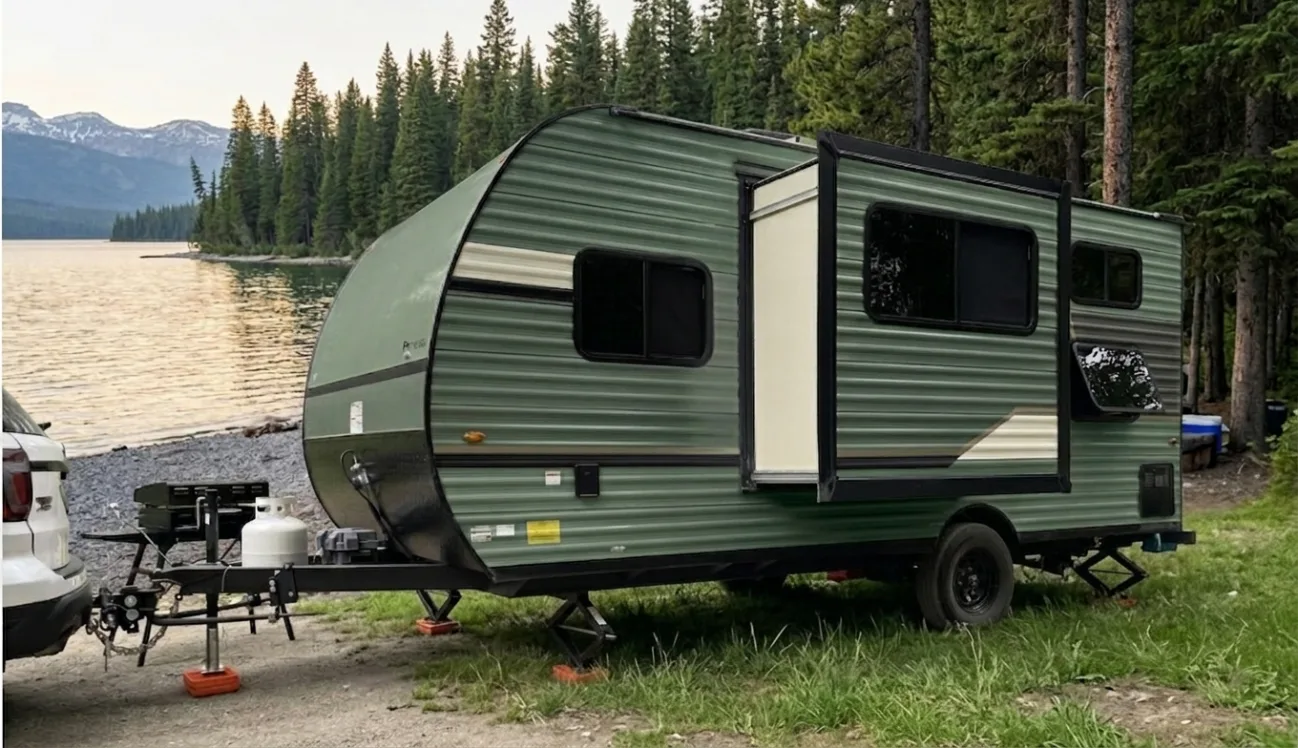
For towable RVs, stabilizing jacks should be deployed to reduce stress on the frame and suspension during the storage period. Level the RV front-to-back and side-to-side using a quality bubble level before dropping the jacks. This protects the refrigerator’s cooling unit — many RV refrigerators use absorption cooling systems that can be permanently damaged by sitting unlevel for extended periods. If your storage surface is soft ground, place jack pads like Camco FasTen Threaded Jack Pads under each stabilizer foot to prevent sinkage.
6. Turn Off the Propane and Keep Pests Out
Close the valve on every propane tank and turn off propane appliances before storage. Follow your owner’s manual and local rules, as some storage facilities require propane tanks to be shut off or removed.
Mice and insects love a quiet, stored RV. Remove all food (including pet food), clean crumbs, and look underneath for gaps where pipes and wires enter the floor; sealing them with a pest-proof foam or steel wool helps keep rodents out. Many owners also place traps or rodent deterrents inside. Choose products that are safe for children and pets if they will be in the RV, and check on the RV every few weeks if you can.
7. Lock Up and Take Photos
Close and lock all windows, roof vents and doors, and remove valuables. Take dated photos of the inside and outside before you leave it. They help with any insurance claim or facility dispute and give you a baseline to compare against when you return.
Storing Your RV Properly Is an Investment, Not an Expense
Every dollar spent on proper RV storage and pre-storage preparation pays back multiples in avoided repairs, extended vehicle life, and retained resale value. An RV that’s been consistently well-stored commands significantly more on the resale market than one with sun-faded paint, cracked seals, and a neglected interior. More importantly, proper storage means your rig is ready to go when you are — no surprise repairs, no delayed trips, and no expensive emergency fixes eating into your adventure budget. Choose the storage type that fits your situation, prep the RV properly each time, and your investment will keep paying off for years on the road.
Frequently Asked Questions
RV storage comes with a lot of questions — especially for first-time owners navigating the options for the first time. Here are the answers to the most common questions RV owners ask when deciding how and where to store their vehicle.
What is the cheapest way to store an RV?
The cheapest way to store an RV is at home — in your driveway, backyard, or garage — since there’s no monthly facility fee. However, this option is only available if your local zoning laws and HOA rules permit it, and it comes with trade-offs in security and weather protection that should be factored into the true cost.
If home storage isn’t an option, outdoor uncovered storage at a dedicated RV storage facility such as SpareFoot is the next most affordable choice, typically ranging from $50 to $150 per month depending on your location and the facility’s amenities. Pairing outdoor storage with a quality RV cover and a hitch lock brings your total cost up only slightly while dramatically improving both protection and security.
Is indoor RV storage worth the extra cost?
For most RV owners storing long-term — especially through winter or an intense summer heat season — indoor storage is absolutely worth the premium. A single weather-related repair, such as fixing a delaminated wall from water intrusion or replacing a cracked plumbing line from freezing, can easily cost more than a full year of indoor storage fees. If your RV is a high-value unit or you’re storing it for more than three months at a stretch, the math almost always favors indoor storage.
Can I store my RV in my driveway year-round?
It depends entirely on where you live. Many municipalities allow driveway storage but limit how long an RV can remain parked there — commonly 72 hours to two weeks without being moved. HOA communities frequently prohibit visible RV storage altogether or require that the vehicle be screened from street view by fencing or landscaping. Before committing to driveway storage, check your local city or county code and your HOA’s CC&Rs (covenants, conditions and restrictions, the community’s written rules) to avoid fines or forced removal.
How much does RV storage cost per month?
RV storage costs vary significantly based on storage type, geographic location, and facility quality. Here’s a general breakdown of what to expect:
- Outdoor uncovered storage: $50 – $150 per month
- Covered storage: $100 – $250 per month
- Standard indoor storage: $200 – $400 per month
- Climate-controlled indoor storage: $300 – $500+ per month
Urban and coastal markets tend to run higher than rural areas simply due to land costs and demand. Facilities in major metro areas like Los Angeles, Seattle, or Miami can push well above these ranges for premium indoor units. Shopping multiple facilities in your area and asking about long-term or prepaid discounts can bring monthly costs down meaningfully — some facilities offer a discount for paying several months or a year upfront.
Keep in mind that the cheapest option isn’t always the most cost-effective one. Factor in what a single storage-related repair would cost versus the incremental difference between storage tiers. In many cases, spending an extra $75 to $100 per month for covered or indoor storage is far less expensive in the long run than repairing sun or freeze damage on an RV that spent a year in an open lot.
What should I do to my RV before putting it in storage?
Start with a complete exterior wash and a thorough roof and seal inspection. Look closely at all roof seams, window frames, slide-out seals, and any penetration points for antennas or vents. Apply lap sealant to any cracks or gaps before storing — water intrusion during storage is one of the most damaging and expensive outcomes you can prevent with a $15 fix.
Winterize the plumbing system if there’s any risk of freezing temperatures at your storage location. Use propylene glycol-based RV antifreeze — such as Camco RV Antifreeze — or blow out the lines with compressed air. Drain the fresh water tank, the water heater, and all low-point drains completely. Don’t forget to bypass the water heater before adding antifreeze to the lines.
For motorhomes, add a quality fuel stabilizer, change the oil, and put the house batteries on a smart trickle charger. For all RV types, inflate tires to maximum cold pressure, install UV-protective tire covers, and deploy stabilizing jacks on proper jack pads. Remove all food from the interior, clean the refrigerator thoroughly and leave the door propped slightly open to prevent mold, and close all vents and windows to block pest entry.
Finally, throw a quality breathable RV cover over the exterior if you’re in outdoor or covered storage. Document the RV’s condition with photos before storage begins — this protects you in any insurance or facility dispute and gives you a clear baseline to compare against when you return in the spring.
Disclaimer
The information provided is for educational purposes only. Before carrying out any maintenance or safety task on your RV, please do your own further research so you are fully confident in each step. If you are ever unsure, consult a qualified RV professional or get a second opinion. Readers are responsible for their own safety, and PreciousRV.com accepts no liability for any injury, loss or damage.