Article-At-A-Glance
- Every inch of your RV can be optimized — vertical walls, ceiling space, and hollow furniture are the most overlooked storage opportunities.
- Multi-functional furniture like ottomans with storage compartments and fold-down tables can effectively double your usable living space.
- Simple kitchen swaps like magnetic spice racks and nesting cookware can transform a cramped RV kitchen into a fully functional cooking space.
- A minimalist mindset combined with seasonal rotation of gear is one of the most powerful (and underused) RV space strategies — more on that later.
Living in an RV doesn’t mean living with less — it means living smarter.
The difference between an RV that feels cramped and one that feels like a genuine home on wheels almost always comes down to how well the space is used, not how big it is. Most RVers leave a surprising amount of storage potential untapped simply because they haven’t been shown where to look. Whether you’re in a Class B van conversion or a full-sized Class A motorhome, the principles of space maximization are the same.
Small RV Space Works Better Than You Think
The average RV ranges from about 150 to 400 square feet of living space, which sounds tight until you realize that many New York City studio apartments clock in at the same size. The key difference is intentional design. When every item has a home and every surface serves a purpose, the space stops feeling small and starts feeling efficient. RVers who thrive in compact spaces aren’t living with less comfort — they’ve just rethought how comfort is organized.
Vertical Space Is Your Most Wasted Asset
Most people naturally think horizontally — countertops, floor space, shelving at eye level. But in an RV, the walls and ceiling are prime real estate that the majority of owners completely ignore. Going vertical means you’re expanding your storage capacity without adding a single square foot to your footprint.
Think of your RV walls the same way a well-designed kitchen uses its backsplash — every inch is a potential storage opportunity. The moment you shift your thinking upward, the entire rig opens up.
Magnetic Strips and Adhesive Hooks for Walls
A magnetic knife strip mounted inside a cabinet door or along a kitchen wall keeps metal utensils, scissors, and even spice tins with magnetic lids completely off the counter. Command adhesive hooks are equally powerful — they hold everything from lightweight bags and hats to dish towels and small baskets without requiring any drilling. The 3M Command Large hooks are rated to hold up to 7.5 pounds each, which is more than enough for most RV wall storage needs.
Quick Wall Storage Setup:
Item Placement Best Use Magnetic knife strip Kitchen wall or inside cabinet door Utensils, spice tins, scissors 3M Command Large hooks Entryway, bathroom, bedroom walls Bags, towels, hats, small baskets Adhesive wall pockets Beside the bed or desk area Phones, remotes, notebooks Pegboard panel Kitchen or garage bay wall Tools, cookware, accessories
Pegboards deserve a special mention. A small pegboard panel installed in the kitchen or cargo bay gives you a fully customizable wall storage system that can be rearranged any time your needs change.
Ceiling Nets and Overhead Storage Solutions
Cargo nets strung across ceiling corners — especially above the bed or in slide-out areas — are ideal for lightweight items like extra pillows, stuffed animals for kids, hats, or rolled-up yoga mats. They keep items accessible without eating up a single drawer or shelf. Many RVers also install shallow overhead shelving above the main seating area to hold books, board games, or folded blankets that aren’t needed daily.
Over-the-Door Organizers for Every Room
An over-the-door organizer on your bathroom door, pantry door, or even bedroom closet door can hold an extraordinary amount of gear in a space that was previously doing nothing. Clear pocket organizers are especially useful because you can see exactly what’s inside without digging around. For more tips on maximizing space in your RV, check out our RV maintenance guide.
Multi-Functional Furniture That Pulls Double Duty
In a small space, furniture that only does one job is a liability. Every major piece in your RV should serve at least two purposes — ideally three. The good news is that the RV furniture market has evolved significantly, and multi-functional options are more accessible and affordable than ever.
Ottomans With Hidden Storage Compartments
A storage ottoman is one of the single best investments an RVer can make. It functions as a footrest, extra seating, a coffee table with a tray on top, and a storage bin all in one. Brands like Linon and Convenience Concepts make collapsible storage ottomans specifically sized for compact spaces, with interior capacities ranging from 50 to 100 liters — enough to swallow extra blankets, board games, or off-season clothing in one shot.
Fold-Down Tables and Wall-Mounted Desks
A fold-down table mounted to the wall takes up virtually zero space when not in use and expands into a full dining or work surface in seconds. Murphy-style wall desks follow the same principle for remote workers living the full-time RV lifestyle. When the workday is done, the desk folds flat against the wall and the living room returns to its original layout — no permanent footprint required.
Sofa Beds and Convertible Sleeping Arrangements
The dinette-to-bed conversion is an RV classic for a reason — it works. But beyond the standard dinette flip, jackknife sofas and tri-fold foam mattresses give you the flexibility to configure sleeping arrangements based on who’s traveling with you. For solo travelers or couples, a jackknife sofa that converts to a twin or full bed can free up what would otherwise be a dedicated bedroom area for additional storage or living space.
Kitchen Space Solutions That Actually Work
The RV kitchen is where space constraints hit the hardest. You’re expected to prep, cook, store food, and clean dishes in a space that’s often no larger than a hallway. But with the right tools and a bit of reorganization, an RV kitchen can be just as functional as a residential one.
The first move is eliminating anything you don’t use regularly. Most RVers load their kitchen with tools they use once a trip, if ever. A sharp chef’s knife, one quality skillet, a nesting pot set, and a cutting board handle 90% of cooking needs on the road.
From there, it’s about choosing gear that’s built for small spaces. Collapsible bowls and measuring cups fold completely flat when not in use. Nesting cookware sets like the GSI Outdoors Pinnacle Ceramic Camper Cookset or the Stainless Steel Stanley Adventure Base Camp Cook Set stack into a single compact unit that takes up a fraction of the space that individual pots and pans would.
Drawer dividers are underrated in the RV kitchen. A simple adjustable bamboo drawer divider keeps utensils, gadgets, and tools from becoming a jumbled mess every time you hit a bumpy road. Combined with pull-out cabinet organizers, your kitchen drawers and cabinets stay functional and accessible no matter the terrain.
- Use a magnetic spice rack mounted to the refrigerator or wall to free up an entire cabinet shelf
- Store nesting pots and pans with the lids in a separate vertical lid organizer inside a cabinet door
- Replace bulky paper towel rolls with a wall-mounted paper towel holder under a cabinet
- Use stackable, uniform food containers (avoid use of plastic containers) so every inch of shelf height is used
- Install a tension rod under the sink to hang spray bottles vertically, freeing up the floor of the cabinet
Magnetic Spice Racks and Collapsible Cookware
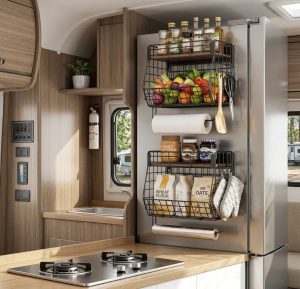
A magnetic spice rack mounted directly on the refrigerator door or a metal kitchen wall panel is one of the quickest wins in RV kitchen organization. Kamenstein makes magnetic spice tins that stick securely even on bumpy roads, keeping your most-used seasonings visible and within arm’s reach without occupying a single inch of counter or cabinet space. The freed-up shelf space alone makes this upgrade worth every penny. Collapsible cookware and colanders takes the concept further — your entire cooking kit fits into a small space. Best to avoid using plastic cookware with hot foods or liquids.
Bathroom Organization in Tight Quarters
The RV bathroom might be the most challenging space to organize in the entire rig. You’re working with a sink, toilet, and shower — sometimes all within arm’s reach of each other — and you still need to store toiletries, cleaning supplies, towels, and personal care products. The solution isn’t more space; it’s smarter placement of every item you bring aboard.
Suction Cup Caddies and Retractable Clotheslines
Suction cup shower caddies are purpose-built for the RV bathroom. Unlike tension pole caddies that require floor-to-ceiling pressure to stay upright, suction cup versions like the InterDesign Forma Suction Shower Caddy mount directly to the shower wall and hold shampoo, conditioner, razors, and soap without taking up any floor space. The suction cups hold firmly on fiberglass RV shower walls, which is the most common material in production RVs.
A retractable clothesline strung across the shower enclosure pulls double duty as both a drying line for swimwear and delicates and as a spot to hang a small mesh bag of shower products. When not in use, it retracts completely out of the way. The Stinky Lockers retractable clothesline is a popular choice among full-time RVers specifically because it holds up to the constant moisture exposure inside an RV shower.
Towels and Collapsible Toiletry Alternatives
Switching from standard bath towels to other alternatives is a small change with a big spatial impact. Examples include 100% flax linen towels and 100% cotton turkish towels with high packability factor. For toiletries, solid shampoo and conditioner bars eliminate the bulky plastic bottles entirely — they last longer, weigh less, and take up a fraction of the space of their liquid counterparts. For more ideas on optimizing space, check out these RV storage ideas.
Bedroom and Closet Storage Done Right
The RV bedroom has to work harder than almost any other room. It’s where you sleep, store clothing, charge devices, keep personal items, and sometimes work — all within a space that might be 8 feet wide on a generous day. Getting this room right makes a real difference in how rested and comfortable you feel on the road.
Vacuum Storage Bags for Clothing and Bedding
Vacuum storage bags are one of the most space-efficient tools available to RV travelers. A queen-sized comforter that would normally fill an entire overhead cabinet compresses down to roughly the size of a throw pillow when vacuum-sealed. Space Saver Premium Jumbo bags are a reliable option — they’re double-zip sealed and designed to stay compressed even without a vacuum pump, using a roll-up compression method that works anywhere. Off-season clothing, extra blankets, and bulky winter gear all disappear into manageable flat packages that slide under a bed or into a slide-out compartment with ease.
Under-Bed Storage Containers and Bed Lift Systems
The space beneath an RV bed is some of the most valuable square footage in the entire rig, and it’s often completely wasted. Shallow rolling storage containers like the IRIS USA Underbed Storage Box with wheels fit perfectly in most RV under-bed clearances and roll out smoothly on carpet or hard floors. For RVers with fixed beds that don’t have easy access underneath, a simple bed lift kit — essentially heavy-duty hinges and a gas-assisted lift mechanism — converts the entire mattress platform into a storage hatch that opens like a trunk lid, revealing a full-width storage bay beneath.
Roll Clothes Instead of Folding to Save Space
The military roll — where clothing is rolled tightly from the bottom hem upward — consistently outperforms flat folding for space efficiency. Rolled clothes stand upright in drawers like files in a filing cabinet, which means you can see every item at a glance without digging through a stack. A standard RV drawer that holds 6 folded t-shirts typically holds 10 to 12 when rolled using this method. It also reduces wrinkles in most casual fabrics, which is a bonus when you’re living without a full-sized iron.
Hidden Storage Spots Most RVers Overlook
After the obvious spots are organized, the real gains come from finding storage in places most RVers walk past every day without a second thought. These hidden zones don’t require major renovation — just a fresh perspective on what’s already there.
The space above the cab in Class C motorhomes is a classic example. That overhead bunk area often goes unused by RVers who don’t need the extra sleeping space, but it’s perfectly sized for storing board games, bulky jackets, or a rolled-up outdoor rug. Similarly, the gap between the refrigerator and an adjacent cabinet wall is often just wide enough to accommodate a slim pull-out pantry rack that holds canned goods, bottles, or snack packages in a space that was previously dead air.
Toe kick spaces — the recessed area at the base of kitchen and bathroom cabinets — are another overlooked zone. Some RV manufacturers leave these completely hollow, and a simple pull-out drawer insert transforms them into usable storage for flat items like cutting boards, baking sheets, or spare sandals. It takes a bit of DIY effort, but the payoff is a surprising amount of storage in a location that costs zero living space.
The Minimalist Mindset Makes Everything Easier
Every experienced full-time RVer eventually arrives at the same conclusion: the less you bring, the better everything works. It sounds obvious, but the pull toward bringing “just in case” items is strong, and it’s the single biggest enemy of a well-organized RV. Before every trip — and especially before transitioning to full-time living — go through every category of belongings and ask whether each item has been used in the last 30 days. If the answer is no, it probably doesn’t need to be on board.
Minimalism in an RV isn’t about deprivation. It’s about intentionality. Every item that earns a spot in your rig should either serve a clear function, bring genuine comfort, or do both. The reward for this discipline is a living space that stays organized almost automatically, because there simply isn’t enough clutter to create chaos. RVers who commit to this mindset consistently report feeling less stressed, spending less time cleaning and organizing, and enjoying their travels more fully.
Seasonal Rotation Keeps Your RV Clutter-Free Year Round
Seasonal RV Storage Rotation Guide
Season Keep On Board Rotate to External Storage Summer Swimwear, lightweight clothing, sunscreen, outdoor chairs, water gear Heavy coats, thermal layers, snow gear, extra blankets Fall Light layers, rain gear, medium-weight bedding, hiking boots Full summer swimwear sets, heavy winter gear Winter Thermal clothing, heavy blankets, cold-weather boots, heat management tools Summer clothing, outdoor water toys, lightweight camping gear Spring Transitional layers, allergy supplies, rain jacket, medium bedding Heavy winter gear, bulky thermal items
Seasonal rotation is the strategy that keeps long-term RVers consistently organized without constantly feeling like they’re running out of room. The concept is simple: only carry what you actually need for the climate and activities of your current travel window. Winter gear in July and swimsuits in December are just dead weight consuming valuable storage space.
A small off-site storage unit or a dedicated storage space at a home base works well for rotating seasonal items in and out. Many full-time RVers use a 5×5 or 5×10 climate-controlled storage unit — at an average cost of $50 to $100 per month — as a seasonal swap station where they trade out clothing, gear, and recreational equipment based on where they’re headed next. It’s a low-cost solution that dramatically extends the functional storage capacity of any RV.
Vacuum storage bags play a key role in the rotation process. Items being moved to off-site storage get compressed and sealed, staying protected from moisture and pests while taking up minimal room in the storage unit. When it’s time to swap back, the bags open easily and the contents are fresh and ready to use. It’s a system that takes about an hour to execute at each seasonal transition but pays dividends in daily organization for months at a time.
Small Changes Add Up to a Comfortable RV Life
You don’t need to overhaul your entire rig to start living better in it. Swap in one storage ottoman, mount a magnetic spice rack, toss a ceiling cargo net above your bed — each individual change is small, but the cumulative effect of a dozen smart upgrades transforms how your RV feels to live in every single day. Start with the area causing you the most frustration right now and work outward from there. The improvements compound quickly.
Frequently Asked Questions
RV space optimization is one of the most searched topics in the RV community, and for good reason — it directly impacts daily comfort, stress levels, and how much you actually enjoy life on the road. Whether you’re brand new to RV living or rethinking a system that isn’t working anymore, these answers address the most common questions RVers ask when tackling storage and space challenges.
The answers below are practical, road-tested, and applicable across most RV types and sizes — from compact Class B vans to full-sized Class A motorhomes.
What is the best way to add storage to a small RV without doing permanent modifications?
The best non-permanent options are over-door organizers, 3M Command adhesive hooks and shelves, tension rods inside cabinets, suction cup caddies in the bathroom, and freestanding storage ottomans in the living area. These solutions require no drilling, leave no lasting damage, and can be repositioned or removed at any time — making them ideal for renters, leased rigs, or RVers who prefer to keep their modifications reversible.
How do I keep my RV kitchen organized when cooking regularly?
Consistency is the key. Every item needs an assigned home and needs to return to that home after every use. Use uniform stackable containers for all pantry items, install a magnetic spice rack to get seasonings off the counter, and do a quick 5-minute reset after each meal before moving on. RVers who cook daily swear by the “one in, one out” rule for kitchen gear — when a new tool comes in, an old one that’s used less frequently gets removed from the rig entirely.
Are vacuum storage bags safe to use in an RV with temperature changes?
Yes, with some important caveats. Standard vacuum storage bags are safe for clothing, bedding, and soft goods in an RV environment. However, extreme heat — like the interior of an RV parked in direct summer sun, which can reach 130°F or higher — can weaken the plastic seals over time and cause bags to lose their compression. Store vacuum-sealed bags in shaded, ventilated areas inside the rig rather than in exterior bays or under direct sunlight exposure.
For items stored in exterior cargo bays where temperature fluctuations are more extreme, use heavy-duty vacuum bags rated for temperature variance, such as the Space Saver Premium bags with double-zip seals. These hold their compression across a wider temperature range and are more resistant to puncture from the shifting and vibration that’s normal during travel on rough roads.
What multi-functional furniture works best in a Class B or Class C RV?
In a Class B van-style RV, a jackknife sofa or tri-fold foam mattress that converts between seating and sleeping is the most space-efficient choice, since dedicated bedroom space is typically nonexistent. In a Class C motorhome, a storage ottoman paired with a fold-down wall table near the dinette area maximizes both seating flexibility and workspace without adding permanent bulk. The goal in both cases is furniture that changes function based on the time of day rather than furniture that serves only one role around the clock.
How often should I reassess my RV storage systems?
Reassess every 30 days for the first three months of a new setup, then seasonally after that. The first 90 days in any RV storage configuration reveal what’s working, what’s annoying, and what’s being ignored entirely. Items you haven’t touched in 30 days are strong candidates for removal or relocation to off-site storage.
After the initial optimization period, a seasonal reassessment — coinciding with your gear rotation — is typically enough to keep things running smoothly. Use these checkpoints to ask whether your current system still matches your travel style, travel companions, and destination types, since all three tend to shift over time.
The most organized RVers treat their storage systems as living, evolving setups rather than one-time projects. A 20-minute quarterly audit of every storage zone keeps clutter from quietly accumulating and ensures your space continues to work for you rather than against you.