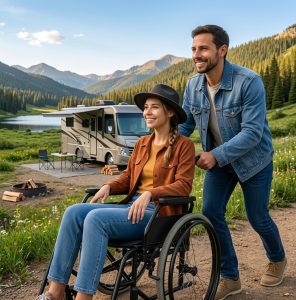
- Handicap RV rentals offer true travel independence — with built-in ramps, wider doorways, and accessible bathrooms, you’re not at the mercy of a hotel’s idea of “accessible.”
- Key features to prioritize include entry lifts or ramps, open floor plans, roll-in showers, and lowered countertops — not all accessible RVs include every feature, so always verify before booking.
- Platforms like RVshare and Outdoorsy make it easier to filter for ADA-accessible RVs and communicate directly with owners about specific mobility needs.
- Major manufacturers like Newmar and Winnebago build wheelchair-accessible Class A models, while custom builders like Sportsmobile offer more tailored solutions for unique needs.
- Modifying a standard RV is possible, but working with specialized accessible RV builders from the start saves time, money, and frustration — keep reading to find out what to look for.
Most travel is designed with the assumption that you can climb three steps, squeeze through a narrow hallway, and manage a standard bathroom — handicap RV rentals flip that assumption entirely.
For wheelchair users and travelers with mobility needs, the open road has historically come with a long list of uncertainties. Will the hotel room actually be accessible? Is the bathroom going to work? Traveling in a properly equipped accessible motorhome removes most of those questions before you even leave the driveway. RVshare is one of the leading peer-to-peer RV rental platforms where you can filter directly for accessible options and talk to owners about exactly what’s on board.
Handicap RV Rentals Give You the Freedom Most Travelers Take for Granted
An accessible RV isn’t just a vehicle with a ramp bolted on — it’s a fully self-contained travel environment built around your needs. Your restroom comes with you. Your bed is set up the way you need it. You control the schedule, the route, and the stops.
For travelers who rely on wheelchairs or have significant mobility limitations, this kind of control isn’t a luxury — it’s what makes travel possible at all. Traditional travel often means calling ahead, hoping for the best, and spending energy managing logistics that other travelers never think about. A well-equipped handicap RV rental changes that dynamic completely.
- No calling hotels to confirm whether the “accessible” room actually has grab bars
- No navigating unfamiliar bathrooms in the middle of the night
- No worrying about whether a restaurant or attraction will have accessible parking nearby
- No depending on staff assistance for things you’d handle independently at home
The result is travel that feels genuinely independent — which is exactly what it should feel like.
Essential Accessibility Features to Look for in a Rental RV
Not every RV marketed as “accessible” is built equally. Some have a single grab bar added to the bathroom and call it done. Knowing which features actually matter — and which ones are non-negotiable for your specific needs — will save you from a frustrating experience on the road.
Ramps and Lifts for Entry
This is the starting point for any wheelchair-accessible RV rental. Standard RVs have a step-up entry that’s simply not usable for most wheelchair users. A proper accessible RV will have either a fold-out ramp or a powered platform lift at the entry door. Lifts tend to be more reliable for power wheelchair users or anyone with a heavier chair, while ramps work well for manual chairs and lighter powerchairs on flat ground. Always ask the owner or rental company about the weight capacity of the lift or ramp before you book.
Wider Doorways and Open Floor Plans
Standard RV doorways typically measure around 24 to 26 inches — too narrow for most wheelchairs. Accessible models widen interior doorways to at least 32 inches, with many reaching 36 inches to meet ADA guidelines. But doorway width alone isn’t enough if the interior is packed with fixed furniture and tight corners.
Open floor plans are what make a wheelchair-accessible RV actually functional. Without adequate turning radius — typically a minimum of 60 inches for a full 360-degree turn — even a wide-door RV becomes an obstacle course. The best accessible Class A motorhomes are designed with this in mind from the ground up, not as an afterthought.
Here’s a quick look at the core interior features and why each one matters:
| Feature | Why It Matters | What to Look For |
|---|---|---|
| Doorway Width | Must accommodate wheelchair width | Minimum 32″, ideally 36″ |
| Turning Radius | Allows full maneuvering indoors | 60″ clear floor space |
| Floor Surface | Affects rolling ease and safety | Low-pile or hard flooring preferred |
| Furniture Placement | Determines usable pathways | No fixed obstacles in main travel path |
Accessible Bathrooms and Showers
The bathroom is where many “accessible” RVs fall short. A true roll-in shower with no threshold lip, a fold-down shower bench, and a handheld showerhead are the baseline for a usable accessible bathroom. Grab bars need to be properly positioned — not just present — and the toilet should have adequate transfer space on at least one side, ideally 18 inches or more.
Some higher-end accessible motorhomes also include roll-under sink vanities, which allow wheelchair users to get close enough to the mirror and faucet for comfortable use. This detail is often overlooked but makes a significant daily difference on a longer trip.
Lowered Countertops and Recessed Sink Cabinets
Kitchen accessibility is just as important as bathroom accessibility, especially on longer trips. Lowered countertops — typically set at 28 to 34 inches rather than the standard 36 inches — allow wheelchair users to prep meals, use the stovetop, and access the sink without straining. Recessed cabinet toe-kicks give wheelchairs room to pull up close, and some models include pull-out cutting boards at a lower height for added function.
Wheelchair Accessible Motorhome Models Worth Knowing
A handful of manufacturers have made genuine commitments to accessible RV design. Knowing which models are built with real accessibility in mind — rather than minimal modifications — helps you ask the right questions when searching for a rental or considering a purchase.
Newmar Dutch Star 4311, Ventana 4311, and Canyon Star 3911
Newmar is one of the most recognized names in wheelchair-accessible Class A motorhomes. The Newmar Dutch Star 4311, Ventana 4311, and Canyon Star 3911 are among their most well-known accessible configurations. These models feature widened entry doors, open living areas with sufficient turning radius, roll-in showers, lowered countertops, and in many cases, powered entry lifts. Newmar builds these as purpose-designed accessible floorplans rather than retrofitted standard models, which makes a meaningful difference in how livable they actually are.
Winnebago Inspire and Other Accessibility-Enhanced Class A Models
Winnebago’s Inspire is built on a Volvo chassis and represents one of the more thoughtfully designed accessible Class A options on the market. It features a wider entry door, open floor plan, roll-in shower, and lowered countertops as standard — not as add-ons. Winnebago has leaned into the accessible travel market more deliberately than many of its competitors, and it shows in the details of how these coaches are laid out.
Beyond the Inspire, Winnebago has produced accessibility-enhanced versions of other Class A diesel pushers where buyers have worked directly with the manufacturer to customize floorplans. If you’re renting rather than buying, knowing the Winnebago name means you can ask an owner specifically whether their unit is a factory accessible build or a retrofit — a distinction that matters considerably when you’re relying on the features to work perfectly every day of your trip.
Custom Class B and Class C Builds From Showhauler and Sportsmobile
For travelers who need something more tailored, custom builders like Sportsmobile offer wheelchair-accessible Class B van conversions built around specific mobility requirements. These are smaller rigs — easier to drive and park — but can be outfitted with hand controls, ramps, tie-down systems for power wheelchairs, and modified interiors. Showhauler works on larger custom coach builds for those who need more space. These custom options are less likely to appear in standard rental marketplaces, but they’re worth knowing about if your needs go beyond what factory accessible models provide.
How to Find a Handicap RV Rental
Finding a genuinely accessible RV rental takes more effort than booking a standard rig — but the landscape has improved significantly with peer-to-peer rental platforms entering the market. The key is knowing where to search, what questions to ask, and how to verify that what’s listed actually matches what you need.
Why Big-Box RV Rental Companies Often Fall Short
- Large national rental chains rarely stock purpose-built accessible motorhomes
- Retrofit modifications on standard fleet vehicles are often minimal and inconsistent
- Staff may not have detailed knowledge of specific accessibility features on individual units
- Fleet vehicles are designed for the broadest possible market — not mobility-specific needs
- Availability of any accessible units is extremely limited, especially during peak travel season
The fundamental problem with big-box rental companies is that accessible RVs represent a small slice of their business, so there’s little incentive to invest in purpose-built units or train staff on the specifics. What gets listed as “accessible” often means a grab bar was added to an otherwise standard bathroom — and that’s not going to cut it for a full-time wheelchair user on a two-week road trip.
This doesn’t mean national chains are never an option. If your mobility needs are moderate — say, limited walking ability but no wheelchair — a standard RV with some basic modifications might genuinely work. The issue is that you need to go in with very specific questions rather than trusting a checkbox labeled “accessible” on a booking page.
Always ask for photos of the bathroom, entry door, and interior pathways. Ask about the exact doorway width in inches. Ask whether the shower has a threshold lip. Ask about counter height. If a rental company can’t answer these questions specifically, that’s important information too. For more detailed insights, check out this guide on handicap RV rentals.
How RVshare Makes It Easier to Find Accessible Rigs
Peer-to-peer platforms like RVshare have changed the accessible RV rental landscape by connecting renters directly with owners. This means you can have a real conversation with the person who knows every inch of the vehicle — not a call center representative reading from a spec sheet. Many owners of accessible RVs on RVshare are themselves disabled travelers or family members of wheelchair users, which means the units are often genuinely well-equipped rather than minimally compliant.
How to Search for Accessible RVs on RVshare:
- Go to RVshare.com and enter your travel dates and location
- Open the filters and look for the accessibility or ADA-accessible option
- Review listings carefully and read the full description — owners often detail specific features
- Message the owner directly with your specific questions before booking
- Ask for additional photos of the entry, bathroom, shower, and kitchen if not already listed
- Confirm lift or ramp weight capacity if you use a power wheelchair
Outdoorsy is another peer-to-peer platform worth checking — they have an ADA Accessible checkbox under the Guests filter in their RV search. Running both platforms simultaneously gives you the widest possible pool of accessible options for your travel dates and location.
One practical tip: contact owners early, especially if you’re planning a summer or holiday trip. Accessible RVs are a small subset of the total rental market, and the good ones book up fast. Reaching out weeks or even months ahead gives you time to find the right fit rather than settling for whatever’s left.
Real Benefits of Traveling in an Accessible RV
The practical advantages of renting a handicap-accessible motorhome go well beyond convenience — for many travelers with disabilities, it’s the difference between a trip that’s possible and one that simply isn’t.
No More Guessing If the Hotel Room Will Actually Be Accessible
Anyone who travels regularly with a mobility disability knows the particular anxiety of checking into a hotel room labeled “ADA accessible” — and finding a bathroom that technically meets the legal minimum but doesn’t actually work for their needs. Roll-in showers that are too small, grab bars positioned for someone with different needs, or a room layout that makes maneuvering a power wheelchair nearly impossible. With an accessible RV rental, you inspect and verify your living space before you leave home — and it stays exactly the same for the entire trip.
Your Accessible Restroom Travels With You
This is one of the most underrated advantages of accessible RV travel. On a road trip, you stop when you want to stop — but for wheelchair users, every unplanned stop raises the question of whether the gas station, rest area, or roadside attraction will have a usable restroom. An accessible motorhome eliminates that calculation entirely.
Having your own accessible bathroom on board means you can stop at a scenic overlook, a state park, or a small town diner without spending mental energy pre-scouting the bathroom situation. It’s a level of spontaneity that most travelers never think about — but for wheelchair users, it’s genuinely life-changing on the road.
Travel on Your Schedule Without Accessibility Uncertainty
Accessible RV travel puts you back in control of your itinerary in a way that hotel-based travel rarely does. You’re not timing your day around accessible shuttle schedules, calling ahead to attractions to confirm accessible parking, or cutting a day short because the hotel restaurant isn’t wheelchair-friendly. Your home base — with everything set up exactly the way you need it — moves with you from destination to destination.
Can You Modify an RV to Be Wheelchair Accessible?
Yes — but the answer comes with an important caveat. Modifying a standard RV to be genuinely accessible is possible, but the scope of what’s actually achievable depends heavily on the RV’s existing structure. Some modifications are straightforward. Others require extensive work that may cost more than the RV itself is worth, or simply can’t be done without compromising the vehicle’s structural integrity.
The modifications that tend to work well as retrofits include:
- Installing a fold-out ramp or powered platform lift at the entry door
- Adding grab bars in the bathroom, near the toilet, and in the shower
- Replacing a standard shower pan with a low-threshold or zero-threshold option
- Adding a handheld showerhead and fold-down shower bench
- Lowering a section of countertop for wheelchair-height access
- Replacing carpet with hard flooring for easier rolling
What’s much harder to retrofit is structural — doorway widths, floor plan layout, and turning radius. If the interior doorways are 24 inches wide, widening them requires cutting into walls and potentially compromising cabinetry, wiring, or structural supports. If the floor plan is tight with fixed furniture, opening it up for a 60-inch wheelchair turning radius may mean gutting the interior entirely. These are jobs for specialized accessible RV conversion companies, not weekend DIY projects.
If you’re considering a full accessible conversion, companies that specialize in this work will assess the specific RV and give you a realistic scope of what’s achievable. In many cases, they’ll tell you honestly that purchasing a factory-built accessible model is the smarter financial and practical decision. That honest conversation is worth having before you invest in a conversion that may fall short of your actual needs.
Accessible RV Travel Is Hard to Find, But Worth the Search
The inventory of genuinely accessible RV rentals is small compared to the overall rental market — but it’s growing, and the platforms to find them have improved significantly. The effort you put into finding the right handicap RV rental pays off the moment you’re on the road, moving on your own schedule, sleeping in a space that actually works for you, and experiencing destinations that too many people with disabilities have been told aren’t really for them.
Whether you’re a full-time wheelchair user, traveling with a family member who has significant mobility needs, or managing a condition that makes standard travel infrastructure genuinely difficult, accessible RV travel is one of the most empowering ways to see the country. Start your search on RVshare, ask detailed questions, verify the features that matter most for your specific situation, and don’t settle for a unit that doesn’t truly meet your needs. For more resources, check out wheelchair accessible RV options. The right rig is out there.
Frequently Asked Questions
Here are the most common questions travelers ask when exploring handicap RV rentals for the first time.
What Is a Handicap-Accessible RV Rental?
A handicap-accessible RV rental is a motorhome or camper equipped with features designed to accommodate wheelchair users and travelers with mobility limitations. These features typically include entry ramps or powered lifts, widened interior doorways, open floor plans with adequate turning radius, roll-in showers, grab bars, and lowered countertops. The best units are purpose-built by manufacturers like Newmar or Winnebago with accessibility designed into the floor plan from the start — not added on afterward.
Are Handicap RV Rentals More Expensive Than Standard Rentals?
Generally, yes. Accessible RVs command a higher rental price because they’re a specialized, lower-supply segment of the market and because the vehicles themselves cost more to build or modify. Purpose-built accessible Class A motorhomes from manufacturers like Newmar represent a significant investment, and rental pricing reflects that. However, when you factor in what you’re replacing — hotel rooms that may or may not be genuinely accessible, the logistics of accessible transportation at each destination, and the peace of mind of a fully self-contained accessible environment — the value proposition is strong.
Pricing also varies considerably by platform, location, and season. Peer-to-peer platforms like RVshare can sometimes offer better value than commercial rental companies because owners set their own rates and don’t carry the overhead of a large rental fleet. It’s worth comparing options across both RVshare and Outdoorsy for your specific dates before assuming accessible rentals are out of budget.
What Accessibility Features Matter Most for Wheelchair Users?
The entry point — literally — is the ramp or lift. Without reliable, weight-appropriate access into the vehicle, nothing else matters. After that, the priority order generally goes: interior doorway width, turning radius in the main living area, bathroom configuration (roll-in shower, toilet transfer space, grab bar placement), and then kitchen accessibility features like lowered countertops.
That said, the features that matter most depend on your specific situation. A manual wheelchair user has different requirements than someone using a 300-pound power chair. Someone with upper body strength limitations needs different grab bar placement than someone with strong arms but no lower body function. Be specific about your own needs when evaluating any accessible RV rental — don’t assume that “accessible” as listed covers everything you actually require.
Can Any RV Be Modified to Accommodate Mobility Needs?
Some RVs can be meaningfully modified, and some cannot — at least not without a cost that makes the project impractical. Bolt-on modifications like ramps, grab bars, handheld showerheads, and low-threshold shower inserts are achievable on many standard RVs. Structural changes like widening doorways or reconfiguring floor plans are a much more complex undertaking that requires professional accessible conversion specialists.
The honest answer for most people considering a modification is: get a professional assessment first. A company specializing in accessible RV conversions can tell you exactly what’s possible on a specific vehicle and what it will cost. In many cases, they’ll confirm that a purpose-built accessible model from Newmar or Winnebago is a better long-term investment than converting a standard rig.
Where Is the Best Place to Search for a Wheelchair Accessible RV Rental?
The two best starting points are RVshare and Outdoorsy. Both are peer-to-peer RV rental platforms where you can filter specifically for accessible or ADA-compliant vehicles. On Outdoorsy, look for the ADA Accessible checkbox under the Guests filter. On RVshare, use the accessibility filter and then read individual listings carefully — owners of genuinely accessible rigs tend to describe their vehicles in detail.
The major advantage of peer-to-peer platforms over traditional rental companies is direct owner communication. You can ask specific questions about doorway widths, lift weight capacity, shower configuration, and floor plan dimensions — and get answers from someone who actually knows the vehicle. This level of detail is rarely available when booking through a national rental chain.
Beyond the platforms, specialized accessible travel communities and forums are valuable resources. Organizations focused on disability travel often maintain lists of vetted accessible RV rental options, and firsthand recommendations from other wheelchair-using travelers carry a lot of weight when you’re making a decision this important.