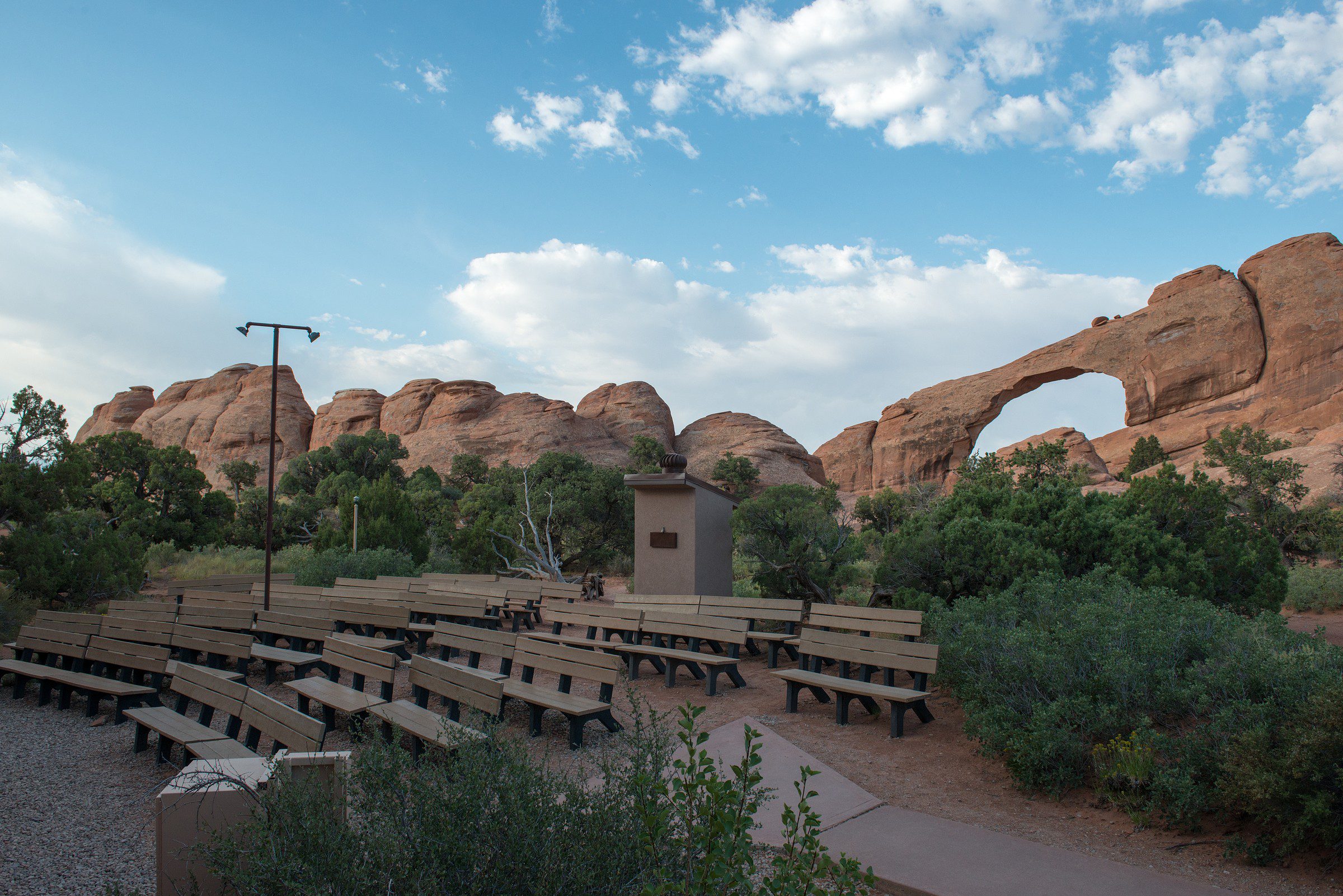
 “Devils Garden Campground Amphitheater …” from naturalatlas.com and used with no modifications.
Devils Garden Campground is the only campsite inside Arches National Park, with just 51 sites that accommodate RVs up to 40 feet — and it books out months in advance during peak season.
- The 43-mile scenic drive through Arches is fully paved and accessible to most RV sizes, with pullouts at major landmarks like Delicate Arch Viewpoint and The Windows Section.
- Spring (March–May) and Fall (September–October) are the best seasons for RV camping at Arches, offering mild temperatures and fewer crowds than the brutal summer heat.
- Timed entry reservations are required from April through October — missing this step could mean turning your RV around at the gate.
- Moab, just 5 miles south of the park entrance, is packed with full-hookup RV resorts that make an excellent base camp when Devils Garden is fully booked.
Over 2,000 sandstone arches carved by millions of years of erosion — Arches National Park is one of those places that genuinely earns its reputation, and exploring it from the seat of an RV might just be the best way to do it.
RVshare, one of North America’s leading RV rental companies, has helped thousands of travelers experience the American Southwest by RV — and Arches is consistently one of the most sought-after destinations on the map. It’s easy to see why. The park sits just off US Highway 191, a few miles north of Moab, Utah, and is one of the most RV-accessible national parks in the country. The main scenic drive is paved, most trailhead parking lots accommodate larger rigs, and the surrounding Moab area is loaded with RV parks and campgrounds at every price point.
Spanning 76,680 acres of red rock terrain in southeastern Utah, Arches National Park welcomed over 1.5 million visitors in recent years — which means planning your RV trip carefully is everything. Nail the timing, lock down your campsite reservations, and understand the timed entry system, and you’ll have one of the most unforgettable outdoor adventures of your life.
Devils Garden Campground: The Only Campsite Inside the Park
If you want to sleep inside Arches National Park itself, Devils Garden Campground is your one and only option — and it’s a spectacular one. Sitting 18 miles from the park entrance at an elevation of 5,200 feet, the campground is surrounded by towering sandstone fins and within walking distance of some of the park’s most iconic trails.
Site Types, Hookups, and RV Size Limits
Devils Garden has 51 total campsites. There are no electrical, water, or sewer hookups — this is dry camping only, so your RV’s onboard tanks and power systems need to be ready to go. The campground accommodates RVs up to 40 feet in length, and the access road to the campground is paved, making entry straightforward for most rigs. Vault toilets are available on-site, and each site includes a picnic table and fire grate.
Water is available at the campground from a central faucet, but supply can be limited during peak season. Fill your tanks before heading in — desert conditions are no joke, and staying hydrated in Utah’s high desert is non-negotiable.
How to Book Before Sites Sell Out
Reservations at Devils Garden go through Recreation.gov, and they open up six months in advance. During spring and fall — the most popular RV camping seasons — sites can be fully booked within minutes of becoming available. For more insights on camping in the region, check out this Canyonlands National Park RVing guide. Also look up information HERE. Here’s the booking breakdown you need to know:
- Reservations open 6 months before your arrival date at 8:00 AM Mountain Time
- A limited number of sites are held for first-come, first-served booking starting 2 days before the arrival date
- Site fees run approximately $25 per night during peak season
- Group sites are available for larger parties
- Cancellations do open up — check Recreation.gov regularly if you missed the initial window
Setting a calendar reminder for exactly six months before your target arrival date and logging on right at 8:00 AM is the best strategy. Competition is real, and hesitating costs you the site.
What to Expect On-Site
Devils Garden delivers on atmosphere in a way that few campgrounds anywhere can match. Waking up surrounded by red rock formations with virtually no light pollution overhead is an experience that stays with you. That said, it’s a primitive setup, so come prepared.
- No hookups of any kind (electric, water, sewer)
- Vault toilets — no flush restrooms or showers
- Potable water available on-site (bring backup)
- Bear boxes not required, but food storage best practices apply
- Generators allowed only during designated hours (typically 8–10 AM and 4–6 PM)
- Quiet hours enforced from 10 PM to 6 AM
The Devils Garden Trailhead is steps from the campground, giving you direct access to Landscape Arch — the longest natural arch in North America at 306 feet — before the day-tripping crowds arrive. That early morning trail access alone is worth every bit of effort it takes to secure a site.
Best RV Parks Near Arches National Park in Moab
When Devils Garden is booked solid — which is most of the time from April through October — Moab is your answer. The town sits just 5 miles south of the park entrance along US-191 and offers a strong lineup of RV parks ranging from basic pull-throughs to full-service resort-style campgrounds. Most are within a 15-minute drive of the Arches entrance, and several are within easy reach of Canyonlands National Park and Dead Horse Point State Park as well.
Moab Valley RV Resort
Located right on the Colorado River with views of the canyon walls, Moab Valley RV Resort & Campground is one of the most well-regarded options in the area. It offers full hookup sites with 30/50 amp service, a swimming pool, Wi-Fi, and pull-through sites that accommodate large rigs with no problem. It’s a popular pick for good reason — the setting is genuinely beautiful, and the amenities make decompressing after a long day on the trails easy.
Canyonlands Campground
Canyonlands Campground sits right in Moab’s downtown area, making it incredibly convenient for grabbing supplies, hitting local restaurants, or exploring the town between park visits. It offers full hookups, laundry facilities, and a pool. Sites here accommodate rigs up to 45 feet, and the walkability to Moab’s main strip is a genuine bonus for those who want a bit of town life mixed into their outdoor adventure. For more tips on exploring the area, check out this Canyonlands National Park RVing guide.
Portal RV Resort
Portal RV Resort is another strong contender, positioned just outside of Moab near the Colorado River. It features full hookups, shaded sites, a pool, and a hot tub — welcome after a demanding desert hike. The resort-style setup makes it particularly appealing for longer stays where comfort is a priority alongside the adventure.
Best Time to Visit Arches National Park in an RV
Timing your Arches trip correctly makes an enormous difference in what kind of experience you’ll have. The park’s desert climate means temperature swings are dramatic between seasons, and crowd levels vary just as sharply. Getting this right is one of the most important parts of planning your RV trip.
- Spring (March–May): Ideal temperatures, wildflowers, peak crowds
- Summer (June–August): Extreme heat above 100°F, busiest season, early starts essential
- Fall (September–October): Best kept secret season — mild, less crowded, stunning light
- Winter (November–February): Cold nights, occasional snow, near-empty trails, no timed entry required
Spring: Peak Season With Perfect Temperatures
March through May brings daytime temperatures ranging from the mid-50s to the mid-70s°F — nearly perfect hiking weather. Wildflowers occasionally bloom across the desert floor, and the light for photography is exceptional. The tradeoff is that spring is also the park’s busiest window, and timed entry reservations are mandatory. Book your Devils Garden site and your entry permit as early as possible if spring is your target.
Summer: Extreme Heat and Crowd Management
Summer at Arches is intense. Temperatures regularly exceed 100°F by midday, and the exposed sandstone radiates heat in a way that makes afternoon hiking genuinely dangerous. That said, it’s still the most visited season — families on summer break and international tourists pack the park daily. If summer is your only option, plan all hikes before 8 AM, carry at least one liter of water per hour of activity, and use your RV as a midday refuge with the AC running. For more tips on exploring national parks, check out our Grand Canyon RVing guide.
Fall: The Hidden Gem Season for RV Travelers
September and October are arguably the best months to visit Arches in an RV, and not enough people know it. Daytime temperatures drop back into the 70s°F, crowds thin out noticeably after Labor Day, and the angle of the autumn sun turns the red rock formations into something that looks almost impossibly vivid. Trail parking lots that were packed by 8 AM in July are manageable by mid-morning in October.
Fall also brings more flexibility with timed entry — availability opens up more frequently as the season winds down. If you can only take one trip to Arches and you have any control over timing, aim for the last two weeks of September or the first two weeks of October. You won’t regret it.
Winter: Solitude on the Red Rocks
Winter is Arches at its most raw and most peaceful. From November through February, the crowds essentially disappear, timed entry permits are not required, and the park takes on an entirely different character. Occasional dustings of snow on the red sandstone create photographic conditions that simply don’t exist any other time of year.
Nighttime temperatures can drop well below freezing, so your RV’s heating system, insulated water lines, and freshwater tank need to be winter-ready. Many of the Moab-area RV parks reduce capacity or close seasonally, so confirm availability before you commit to a winter trip. Those who come prepared, however, get Arches almost entirely to themselves — and that is genuinely rare. For more tips, check out our Canyonlands National Park RVing guide.
The 43-Mile Scenic Drive: What RV Travelers Need to Know
The main road through Arches National Park runs 43 miles round-trip from the entrance to Devils Garden Campground, and the entire route is paved. It’s one of the most spectacular drives in the American national park system — and the fact that it’s fully accessible to RVs makes it even better. Every major landmark in the park is reachable from this single road, either by pullout or short trail, which means you don’t need to unhitch anything or navigate unmarked back roads. For more tips on RVing in national parks, check out this here and at the Canyonlands National Park RVing guide.
Road Conditions and RV Size Restrictions
The scenic drive itself has no official RV length restriction, but practical limitations apply. The road includes some steep grades and sharp switchbacks near the entrance, particularly in the first two miles climbing out of the canyon. RVs over 40 feet should take the entrance switchbacks slowly and with a spotter if possible. The road to Devils Garden Campground at the end of the drive is also paved and manageable for rigs up to 40 feet.
Standard parking lots throughout the park are designed to accommodate RVs up to 40 feet, with pull-through spaces available at several major viewpoints. The Delicate Arch Trailhead, The Windows Section, and Devils Garden Trailhead all have designated RV-friendly parking. Arrive before 9 AM during peak season — by mid-morning in summer and spring, these lots fill completely and overflow parking requires significant backtracking.
Top Pullouts and Viewpoints Worth Stopping At
Every mile of the scenic drive delivers something worth slowing down for, but a handful of stops are truly unmissable for RV travelers. The Windows Section offers two massive arches viewable from a short, flat walk — ideal for all fitness levels. Balanced Rock, located roughly halfway along the drive, has a dedicated pullout and delivers one of the park’s most surreal compositions. Further along, the Delicate Arch Viewpoint gives you a long-distance look at the park’s most iconic feature without the strenuous 3-mile round-trip hike to its base. If you want to stand beneath Delicate Arch itself — and you should — park early and tackle that trail before 7:30 AM in peak season.
Top Things to Do at Arches National Park
Arches rewards every kind of outdoor traveler, from casual walkers who want an easy stroll between canyon walls to serious hikers ready to push into remote backcountry. Add in world-class stargazing and photography conditions, and you have a destination that can easily fill a week of activities without repeating anything.
Best Hikes for Every Fitness Level
The trail system at Arches is remarkably accessible for an RV camping trip, with most trailheads located directly off the main scenic drive. Easy options like the Windows Loop (1 mile, flat) and the Balanced Rock Trail (0.3 miles) are perfect for shorter outings or hiking with kids. The Sand Dune Arch Trail (0.4 miles) leads through narrow sandstone corridors to a sheltered arch sitting in deep, soft sand — a genuinely magical experience that almost feels hidden. You can also find more information here.
For intermediate hikers, the Delicate Arch Trail is 3 miles round-trip with 480 feet of elevation gain across open slickrock — challenging enough to feel earned, but achievable for most fit adults. The Devils Garden Trail to Landscape Arch is 1.6 miles and relatively flat, but extending it to the full primitive loop (7.8 miles) turns it into a serious backcountry adventure through fins and exposed ledges. Start this one early and carry plenty of water.
Fiery Furnace: How to Get a Permit
The Fiery Furnace is a dense labyrinth of narrow sandstone fins that looks, from above, like a maze with no solution. Hiking inside it without a guide requires a self-guided permit, available through Recreation.gov for approximately $10 per person. The permit includes a mandatory orientation video that covers navigation basics and Leave No Trace rules — because getting disoriented in the Fiery Furnace is genuinely easy, even for experienced hikers.
Alternatively, the National Park Service offers ranger-led tours into the Fiery Furnace from spring through fall. These tours are 2–3 hours, cover about 2 miles of terrain, and provide a level of interpretation that makes the experience far richer than exploring solo. Ranger tour spots book up quickly — reserve them through Recreation.gov as early as possible, ideally when you book your campsite.
Stargazing Under a Certified Dark Sky
Arches National Park holds International Dark Sky Park designation from the International Dark-Sky Association, which means light pollution is actively managed and the night sky here is extraordinary. On a clear night away from Moab’s ambient glow, the Milky Way is fully visible to the naked eye, and the combination of star fields above sandstone arches is unlike anything else on earth. For those interested in exploring more of Utah’s stunning landscapes, consider checking out our Canyonlands National Park RVing Guide for additional travel tips.
The Devils Garden Campground area offers some of the best in-park stargazing, simply because you’re 18 miles from the entrance and further from Moab’s light dome. Balanced Rock and the Windows Section are also popular after-dark locations. Bring a red-light headlamp to preserve your night vision, and check the lunar calendar before your trip — a new moon window gives you the darkest possible skies.
Photography Hotspots and Golden Hour Timing
Arches is one of the most photographed landscapes on earth, and for good reason — the red Entrada Sandstone changes color dramatically from golden sunrise to deep amber at sunset. Delicate Arch at sunset is the classic shot, but the hike back in darkness requires a headlamp. The North Window Arch at sunrise frames a perfect view of Turret Arch through its opening, creating a natural frame-within-a-frame composition that photographers travel thousands of miles to capture. Plan your golden hour stops the night before using a sun tracking app like PhotoPills or The Photographer’s Ephemeris.
Essential RV Tips for Visiting Arches National Park
Arches rewards preparation. The combination of desert conditions, high visitor demand, and a timed entry system means that showing up without a plan will cost you time, comfort, and potentially your entire day. These are the five things that separate a smooth Arches RV trip from a frustrating one. For more guidance, check out this RV camping guide for Arches National Park.
None of these tips are complicated — but skipping any one of them in peak season can unravel an otherwise perfect trip. Go through this list like a pre-departure checklist before you leave home.
1. Secure a Timed Entry Permit in Advance
From April through October, Arches National Park requires a timed entry reservation to enter between 7 AM and 4 PM. Without one, you will be turned away at the gate regardless of whether you have a campsite reservation, a hiking permit, or an America the Beautiful pass. The timed entry system was introduced to manage congestion and it is strictly enforced. If you’re planning to visit other parks, check out our Canyonlands National Park RVing guide for more tips.
Timed entry reservations are separate from your campsite booking and cost $2 per vehicle on top of the park entrance fee. They open up through Recreation.gov on a rolling basis — some slots release months in advance, while a portion are released the day before at 7 AM Mountain Time. The day-before release is your best opportunity if you’re planning last-minute.
A few key situations where timed entry is not required can be found in this Arches National Park guide.
- Entering before 7 AM or after 4 PM
- Visitors with a confirmed Devils Garden Campground reservation
- Travelers visiting during the winter season (November through March)
- Vehicles entering for a pre-reserved Fiery Furnace ranger tour
2. Stock Up on Water Before Entering the Park
There are no stores, gas stations, or restaurants inside Arches National Park. The only potable water inside the park is at Devils Garden Campground, and supply there can be limited during peak season. For RV travelers, this means filling your fresh water tank completely in Moab before entering — and carrying additional bottled water reserves on top of that.
3. Arrive at Trailheads Before 8am in Peak Season
Parking at Arches fills up fast — and that’s not an exaggeration. During spring and summer, the Delicate Arch Trailhead, Devils Garden Trailhead, and The Windows Section parking lots routinely reach capacity before 9 AM. Once a lot is full, rangers close access and you’re left circling or waiting, which burns time and fuel in your RV with nowhere productive to be.
The simplest fix is to set your alarm and get moving early. Being on trail by 7:30 AM means you beat the crowds, get the best light for photos, and avoid the worst of the midday heat all in one move. If you’re staying at Devils Garden Campground, this is especially easy — the trailhead is right at your doorstep.
4. Keep Generators Quiet During Designated Hours
At Devils Garden Campground, generators are only permitted during two windows: 8–10 AM and 4–6 PM. Quiet hours run from 10 PM to 6 AM. This isn’t just a courtesy rule — it’s enforced, and violations can result in being asked to leave. Plan your power usage and battery charging around these windows, and consider a solar charging setup if your RV supports it. The desert sun at Arches National Park will keep your panels working hard all day.
5. Follow Leave No Trace Principles on All Trails
The cryptobiotic soil crust that covers much of Arches’ desert floor is a living organism — a fragile black crust made of cyanobacteria, fungi, and algae that takes decades to form and can be destroyed by a single footstep off the trail. Staying on designated paths isn’t just a rule here, it’s genuinely critical to protecting the ecosystem. The park’s “stay on the rock or established trails” principle applies everywhere.
Pack out everything you bring in, including food scraps and orange peels — decomposition in the desert is extremely slow and attracting wildlife to camp areas creates serious problems. Campfires are only permitted in the fire grates provided at Devils Garden, and fire bans go into effect during dry conditions, which are common throughout summer and fall. For more tips on RV camping in Arches National Park , check out this site, and for exploring national parks, check out our Grand Canyon National Park RVing tips.
- Never step on dark cryptobiotic soil crust — stay on rock or trail
- Pack out all waste including food scraps and fruit peels
- Use only designated fire grates; check current fire restrictions before lighting
- Keep pets on a leash at all times and on paved surfaces or bare rock only
- Do not move or stack rocks — natural formations are protected
- Human waste must be packed out on backcountry routes using WAG bags
Arches sees over a million visitors a year, and the pressure that puts on a fragile desert ecosystem is enormous. The difference between a visitor who follows Leave No Trace and one who doesn’t is the difference between a landscape that survives and one that doesn’t. For more tips on exploring Aches National Park, checkout this site, and for national parks, check out this Canyonlands National Park RVing Guide.
These principles aren’t bureaucratic box-checking — they’re what keeps Arches looking like Arches for the next generation of RV travelers who deserve the same experience you’re having right now.
Renting an RV for Arches: What You Need Before You Go
Not everyone arrives at Arches in their own rig, and renting an RV is one of the most practical ways to experience the park if you’re flying into Salt Lake City, Denver, or Las Vegas. Several national RV rental companies operate pickup locations within driving distance of Moab, making it straightforward to collect your vehicle and head straight for red rock country.
Cruise America operates RV rental locations across the Southwest with fleet options that work well for the Arches road trip experience. Their standard Class C motorhomes fall within the 25–30 foot range, which fits comfortably at Devils Garden Campground and navigates the entrance switchbacks without drama. Booking early during peak season is essential — rental availability mirrors campsite availability, and both disappear fast.
Click HERE for more information on RV rentals near Arches National Park, Arches National Park hiking trails, and things to do outside Arches National Park, RV resorts and Campsites near Arches National Park, and to find the best dump station near Arches National Park.
RV Size Recommendations for Park Roads
For Devils Garden Campground specifically, the hard limit is 40 feet. In practical terms, rigs in the 25–32 foot range are the sweet spot for Arches — they fit in every parking lot, handle the entrance grade comfortably, and are maneuverable enough to navigate the campground loops without stress. If you’re towing a trailer, factor your combined length carefully and keep the total under 40 feet.
Must-Have Gear and Supplies for the Desert
Desert camping requires a gear list that’s different from almost any other environment. The combination of intense sun, low humidity, and dramatic temperature swings between day and night means you need to prepare for two completely different conditions within the same 24-hour period.
Before heading to Arches, make sure your RV and gear kit includes all the essentials for a smooth trip. For more detailed tips, check out this Canyonlands National Park RVing guide.
- Full fresh water tank plus at least 4 extra gallons of bottled water per person
- High-SPF sunscreen (SPF 50+) and UV-protective clothing for open slickrock hikes
- Electrolyte supplements — dehydration hits fast and quietly at elevation in dry heat
- Headlamp with red-light mode for stargazing and early morning trailheads
- Trekking poles for the Devils Garden primitive loop and Delicate Arch slickrock sections
- Portable shade structure or awning for campsite afternoon relief
- 30 and 50 amp adapters if staying at Moab-area RV parks with varying hookup standards
- WAG bags if venturing into any backcountry routes beyond marked trails
One item that’s easy to forget but critical in the desert: a quality surge protector for your RV’s electrical hookup. Power at some Moab campgrounds can spike, and protecting your onboard systems costs far less than replacing them mid-trip. If you’re unsure about the power requirements, learn more about 30 and 50 amp adapters to ensure compatibility.
Arches Fits Perfectly Into a Larger Southwest Road Trip
Arches sits at the center of one of the greatest RV road trip corridors in North America. Within a two-hour drive, you have Canyonlands National Park to the southwest, Dead Horse Point State Park just 30 miles from Moab, Capitol Reef National Park roughly 2.5 hours west, and Mesa Verde National Park about 2.5 hours east into Colorado. A 10–14 day Southwest loop that connects Arches, Canyonlands, Capitol Reef, Bryce Canyon, and Zion gives you one of the most iconic RV itineraries on the continent — and Moab makes the perfect anchor point to begin or end that journey.
Frequently Asked Questions
Planning an RV trip to Arches raises a consistent set of questions, especially around campsite availability, entry permits, and vehicle restrictions. The logistics here are more involved than at many other national parks — but they’re entirely manageable once you understand the system.
Here are the answers to the questions that come up most often from RV travelers heading to Arches for the first time.
Can You Camp Inside Arches National Park With an RV?
Yes. Devils Garden Campground is the only campground inside Arches National Park, and it accommodates RVs up to 40 feet in length. The campground has 51 sites, offers no hookups (dry camping only), and provides potable water and vault toilets. Reservations are made through Recreation.gov and open six months in advance — book as early as possible for spring and fall visits.
Do You Need a Permit to Drive Into Arches National Park?
From April through October, a timed entry reservation is required to enter Arches between 7 AM and 4 PM. This is separate from your campsite reservation and costs $2 per vehicle on top of the standard park entrance fee ($35 per vehicle or covered by America the Beautiful pass). Reservations open on Recreation.gov months in advance and also release in smaller batches the day before at 7 AM Mountain Time.
What Is the Maximum RV Length Allowed at Devils Garden Campground?
The maximum RV length at Devils Garden Campground is 40 feet. This applies to the total length of your vehicle, including any tow vehicle and trailer combination. The access road to the campground is paved and manageable for rigs up to this limit.
If your RV exceeds 40 feet, you’ll need to base yourself at one of the Moab-area RV parks and make day trips into the park. Options like Moab Valley RV Resort and Portal RV Resort can accommodate larger rigs and offer full hookups as a comfortable alternative. For more tips on maintaining your RV, check out this complete guide to RV maintenance.
Are There Full Hookup RV Sites at Arches National Park?
No. Devils Garden Campground offers no electrical, water, or sewer hookups of any kind. All camping inside the park is dry camping. For full hookups, you’ll need to stay at one of the private RV parks in Moab, where options like Canyonlands Campground and Moab Valley RV Resort offer 30/50 amp service with water and sewer connections.
How Far Is Moab From Arches National Park?
Moab is approximately 5 miles south of the Arches National Park entrance along US Highway 191. The drive from downtown Moab to the park gate takes roughly 10 minutes under normal traffic conditions. For those planning a broader trip, consider checking out RVing tips for Grand Canyon National Park.
During peak season, however, the entrance road can back up significantly — especially during the timed entry window opening at 7 AM. Leaving Moab by 6:30 AM gives you enough buffer to reach the gate comfortably without sitting in a line of vehicles all trying to enter at the same time.
From Salt Lake City, Arches is approximately 235 miles southeast — about a 3.5-hour drive via I-15 South and US-6 East to US-191 South. From Las Vegas, the drive is roughly 430 miles and takes approximately 5.5 to 6 hours through St. George and along US-191. Both routes are entirely RV-friendly on major highways with regular fuel and service stops along the way.
Whether you’re rolling in from Salt Lake, Denver, or Vegas, the approach into Moab through the canyon corridor on US-191 is a preview of the red rock world you’re about to spend the next few days exploring — and it sets the tone perfectly for everything Arches has to offer.