Safety note: This guide is general information, not professional driving instruction. Always follow your RV owner’s manual, posted signs and local traffic laws, and check your state’s license rules for your vehicle. If you can, take a hands-on RV driving course before your first big trip. See our full disclaimer at the end of this article.
Driving an RV (recreational vehicle) for the first time can feel like steering a small house down the highway. It is longer, taller and much heavier than your car, and it reacts more slowly to everything you do. The good news: RV driving is a skill anyone can learn. With some preparation, a few hours of practice in an empty parking lot and the habits in this guide, most beginners feel noticeably more comfortable after their first few trips.
We have pulled our best first-time RV driving tips into one complete guide, from the checks to do before you leave the dealer or rental lot to backing into your first campsite.
Key Takeaways
- Know your numbers. Write down your RV’s exact height, length, width and weight and keep them by the driver’s seat.
- Practice first. Spend a few hours in a large, empty parking lot before you drive in real traffic.
- Slow everything down. Brake early, turn wide, change lanes gradually and leave a large gap to the vehicle ahead.
- Use the right tools. An RV-specific GPS (Global Positioning System) navigator, a backup camera and a tire pressure monitor prevent many common accidents.
- When in doubt, get out and look. There is no shame in stopping to check a tight spot.
Why an RV Drives Differently From a Car
Everything about an RV is bigger, and that changes how it behaves on the road.
- Weight: Many motorhomes weigh 10,000 to 30,000 pounds or more. More weight means more momentum, so it takes much longer to speed up and much longer to stop.
- Height: Many RVs stand roughly 10 to 13.5 feet tall once you count the air conditioner and antennas. Gas station canopies, drive-thrus, tree branches and low bridges all become hazards.
- Width: Most RVs are about 8 to 8.5 feet wide, not counting the mirrors. That leaves little room to spare in a standard 12-foot highway lane.
- Length: RVs run from about 20 feet for a small Class C to over 40 feet for a large Class A motorhome. A longer vehicle needs wider turns and has a bigger “tail swing” (explained below).
- Wind: A tall, flat-sided RV catches crosswinds and the air pushed by passing trucks, so expect to make small steering corrections.
Inside, you are also carrying a home’s worth of belongings. Anything that is not secured can slide during turns and stops, which can damage the interior and even affect handling.
Before You Drive Off the Lot: The Walkthrough
Whether you are buying or renting, the dealer or rental company should give you a walkthrough of the RV before you leave. This is your best chance to ask questions, so do not rush it. Ask them to show you, on your RV:
- How to adjust every mirror, including any convex (“fish-eye”) mirrors, and how the backup camera works.
- The RV’s exact height, length and weight ratings, including the GVWR (Gross Vehicle Weight Rating, the maximum safe loaded weight).
- How to check the tires and how old they are. The last four digits of the DOT (Department of Transportation) code on the sidewall show the week and year the tire was made, so “2122” means the 21st week of 2022.
- How the steps, slide-outs, awning and leveling jacks retract, and which warning lights tell you something is still out.
- For towable RVs: how to hitch and unhitch, connect the safety chains and breakaway cable, and set the trailer brake controller.
- Where the main propane valve, battery disconnect and generator controls are.
Take photos or a short video on your phone as they explain each item. It is much easier to remember later.
Pre-Drive Checks Before Every Trip
A written checklist is one of the best habits a new RV driver can build. Go through it slowly every single time, even when you are excited to get going. Our free RV Pre-Departure Safety Checklist covers the full list. The most important driving-related items are:
- Tires: check pressure while the tires are cold (before driving) and look for cracks or bulges on the sidewalls.
- Walk-around: walk all the way around the RV. Confirm that steps are up, the awning and slide-outs are in, compartment doors are locked, the TV antenna is down and roof vents are closed.
- Inside: latch cabinets and the fridge door, and put away anything loose on counters and tables.
- Towables: check the hitch, safety chains, breakaway cable and that the trailer’s brake lights and turn signals work.
- Mirrors and seat: adjust them before you start moving, not on the road.
Make a Dimensions Card
Write your RV’s exact height, length, width and weight on a card and keep it where you can see it from the driver’s seat. Measure the height yourself to the highest point on the roof, including the air conditioner, antennas and any satellite dish you have added. When you see a clearance sign, give yourself at least 6 inches of extra margin. New pavement or snow can make the real clearance lower than the sign says.
Set Your Mirrors Correctly
In most RVs you cannot see out of the back through a center rearview mirror, so your side mirrors (and backup camera) are how you see behind you. Adjust the flat mirrors so you can just see the side of your RV and the lane beside you. Then set the convex mirrors to cover the blind spots next to the front of the RV.
Practice in an Empty Parking Lot First
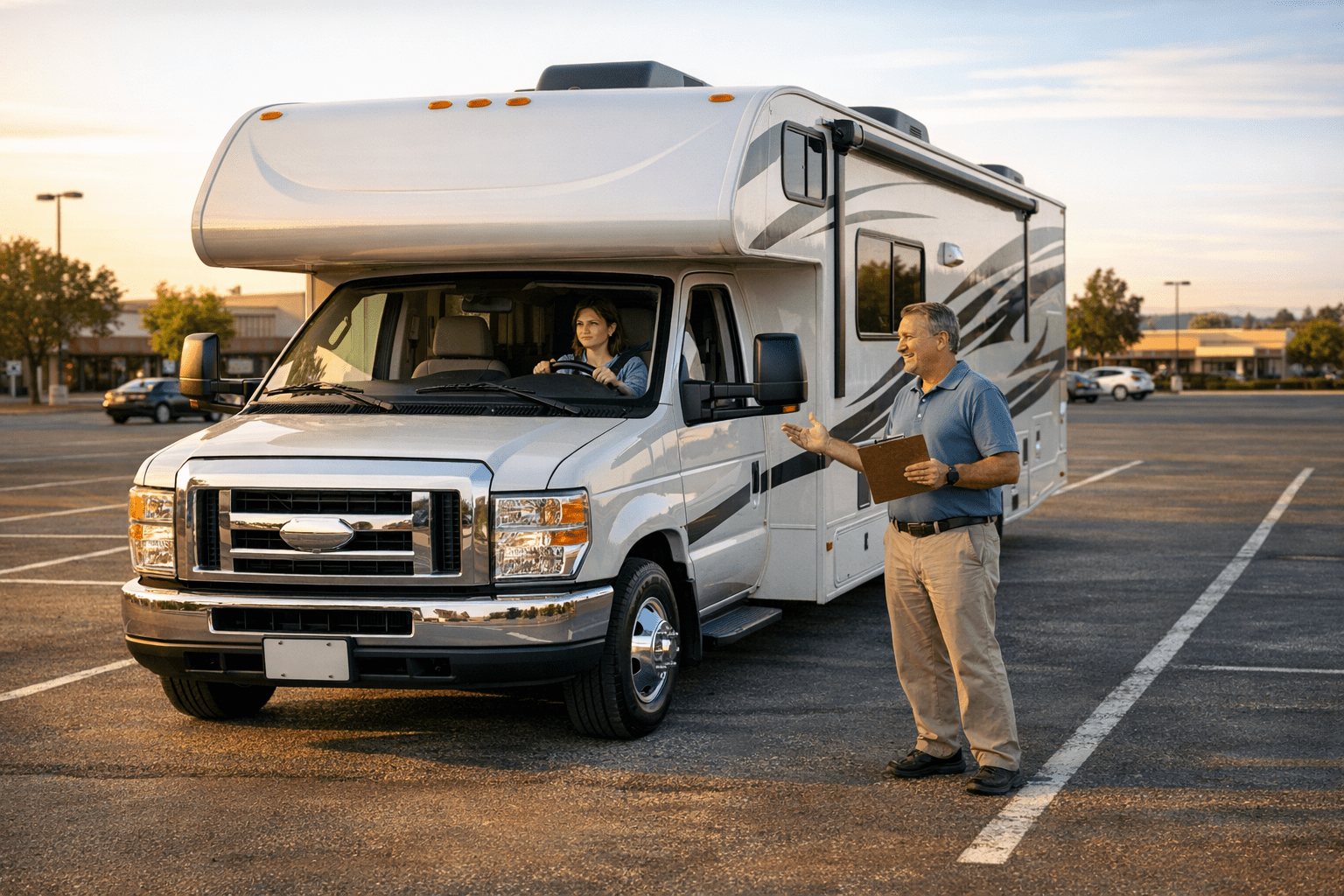
Before you drive in traffic, spend a few hours getting to know your RV in a big, empty space. Many experienced RVers recommend at least two to three hours of practice for a first-timer. Ask permission before using a private lot, and bring a patient friend to act as your spotter. Use cones, empty jugs or other soft markers you will not mind hitting.
Work through these drills in order:
- Straight lines and gentle stops. Drive slowly in a straight line and get used to the seating position and how the RV responds. Practice smooth stops from 5 mph (miles per hour), then 15 to 20 mph, and notice how far the RV keeps rolling.
- Right and left turns. Set up a “corner” with cones and practice 90-degree turns. Watch in your mirrors how the rear wheels track inside the front wheels.
- Lane changes. Use the parking lines as lanes. Signal, check your mirrors, and move over gradually.
- A firm stop from about 20 to 25 mph. Not a panic stop, just firmer than usual, so you feel how the weight shifts forward.
- Backing in a straight line. Back slowly along a parking line using only your mirrors. Then practice backing into a “space” marked with cones.
Understand Pivot Point and Tail Swing
An RV turns around its rear axle, which is called the pivot point. Because the rear wheels follow a tighter path than the front wheels, you need to drive farther into an intersection before you turn, or your rear wheels will clip the curb.
Tail swing is the opposite problem. On a motorhome with a long overhang behind the rear wheels, the back corner swings outward in the opposite direction of your turn. Turn right, and the left rear corner swings left. Before turning out of a tight spot, check that nothing (a gas pump, pole or parked car) is close to the side opposite your turn.
Turning, Braking and Changing Lanes
Brake Early and Gently
Start braking much earlier than you would in a car, especially before intersections and exit ramps. Use light pressure first and then gradually press harder. Smooth braking is safer, keeps your belongings from shifting forward and is easier on your brakes.
Take Turns Wide and Slow
For a right turn, stay in your lane but keep toward its left side as you approach. Drive forward until your front wheels are past the corner, then turn. Watch the right-side mirror the whole way to make sure your rear wheels clear the curb. Never swing into another lane unless it is clear and legal to do so.
Change Lanes Deliberately
Signal early, give other drivers several seconds to notice, check both mirrors and then move over gradually. Your blind spots are much bigger than in a car, so a passenger can help confirm the lane is clear. A simple way to know you have passed a vehicle safely: wait until you can see the whole front of that vehicle, including both headlights, in your side mirror before moving back over.
On the Highway
Leave a Big Following Distance
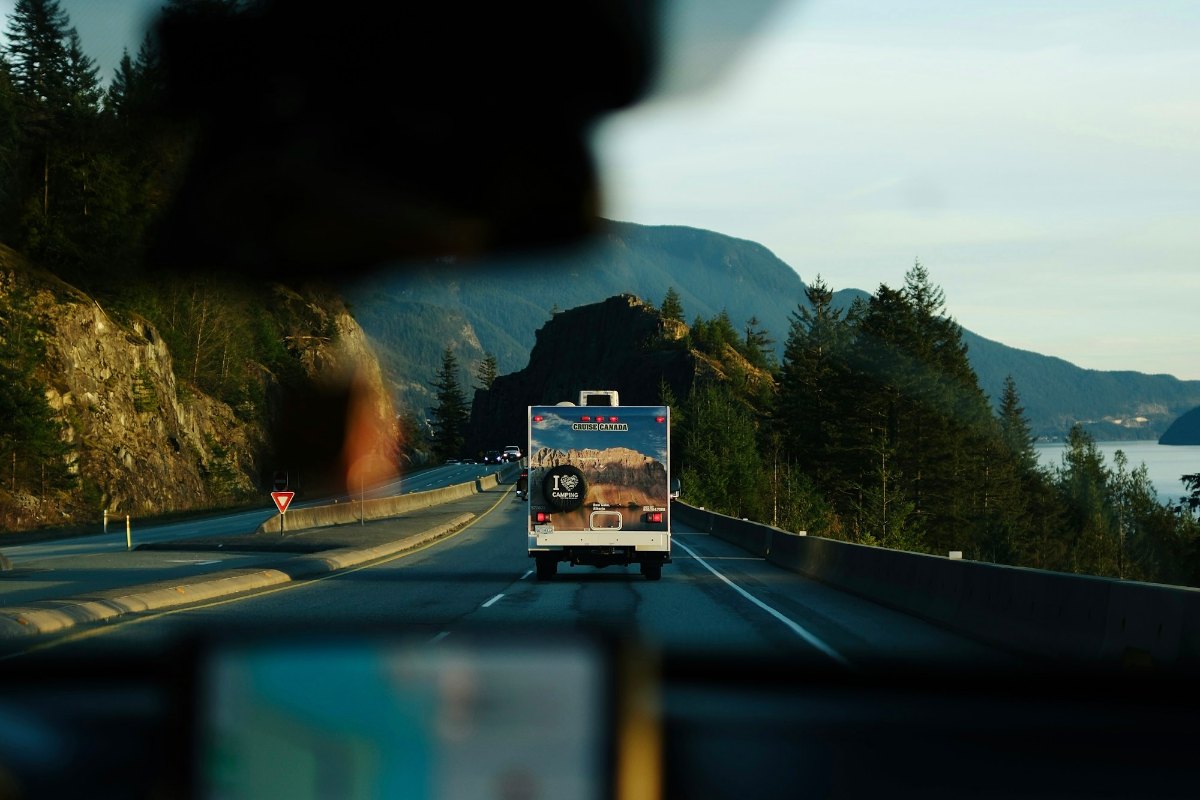
Keep at least 4 to 6 seconds between you and the vehicle ahead, and more in rain, wind or heavy traffic. To measure it, pick a sign or bridge the vehicle ahead passes and count the seconds until you reach it. Look far down the road so you see slowdowns early.
Pick a Lane and Stay in It
The right lane is usually the best place for an RV: you can drive at a steady speed and let faster traffic pass. Use the left lanes only to pass or when signs require it, and move back right afterwards. Stay centered in your lane. Many new drivers drift toward the right edge because the RV feels so wide, which can put your tires off the pavement.
Choose a Comfortable Speed
Many RVers cruise at around 60 to 65 mph even where the limit is higher. It gives you more time to react, improves fuel economy and reduces the effect of crosswinds. Also check your tires: many trailer tires (marked “ST” on the sidewall) are rated for a maximum of 65 mph, so look at the tire’s speed rating before you set your cruising speed.
Merging Onto the Highway
Use the full on-ramp to build up speed, but accept that you may not reach highway speed, especially on short or uphill ramps. Signal early, look for a gap and adjust your speed to fit into it. Never force your way in.
Hills and Mountain Grades
Going uphill, your RV may slow down a lot, sometimes to 45 mph or less on long, steep grades. That is normal. Move to the right lane, turn on your hazard lights if you are going well below the speed of traffic and watch your engine temperature gauge.
Going downhill is where new drivers get into trouble. Slow down before the descent starts and shift to a lower gear. A common rule is to use the same gear going down that you would need to climb the same hill. This lets the engine help hold your speed (called engine braking). If your RV has an exhaust brake, use it as your manual describes. Brake firmly in short bursts rather than riding the brakes the whole way down. If the brakes feel soft or you smell burning, pull over in a safe spot and let them cool.
Wind, Rain and Bad Weather
RVs are affected by weather far more than cars. Check the forecast, including wind, before every travel day, and be willing to wait a day if conditions look bad.
- Wind: slow down, keep both hands on the wheel and make small corrections. Be ready for a push when a large truck passes you or when you leave the shelter of trees or a hillside. Many experienced RVers park and wait out gusts above roughly 30 mph, and lighter or taller RVs may need to stop sooner. Check your manufacturer’s guidance.
- Rain: slow down, double your following distance and turn on your headlights. Worn or underinflated tires make hydroplaning (sliding on a layer of water) more likely.
- Snow and ice: as a beginner, avoid driving an RV on snow or ice altogether.
- Parked in wind: point the front of the RV into the wind if you can, and bring in the awning and slide-outs when strong winds are forecast.
Tricky Spots: Fuel Stops, Drive-Thrus and Cities
Fuel Stops
Choose truck stops or large stations with high canopies and room to pull straight through. Drive past first if you can to see the entrance, exit and pump layout. Pull up so the pump is on the same side as your fuel cap, and leave enough room to turn out when you leave. Check the posted canopy height against your dimensions card.
Skip the Drive-Thru
Drive-thru lanes are built for cars. Tight turns and low overhangs make them risky for almost any RV. Park at the edge of the lot and walk in instead.
City Driving and Low Clearances
Plan city driving for quiet times, such as early weekend mornings, and use ring roads or bypasses to avoid downtown streets when you can. Watch for low clearances that cars never think about: parking garage entrances, bank drive-thrus, building awnings and tree branches. Some tunnels also restrict vehicles carrying propane, so check your route ahead of time. If you cannot complete a turn safely, stop, use your hazard lights and take your time. A few minutes of blocked traffic is better than a damaged RV.
Backing Up and Using a Spotter
Backing up is the skill most new RVers worry about. These tips help:
- Hand at the bottom of the wheel. For trailers, put your hand at the bottom of the steering wheel while backing. Move your hand in the direction you want the back of the trailer to go.
- Small corrections. Turn the wheel a little, back a few feet, then check. Big steering movements cause zigzagging or, with a trailer, a jackknife.
- Pull forward and reset. If the angle is wrong, pull forward to straighten out and try again rather than over-steering.
- GOAL: Get Out And Look. Even experienced RVers stop and walk around during a tricky back-in.
Agree on Signals With Your Spotter
A spotter is a huge help, but only if you both use the same signals. Agree on them before you start. Your spotter should always stay where you can see them in your mirror. If you lose sight of them, stop. Many couples also use inexpensive two-way radios, such as the Motorola Talkabout T210 two-pack, or a phone call on speaker, because engine noise makes shouting useless.
| Signal | Meaning |
|---|---|
| Crossed arms or a raised flat palm | Stop now |
| Waving you back with both hands | Keep backing straight |
| Pointing left or right | The direction the back of the RV should move |
| Hands held apart, like showing the size of a fish | How much room is left behind you. If the spotter’s hands are about 3 feet apart, you have about 3 feet left. They bring their hands closer as you get closer, and when the palms touch, stop. |
| Palm facing down, moving slowly lower | Slow down |
Arriving at the Campground
Arrive in daylight whenever possible. Call ahead to confirm your site fits your RV, and tell the campground you are new. Many will happily give you an easier site or someone to help.
Start With Pull-Through Sites
For your first few trips, book pull-through sites so you can drive straight in and straight out. Pull far enough forward that your whole RV is off the campground road. Before you set up, check that your slide-outs and awning will clear trees, posts and the picnic table, and that your hookups reach.
Backing Into a Site, Step by Step
- Park at check-in and walk to your site first. Look for posts, low branches, hookups and the fire ring.
- Drive slowly past the site so the back of your RV ends up just beyond it.
- With your spotter in view, back slowly toward the site, turning so the rear of the RV aims into it.
- Make small corrections, stop often, and pull forward to reset whenever the angle is off.
- Once in place, level the RV. Our guide to RV leveling blocks explains how. Remember that stabilizer jacks steady the RV but are not designed to lift or level it.
Tech Tools That Make RV Driving Easier
- RV-specific GPS: regular car navigation does not know your height or weight and can send you under a low bridge. RV navigators let you enter your dimensions and route around restrictions. Options include a dedicated Garmin RV GPS navigator or the RV Life trip planner and GPS app. Always obey posted signs over any app.
- Backup camera: makes reversing far less stressful, especially in Class A motorhomes. Many newer RVs come pre-wired for a Furrion camera (check your owner’s manual or look for a small mounting bracket high on the back of the RV). If yours is, a plug-and-play option like this Yakry wireless RV backup camera is an easy upgrade. For trailers or RVs without pre-wiring, a magnetic wireless backup camera attaches in minutes with no wiring.
- TPMS (Tire Pressure Monitoring System): sensors on each tire warn you about low pressure or overheating before a tire fails. Many RVers consider it one of the most valuable safety upgrades. The TST 507 TPMS is a long-time favorite among RVers, and the Tymate TM7 is a lower-cost way to start. Make sure the system you choose covers every tire on your RV (and any towed vehicle) and the tire pressures you run. See our list of RV safety tools for options.
- Dash cam: records what happens on the road if you ever need it for insurance. Our RV dash cam guide explains how to set one up.
Your First Trip: Start Small
For your first outing, pick a campground one to two hours from home, on roads without heavy traffic or steep mountain grades. Think of it as a “shakedown” trip: you will practice driving and setting up camp, and you will find out what you forgot to pack while home is still close.
Plan shorter driving days than you would in a car. Many RVers follow the 3-3-3 rule: drive no more than about 300 miles a day, arrive by 3 p.m. and stay at least three nights. Take a break every two to three hours to stay alert, and expect the trip to take noticeably longer than it would by car.
Frequently Asked Questions
Do I need a special license to drive an RV?
In most states, a regular driver’s license is enough for most RVs used for personal travel. A few states require a special non-commercial license for larger rigs. For example, California requires a non-commercial Class B license with a housecar endorsement for motorhomes over 40 feet long, and Texas requires a non-commercial Class A or B license for RVs rated over 26,000 pounds. You do not usually need a CDL (Commercial Driver’s License) for a personal RV. Rules change, so check with your state’s DMV (Department of Motor Vehicles) before you buy or rent a large RV.
How long does it take to feel comfortable driving an RV?
Everyone is different, but most beginners feel much more confident after a few hours of parking-lot practice and their first few short trips. Driving in many different conditions (highways, hills, towns and campgrounds) builds skill fastest. Remember that every experienced RVer was once a nervous beginner.
What should I do if a tire blows out while I am driving?
Do not slam on the brakes. Hold the steering wheel firmly with both hands and keep the RV going straight in your lane. Ease off the gas and let the RV slow down gradually. Once you have control and have slowed down, brake gently, signal and pull completely off the road. To help prevent blowouts, check tire pressure before every trip, use a TPMS, and replace RV tires by age (often every 5 to 7 years, or as the tire maker recommends) even if the tread looks fine.
What if I feel overwhelmed while driving?
It happens to almost everyone. Signal and pull over at the next safe place, such as a rest area or large parking lot. Take a break, have some water and give yourself time. There is no deadline. Shorter driving days and avoiding rush hour and bad weather make a big difference while you are learning.
Is an RV driving course worth it?
For many beginners, yes. Hands-on courses teach turning, backing and emergency skills with an instructor beside you, which builds confidence quickly. Some RV insurance companies offer a discount for completing a recognized course, so ask your insurer.
Disclaimer
The information provided is for educational purposes only. Before carrying out any maintenance or safety task on your RV, please do your own further research so you are fully confident in each step. If you are ever unsure, consult a qualified RV professional or get a second opinion. Readers are responsible for their own safety, and PreciousRV.com accepts no liability for any injury, loss or damage.