Key Takeaways
- RV steps are often too steep and narrow for dogs — especially seniors, large breeds, or dogs with joint issues — making a dedicated ramp or step upgrade essential for safe travel.
- The PetSafe Happy Ride Telescoping Dog Ramp is the top overall pick, offering adjustable length, a high-traction surface, and a 150 lb weight capacity for most breeds.
- Not all ramps work for all RVs — matching ramp length to your RV’s step height is the single most important buying decision you’ll make.
- Senior and arthritic dogs have a clear winner — one tri-fold ramp on this list is specifically built for dogs with mobility issues, and the difference is significant.
- You don’t always need a ramp — for some dogs, upgrading your RV’s existing steps is a better, more permanent fix than any portable ramp on the market.
If your dog hesitates at the RV door every single trip, the problem isn’t your dog — it’s the steps.
RVing with dogs is one of the great joys of life on the road. But the moment your adventure starts — right at the RV entrance — things can get tricky fast. Standard RV steps were designed with humans in mind, not four-legged passengers. For dogs, especially older ones or larger breeds, those steep, narrow, sometimes wobbly steps can be genuinely dangerous. A good RV dog ramp or step upgrade doesn’t just make entry easier — it protects your dog’s joints, prevents falls, and makes the whole trip less stressful for both of you. Resources like Trailblazer RV highlight how pet safety on the road starts before you even hit the highway.
This guide breaks down the best RV dog ramps and step solutions available, with real specs, honest trade-offs, and clear recommendations based on dog size, mobility, and your specific RV setup.
Your Dog Shouldn’t Have to Struggle to Get Into Your RV
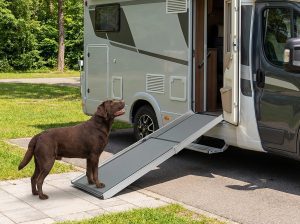
Every time your dog jumps down from a high RV step, the impact travels straight into their joints. For a 60-pound dog, that repeated stress adds up quickly — and for senior dogs or breeds prone to hip dysplasia like German Shepherds or Golden Retrievers, it can accelerate serious joint damage. A ramp or step upgrade removes that impact entirely by giving your dog a gradual, controlled path in and out of the RV.
The fix is simpler than most RV owners expect, and the options range from under $50 to purpose-built step systems that bolt onto your RV permanently.
Quick Reference: Ramp vs. Step Upgrade at a Glance
Solution Type Best For Portability Price Range Telescoping Ramp Most dogs, versatile use High $60–$120 Folding Ramp Large breeds, frequent use Medium $80–$150 Tri-Fold Ramp Small dogs, tight storage Very High $50–$100 RV Step Upgrade All dogs, permanent solution None $150–$400+ Add-On Step Platform Dogs that prefer stairs Low–Medium $100–$250
Why Standard RV Steps Fail Dogs
Standard RV steps typically rise 9 to 12 inches per step — significantly steeper than the 7-inch rise recommended for residential staircases. They’re also narrow, often made of slick metal or plastic, and in many RVs, they retract automatically, which can create a startling or unsafe experience for a dog mid-climb. For those new to RVs, understanding RV driving basics can help ensure a safer and more enjoyable journey for you and your pets.
Small dogs face a proportionally massive climb with each step. A 10-pound Dachshund navigating a 10-inch RV step is the human equivalent of stepping onto a 30-inch ledge repeatedly. That’s not just uncomfortable — it puts real strain on the spine and hips, which is especially damaging for breeds already prone to intervertebral disc disease.
Large dogs present a different problem. Their size and weight make the steps feel unstable, and a misstep on a wet or worn RV step can send a 90-pound Labrador tumbling. The risk isn’t theoretical — it’s one of the most common causes of travel-related pet injuries reported by RV owners.
Ramp vs. Steps: Which Is Right for Your Dog?
The answer depends on three things: your dog’s size, their mobility, and how your specific RV is configured. Ramps are the most flexible solution — they work for nearly every dog and every RV. Steps or step upgrades tend to be more convenient for humans sharing the same entrance but require a dog that’s comfortable with a stair-climbing motion. For those new to RVs, consider checking out this beginner guide to RV driving to ensure a smooth journey for you and your pet.
Dogs with hip dysplasia, arthritis, or post-surgical recovery needs almost always do better on a ramp. The continuous incline keeps their movement smooth and reduces joint stress. Dogs that are young, healthy, and just finding the existing steps too steep or slippery may benefit more from a step upgrade or traction cover.
If your RV door sits higher than 24 inches from the ground — which is common in Class A and Class C motorhomes — a longer telescoping or folding ramp is your most practical option. For smaller travel trailers or fifth wheels with lower entry points, even a compact tri-fold ramp gets the job done. If you’re interested in exploring more about different motorhome options, check out this Forest River Georgetown motorhome for a detailed review.
1. PetSafe Happy Ride Extra Long Telescoping Dog Ramp — Best Overall
The PetSafe Happy Ride Extra Long Telescoping Dog Ramp earns its top spot by doing everything well without overcomplicating the design. It extends from 39 inches up to 71 inches, making it compatible with a wide range of RV heights. The surface is covered in a high-traction material that grips dog paws effectively, even when wet.
Key Specs & Weight Capacity
- Extended length: 39″ to 71″
- Width: 11.5 inches
- Weight capacity: 150 lbs
- Ramp weight: Approximately 11 lbs
- Surface: High-traction, easy-clean material
- Safety feature: Built-in security tether attachment point
What Makes It Stand Out
The telescoping design is the real advantage here. Instead of folding in half like most ramps, it slides open and closed like a telescope — which means there’s no hinge in the middle creating a weak point or an uneven walking surface. Your dog gets a completely flat, uninterrupted incline from bottom to top.
The built-in tether attachment is a thoughtful safety addition. You can secure the ramp to your RV door handle or frame, which prevents the ramp from sliding out from under your dog during use — a real problem with cheaper ramps on uneven campsites.
Best For: Which Dogs Benefit Most
This ramp is the strongest all-around choice for medium to large dogs between 30 and 150 lbs. It also works well for senior dogs who need the longest possible ramp angle to keep the incline as gentle as possible. At 71 inches fully extended, it creates a very walkable slope even for RVs with entry points 24 to 28 inches off the ground.
2. PetSTEP Folding Pet Ramp — Best for Large Dogs
If you have a large or giant breed dog, the PetSTEP Folding Pet Ramp is in a category of its own. Most dog ramps cap out at 150 to 200 lbs — the PetSTEP is rated to support up to 500 lbs, which means it’s built for even the largest Great Danes, Saint Bernards, and Mastiffs without any flex or instability.
Key Specs & Weight Capacity
- Length: 62 inches (open)
- Width: 16 inches
- Weight capacity: 500 lbs
- Ramp weight: 18.5 lbs
- Surface: Non-slip rubber composite
- Fold style: Bi-fold (folds in half)
Why the 500 lb Weight Limit Is a Game-Changer
Weight limits on dog ramps aren’t just about the dog — they’re about structural integrity under dynamic load. When a large dog trots up a ramp, the force on the surface is significantly higher than the dog’s static weight. A ramp rated at only 150 lbs may technically hold a 90-pound dog, but it will flex, bounce, and feel unstable — which causes many dogs to hesitate or refuse the ramp entirely.
The PetSTEP’s 500 lb rating comes from its rigid plastic composite construction. There’s almost no flex when a large dog walks across it, which creates a confident, stable experience that encourages even hesitant dogs to use it consistently. The 16-inch width is also wider than most competitors, giving large breeds enough room to walk naturally without their paws hanging off the edges. For those traveling with pets, it’s essential to consider RV driving tips to ensure a safe journey.
3. Pet Gear Travel Lite Dog Ramp — Best Lightweight Option
Storage space in an RV is always at a premium, and the Pet Gear Travel Lite Dog Ramp was built with that reality in mind. Its tri-fold design compresses the ramp into roughly one-third of its open length, making it easy to slide under a bed, into a cabinet, or behind a seat.
- Tri-fold design for ultra-compact storage
- Lightweight enough for one-handed carry and setup
- Carpet-like surface for secure paw grip
- Rubber feet that grip the ground and prevent sliding
- Side rails for added security on both edges
Key Specs & Weight Capacity
- Length: 56 inches (open)
- Width: 16 inches
- Weight capacity: 150 lbs
- Ramp weight: Approximately 12 lbs
- Surface: Carpet with rubber feet
- Fold style: Tri-fold
Portability vs. Durability Trade-Off
The Travel Lite lives up to its name — it’s one of the easiest ramps to move, store, and set up repeatedly. The trade-off is that the carpet surface, while excellent for traction, can collect mud, dirt, and pet hair quickly. On extended camping trips where your dog is going in and out multiple times a day, the surface will need regular cleaning to maintain grip performance. For those planning to explore the best RV beach campgrounds on the East Coast, having a reliable ramp like this is essential.
For RV owners with small to medium dogs who prioritize packability and ease of setup over heavy-duty construction, the Pet Gear Travel Lite is a genuinely excellent option. It’s not built for giant breeds, but for dogs under 100 lbs it performs reliably across different RV types and entry heights.
4. EZ-Access Suitcase Trifold Portable Ramp — Best for Senior Dogs
Senior dogs need more than just a ramp — they need confidence. A surface that shifts, flexes, or feels unstable underfoot will cause an older dog to freeze mid-ramp, which can actually be more dangerous than the original step. The EZ-Access Suitcase Trifold Portable Ramp solves this with an aluminum construction that feels completely solid under paw, even for dogs moving slowly and deliberately.
This ramp wasn’t originally designed for pets — it was built for wheelchair and mobility aid users, which tells you everything about its build quality. The structural integrity is in a completely different league from standard pet ramps, and that rigidity is exactly what an arthritic or post-surgical dog needs to build trust with a ramp.
Key Specs & Weight Capacity
- Length: Available in 5 ft and 6 ft options
- Width: 26 inches (significantly wider than most pet ramps)
- Weight capacity: 800 lbs
- Ramp weight: Approximately 18–22 lbs depending on length
- Surface: Textured aluminum with raised grid pattern
- Fold style: Trifold with carry handle
The 26-inch width is nearly double what most dog ramps offer. For large senior dogs like aging Labradors or Golden Retrievers who may have balance issues, that extra width gives them the freedom to shift their weight without risking a misstep off the edge. The raised grid surface pattern on the aluminum provides grip without the maintenance problems of a carpet surface. If you’re considering an RV trip, check out these beginner tips for RV driving to ensure a smooth journey.
At 800 lbs weight capacity, this ramp will outlast every dog you’ll ever own. The aluminum construction resists rust, warping, and UV degradation — which matters when you’re storing equipment in an RV compartment through temperature extremes across different climates.
Why Tri-Fold Design Helps Arthritic and Older Dogs
Arthritic dogs often struggle most with the transition from flat ground onto a ramp surface. A bi-fold ramp creates a slight angle change at the fold point when set up — subtle to humans, but noticeable to a dog with joint sensitivity. The EZ-Access trifold design distributes the fold points differently, resulting in a flatter, more consistent walking surface when fully open.
The low angle of incline is the other major benefit for senior dogs. At 6 feet long and positioned against a standard RV entry point, the ramp angle stays gentle enough that an older dog can walk up with minimal hip extension — which is exactly the movement that causes pain in dogs with hip dysplasia or lumbar arthritis.
The main drawback is weight. At 18 to 22 lbs, it’s heavier than most pet ramps. If you’re an RV owner managing this setup solo, that’s worth factoring in. But for senior dog owners who prioritize safety and stability above everything else, no other ramp on this list comes close.
5. Torklift Glow Step Revolution — Best RV Step Upgrade
The Torklift Glow Step Revolution takes a completely different approach to the RV entry problem. Instead of adding a ramp to your existing steps, it replaces your RV’s factory steps entirely with a wider, more stable, better-designed stair system. For dogs that are comfortable with stairs but struggling with the specific failures of standard RV steps — narrowness, wobble, slick surfaces — this is the most permanent and satisfying fix available. For more information on RV dog ramps, check out our detailed guide.
Torklift designed these steps primarily for human safety, but the features that make them better for people make them dramatically better for dogs too. The steps are wider, have a deeper tread, and use a spring-assist mechanism that eliminates the bounce and wobble common in factory RV steps.
Key Specs
- Material: Aircraft-grade aluminum
- Step width: Wider than OEM RV steps (varies by RV model)
- Weight capacity: 1,000 lbs per step
- Lighting: Built-in LED step lighting (the “Glow” feature)
- Compatibility: Fits most Class A, B, and C motorhomes and travel trailers
- Installation: Replaces existing factory step system
How It Solves the Wobbly RV Step Problem
Factory RV steps flex and bounce because they’re built to a weight and cost minimum. The Torklift Glow Step Revolution uses aircraft-grade aluminum and a spring-counterbalance system that makes each step feel as solid as a residential staircase. When a dog puts weight on the step, there’s no movement — and that stability is what gives hesitant dogs the confidence to use stairs rather than requiring a ramp. For those considering an upgrade, it may be helpful to compare features and prices of different recreational vehicles to find the best fit for your needs.
Why This Works Better Than a Ramp for Some Dogs
Dogs that have always used stairs comfortably but started hesitating at the RV entrance are usually reacting to step instability or slickness — not the stair format itself. For these dogs, a ramp can actually introduce new anxiety because it’s an unfamiliar surface requiring training. A step upgrade keeps the familiar motion while removing the problem.
The built-in LED lighting is a genuinely useful feature for dogs and owners navigating the RV entrance in low light. Dawn departures, late-night bathroom trips in a dark campground, or early morning hikes all become safer when your dog can see exactly where to place each paw.
The obvious limitation is cost and permanence. The Torklift Glow Step Revolution is a significant investment compared to any portable ramp, and installation requires some mechanical confidence or a professional. It’s not a solution for renters or those who switch RVs frequently. But for full-time RVers or long-term owners with dogs that prefer steps, it’s worth every dollar.
6. RV-Co Port-A-Steps — Best Add-On Step Platform
Port-A-Steps sit in an interesting middle ground — they’re not a replacement step system, and they’re not a ramp. Instead, they attach directly to your existing top RV step to create a wider, more gradual stair approach. The result is a multi-step system with a platform at the top that makes the final transition into the RV significantly easier for both dogs and humans.
- Attaches to existing RV steps without permanent modification
- Creates a more gradual incline than standard RV stairs
- Wide platform steps accommodate all dog sizes
- Can be removed and stored when not needed
- Works for both dogs and people sharing the same entrance
The real advantage of Port-A-Steps over a ramp is convenience for multi-use households. When you have humans and dogs constantly going in and out of the RV, a ramp needs to be moved out of the way for human traffic. Port-A-Steps stay in place and work equally well for both — which in practice means you’ll actually use them consistently rather than skipping the setup on short stops.
They work particularly well for dogs that have already been trained on stairs and simply need the steps to be wider and less steep. The transition from ground to RV interior happens in multiple smaller steps rather than one large jump or a long ramp walk, which many dogs find more intuitive. For those new to RVs, here’s a beginner guide to RV driving to ensure a smooth journey.
Key Specs
- Attachment: Clips onto existing top RV step
- Material: Heavy-duty plastic with non-slip surface
- Compatibility: Works with most standard RV step configurations
- Step width: Wider than standard factory RV steps
- Setup: Tool-free attachment and removal
How Port-A-Steps Attach to Existing RV Stairs
The attachment mechanism hooks over the lip of your RV’s existing top step, then locks in place without any tools or drilling. Setup takes about 60 seconds, and removal is equally fast. The steps hang in front of your existing staircase, effectively extending it downward with wider, more gradual treads. The attachment point needs to be compatible with your specific step width and profile, so checking fit before purchasing is important — most standard RV steps are compatible, but some proprietary step designs may not work.
7. RV Step Covers — Best Budget Fix for Slippery Steps
If your dog’s issue isn’t the height of the steps but the slickness of the surface, RV step covers are the most affordable and immediate fix available. These are textured rubber or carpet covers that grip directly onto existing RV steps, transforming a slippery metal or plastic tread into a high-friction surface your dog can actually grip confidently.
Quality RV step covers typically use either rubber diamond-plate texturing or an indoor-outdoor carpet material, both of which provide meaningful traction improvement over bare steps. They’re secured with adhesive strips, hook-and-loop fasteners, or wrap-around grips depending on the design. At a fraction of the cost of any ramp or step upgrade, they’re worth trying first if your dog seems capable on the steps but hesitates due to sliding. The main limitation is that they don’t address step height or stability — they only improve surface grip, which means they’re a partial solution for most dogs but a complete solution for young, healthy dogs dealing with a purely traction-related issue.
How to Pick the Right RV Dog Ramp
Choosing the right RV dog ramp comes down to four variables: your RV’s entry height, your dog’s weight, the surface traction quality, and how easily you can set it up and put it away on a real camping trip. Getting one of these wrong means the ramp either doesn’t fit, fails under load, causes your dog to slip, or gets left in a storage compartment after the first use.
1. Match the Ramp Length to Your RV Height
The entry height of your RV determines the minimum ramp length you need to keep the incline manageable. A ramp that’s too short for your RV height creates a steep angle that defeats the entire purpose — it’s harder on joints than the original steps. As a general rule, for every 12 inches of entry height, you want at least 24 to 30 inches of ramp length to maintain a safe, comfortable slope. A 24-inch entry height needs a minimum 48-inch ramp, and ideally 60 inches for senior or mobility-compromised dogs. Measure your RV entry height from the ground to the door threshold before purchasing any ramp.
2. Check the Weight Limit Before You Buy
Never buy a ramp based on your dog’s static weight alone. When a dog walks, trots, or makes a sudden movement on a ramp, the dynamic force applied to the surface can be significantly higher than their standing weight. A ramp rated at exactly your dog’s weight will flex, feel unstable, and likely fail sooner than expected. Always choose a ramp with a weight capacity at least 25 to 50 percent higher than your dog’s actual weight.
This matters even more for large and giant breeds. A 110-pound Rottweiler needs a ramp rated for at least 150 to 175 lbs minimum — and ideally more. The PetSTEP Folding Pet Ramp‘s 500 lb capacity isn’t overkill for large dogs; it’s the reason the ramp feels rock-solid underfoot, which is what actually convinces a large, cautious dog to use it confidently.
3. Look for High-Traction Surfaces
Traction is everything. A ramp with a slippery surface is more dangerous than no ramp at all, because a dog that starts to slide mid-ramp can panic, twist, and fall in a way that causes serious injury. Look for surfaces with raised texture patterns, rubber grip material, carpet, or aluminum grid designs. Test the surface yourself with your hand — if it feels slick to you, it will feel slick to your dog’s paws, especially when wet or muddy.
Some ramp surfaces perform well when dry but become hazardous in rain or after a muddy trail walk. If you camp in variable weather conditions, prioritize ramps with rubber or aluminum grid surfaces over carpet, which can become compacted and lose grip over time. The EZ-Access Suitcase Trifold’s raised aluminum grid pattern is one of the most weather-resistant traction surfaces available across all the options on this list.
4. Consider How Often You’ll Set It Up and Pack It Away
The best ramp is the one you actually use every single time. A heavy, complicated ramp that takes two minutes to set up and requires two people to move will get skipped on quick stops, short hikes, and bathroom breaks — and those are exactly the moments when your dog is most at risk of a rushed, clumsy jump down from the RV entrance. Choose a ramp that one person can deploy and pack away in under 30 seconds, even if it means accepting a slightly lower weight capacity or shorter length.
Training Your Dog to Use an RV Ramp
Even the best ramp in the world is useless if your dog won’t walk on it. Most dogs don’t automatically understand a ramp — it’s an unfamiliar surface, at an angle, leading to a destination they usually jump to. Expect to spend two to five short training sessions introducing the ramp before your dog uses it confidently and independently. That’s a small time investment for years of safer entries and exits.
Step-by-Step Introduction Process
Start with the ramp flat on the ground. Let your dog sniff it, walk across it, and get comfortable with the surface texture before it’s ever elevated. Reward every interaction with high-value treats — real chicken or cheese works better than kibble here. Once your dog is walking across the flat ramp without hesitation, prop one end up just a few inches and repeat. Gradually increase the incline over multiple sessions until you reach your actual RV entry height.
The key is never rushing the process. Placing a nervous dog on a fully elevated ramp and trying to lure them across creates a negative association that can take weeks to undo. Let the dog set the pace, keep sessions under five minutes, and always end on a successful rep. Most dogs are confidently using a ramp at full height within three to five sessions when this approach is followed.
What to Do If Your Dog Refuses the Ramp
Ramp refusal almost always comes from one of three things: the surface feels unstable, the incline is too steep, or the dog had a previous negative experience with the ramp. Start by checking whether the ramp is flexing or wobbling when your dog steps on it — even slight movement can cause a cautious dog to shut down. If the ramp surface is solid and the angle is gentle, go back to basics with the flat-on-ground introduction process regardless of how far along in training you think your dog is.
For dogs with a deeply established ramp refusal, try switching the entry direction — some dogs find it easier to learn going down the ramp first, from the RV to the ground, rather than up. The downward direction feels more natural to many dogs and builds the surface confidence they need to attempt the upward climb. Pair every successful step with immediate, enthusiastic reward, and never use force or pressure to move a dog onto a ramp they’re resisting.
The Right Ramp Makes RV Travel Better for Everyone
An RV dog ramp isn’t an accessory — it’s a safety tool that protects your dog’s joints, prevents falls, and removes one of the most consistent stress points in life on the road. The right choice depends on your dog’s size and mobility, your RV’s entry height, and how your daily routine actually works when you’re camping. A senior dog with arthritis needs a completely different solution than a healthy two-year-old Border Collie, and a full-time RVer has different priorities than a weekend camper.
Use the specs, weight limits, and trade-offs in this guide to match the solution to your actual situation rather than buying the most popular option by default. Your dog will tell you pretty quickly whether you got it right — a dog that walks up and down the ramp without hesitation, every single time, is the only performance metric that matters.
Frequently Asked Questions
Here are answers to the most common questions RV owners have when choosing a dog ramp or step solution for their rig. For more information, see which models might best accommodate your pet’s needs.
What Size RV Dog Ramp Do I Need?
The size RV dog ramp you need depends on your RV’s entry height. Measure from the ground to your RV door threshold, then multiply by at least 2.5 to get your minimum recommended ramp length. A 20-inch entry height needs at least a 50-inch ramp, while a 28-inch entry height needs 70 inches or more for a safe, comfortable incline.
For senior dogs or dogs with joint issues, increase that multiplier to 3 or higher to make the slope as gradual as possible. The PetSafe Happy Ride Telescoping Ramp extends to 71 inches, which covers most standard RV entry heights with a comfortable angle for even mobility-compromised dogs.
Can Small Dogs Use the Same Ramps as Large Dogs?
Small dogs can use most ramps rated for large dogs, but width matters. A ramp that’s only 11 to 12 inches wide can feel precarious for a small dog if they can see the ground on both sides — some small breeds become anxious on narrow surfaces at height. Look for ramps with raised side rails or edges if you have a small or toy breed, as the visual boundary on both sides gives them significantly more confidence on the ramp surface.
Are Dog Ramps Better Than Steps for RVs?
Dog ramps are better than steps for most dogs, particularly seniors, large breeds, and dogs with joint conditions, because the continuous incline eliminates the repetitive impact of stair climbing. Each step down from an elevated RV stair puts a concentrated force load on a dog’s front legs, shoulders, and spine — a ramp distributes that load across the entire movement instead.
That said, steps are better for some dogs — specifically younger, healthy dogs that are already comfortable with stairs and would require significant ramp training. In those cases, upgrading to a quality step system like the Torklift Glow Step Revolution solves the real problem, which is step quality rather than step format. The right answer depends entirely on your individual dog.
How Do I Stop My Dog From Slipping on RV Steps?
The most immediate fix for slippery RV steps is adding rubber or carpet step covers to each tread. These grip directly onto existing steps and provide immediate traction improvement without any permanent modification to your RV. Most step covers are secured with adhesive strips or wrap-around fasteners and can be installed in under five minutes.
If step covers aren’t enough — or if your steps are also unstable or too steep — the next step up is either a quality folding ramp with a high-traction surface or a permanent step upgrade. The Torklift Glow Step Revolution addresses both slickness and instability simultaneously, making it the most complete solution for dogs that genuinely prefer stairs over ramps but are being failed by their current step setup.
Can Senior or Injured Dogs Use RV Ramps Safely?
Yes — in fact, a ramp is often the only safe option for senior or post-surgical dogs. The key is choosing a ramp with a gentle enough incline, a completely stable surface with no flex, and strong traction that doesn’t require the dog to grip aggressively with every step. The EZ-Access Suitcase Trifold Portable Ramp is specifically recommended for this category of dog due to its 800 lb rated aluminum construction, 26-inch width, and raised grid traction surface.
For dogs recovering from orthopedic surgery — ACL repair, femoral head ostectomy, or spinal procedures — consult your veterinarian before introducing any ramp. Some post-surgical dogs need restricted movement for a defined period before ramp use is appropriate, and the incline angle may need to be specifically approved based on the type of surgery performed.
Once cleared for ramp use, go slowly with the introduction process. Post-surgical dogs may have reduced proprioception — the sense of where their limbs are in space — which makes the unfamiliar surface of a ramp more challenging than it would be for a healthy dog. Short sessions, maximum positive reinforcement, and a ramp with excellent grip and zero flex will get even a recovering dog using their ramp safely and confidently within a few sessions.
Traveling with your furry friend can be a delightful experience, but ensuring their safety and comfort is crucial. One essential accessory for pet owners who love to travel in their RVs is a dog ramp. These ramps make it easier for your dog to get in and out of the vehicle without any strain or risk of injury. If you’re looking for the best options, consider exploring RV dog ramps that cater to various needs and preferences.