RV Travel at the Grand Canyon: What You Need to Know Before You Go
- The South Rim is open year-round and is the most RV-friendly entry point, while the North Rim is only accessible from May through October.
- Trailer Village RV Park is the only full-hookup campground inside Grand Canyon National Park, accommodating RVs up to 50 feet with 30 and 50-amp service.
- RV parking inside the park is limited to three designated lots — arrive before 9 a.m. to guarantee a spot during peak season.
- Booking campsites well in advance is critical, especially for summer visits when Mather Campground and Trailer Village fill up months ahead.
- There’s a lot more to navigating the Grand Canyon by RV than just showing up — from size restrictions to shuttle systems, the details make or break the trip.
The Grand Canyon is one of those places that genuinely earns the hype — and exploring it from an RV makes the experience even better. Grand Canyon trip planners will tell you that getting here is half the adventure, especially when your home is rolling right along with you.
At over 277 miles long and a mile deep, this park demands more than a quick day visit. An RV gives you the freedom to stay close, move at your own pace, and wake up just minutes from one of the most dramatic landscapes on Earth. With the right preparation, it’s one of the most rewarding road trips you can make.
The Grand Canyon by RV: Why It’s Worth Every Mile
Most national park experiences require you to book a hotel months out, fight for shuttle seats, and feel rushed. RV travel flips that entirely. You bring your own schedule, your own kitchen, and your own bed. At a destination as massive and varied as the Grand Canyon, that flexibility is genuinely valuable.
The park’s South Rim stays open 365 days a year, meaning shoulder season visits in spring and fall offer cooler temperatures, thinner crowds, and golden light that photographers chase. Winter visits are surprisingly magical — snow dusting the canyon rim with far fewer people competing for the view.
North Rim vs. South Rim: Which One Is Right for Your RV Trip?
This is the first real decision every Grand Canyon RV traveler faces, and it matters. The two rims sit about 10 miles apart as the crow flies but are over 200 miles apart by road. They offer completely different experiences in terms of elevation, amenities, crowd levels, and seasonal access. For more detailed information on planning your trip, check out these RV tips for the Grand Canyon.
South Rim: Open Year-Round With Full Amenities
The South Rim is where the majority of the park’s 6 million annual visitors head — and for good reason. It sits at roughly 6,800 feet in elevation and offers the most developed infrastructure for RV travelers, including the only full-hookup RV park inside the national park boundary. Historic lodges, multiple trailheads, museums, ranger programs, and the free shuttle system all operate from here. If this is your first Grand Canyon RV trip, the South Rim is your starting point.
North Rim: Seasonal Access From May Through October
The North Rim sits at over 8,000 feet in elevation, which means it gets significantly more snow and closes every year around mid-October, reopening in mid-May. It draws far fewer visitors, which is exactly its appeal. The landscape feels wilder, the views from Point Imperial and Cape Royal are jaw-dropping, and the campground has a genuinely remote feel.
- North Rim Campground offers RV sites but has no hookups and a 30-foot length limit for some sites
- The nearest full-service town is Jacob Lake, about 44 miles away
- The road to the North Rim (AZ-67) is a two-lane highway through dense ponderosa pine forest
- Cell service is extremely limited on the North Rim — download offline maps before you arrive
- The North Rim lodge, camp store, and visitor facilities close for the season in mid-October
The North Rim is best suited for experienced RV travelers who are self-sufficient and looking for solitude over convenience.
Road Conditions and Elevation Differences to Plan Around
Both rims sit at high elevation, so engine strain is a real consideration for larger diesel pushers and gas-powered Class A rigs. Desert View Drive on the South Rim is generally smooth and RV-accessible, but Hermit Road — the western scenic drive — is restricted to the park shuttle system from March through November. Plan around this if you were hoping to drive the rim yourself. For more travel tips, check out our RVing guide.
Where to Camp With Your RV at the Grand Canyon
Camping options range from full-hookup luxury inside the park to dispersed dry camping on Bureau of Land Management land just outside the boundary. Knowing your choices before you book makes a significant difference in both your experience and your budget. For more information on campgrounds, check out RVezy campgrounds in the area and Kampgrounds of America RV campsites.
Here’s a side-by-side look at the main campground options for RV travelers:
| Campground | Location | Hookups | Max RV Length | Reservations |
|---|---|---|---|---|
| Trailer Village RV Park | South Rim (inside park) | Full (30 & 50-amp, water, sewer) | 50 feet | Required |
| Mather Campground | South Rim (inside park) | None | 30 feet | Recommended |
| Desert View Campground | East South Rim (inside park) | None | 30 feet | First-come, first-served |
| North Rim Campground | North Rim (inside park) | None | Varies by site | Required |
Each campground has a distinct personality and serves a different type of traveler. Here’s what you actually need to know about each one.
Trailer Village RV Park: The Only Full Hookup Option Inside the Park
Trailer Village is operated by a concessioner rather than the National Park Service, which means it books separately from other park campgrounds. It accommodates RVs up to 50 feet in length with 30 and 50-amp electrical service, water connections, and sewer hookups — a rare combination inside a national park. Situated right in Grand Canyon Village on the South Rim, you’re within walking distance of the rim itself, the shuttle stops, and park services. This is the most convenient in-park option for larger rigs and those who need full utilities. For more information, check out these RVing tips for the Grand Canyon.
Book as early as possible. Summer dates at Trailer Village can fill up months in advance, and there’s limited walk-up availability during peak season.
Mather Campground: A Budget-Friendly Alternative
Also located in Grand Canyon Village, Mather Campground is run by the National Park Service and offers 327 sites for tents and RVs without any electrical hookups. The maximum RV length is 30 feet, and flush toilets, drinking water, and a nearby general store are available. It’s the more affordable option and still puts you right in the heart of the South Rim action. Reservations are strongly recommended from spring through fall and can be made through Recreation.gov.
Desert View Campground: For Those Who Want Solitude
Located 25 miles east of Grand Canyon Village near the East Entrance, Desert View Campground operates on a first-come, first-served basis and sits at a quieter end of the park. Sites accommodate RVs up to 30 feet, and while there are no hookups, the campground has restrooms and is close to the Desert View Watchtower — one of the most photographed structures in the entire park. If you’re entering from the East Entrance off Highway 64 and want to avoid the busier Village area, this is a genuinely appealing option. For those planning a broader trip, check out this RV events guide to enhance your journey.
Outside the Park: Tusayan and Valle RV Options
Just one mile south of the South Entrance on Highway 64, the town of Tusayan is the most convenient outside-the-park base for RV travelers. The Grand Canyon Camper Village in Tusayan offers full hookup sites with 30 and 50-amp service, and being just minutes from the park entrance makes it a practical alternative when in-park sites are fully booked. Valle, about 30 miles south, offers even more budget-friendly options with a quieter, more remote feel — though you’ll trade convenience for cost savings.
4 Essential RV Tips for the Grand Canyon
The difference between a frustrating Grand Canyon RV trip and an unforgettable one almost always comes down to preparation. These four tips address the most common pain points RV travelers face at this park and will save you real time and stress on the ground. For more detailed advice, check out these RV tips for the Grand Canyon.
1. Arrive Before 9 a.m. to Secure RV Parking
The National Park Service is direct about this: if you’re driving an RV into the park, get there before 9 a.m. Once the three designated RV parking lots fill up, you will not find overflow options. The park was not designed with large vehicle overflow in mind, and rangers actively manage traffic during peak hours. An early arrival also rewards you with the best light for canyon photography and quieter trails before the midday crowds descend.
2. Use the Free Shuttle System Instead of Driving Rim Roads
Once you’ve parked your RV in one of the designated lots, leave it there and use the park’s free shuttle system to get around. The Grand Canyon shuttle network covers the South Rim extensively, with routes connecting the Visitor Center, Grand Canyon Village, Hermit Road viewpoints, and the Kaibab Trail corridor. Hermit Road is closed to private vehicles from March through November — the shuttle is your only option for reaching those western viewpoints during that period.
The shuttle runs frequently during peak season, typically every 15 to 30 minutes depending on the route. It’s genuinely efficient, stress-free, and lets you focus on the views instead of navigating a large rig on narrow park roads.
3. Book Reservations Far in Advance, Especially for Summer
Grand Canyon campground reservations through Recreation.gov open six months in advance, and popular dates at Trailer Village and Mather Campground can be claimed within hours of becoming available. Summer weekends and holiday weekends are the first to go. If you’re planning a July Fourth visit or a Labor Day trip, set a calendar reminder for the exact six-month mark and book the moment the window opens.
For those who prefer a more spontaneous approach, shoulder season travel in April, May, September, and October dramatically increases your chances of finding available sites — and the weather during those months is far more comfortable for hiking and outdoor activities anyway.
4. Know Your RV Size Limits Before You Enter the Park
Size restrictions at the Grand Canyon are enforced, not suggested. Mather Campground, Desert View Campground, and North Rim Campground all have a 30-foot maximum length limit. Only Trailer Village accommodates RVs up to 50 feet. Beyond campground limits, certain park roads and pullouts have turning radius and clearance restrictions that can make navigating a 40-foot Class A genuinely difficult. Measure your rig including any tow vehicle before you plan your route, and check the NPS website for current road condition updates before entering.
RV Parking Inside Grand Canyon National Park
Parking an RV inside Grand Canyon National Park requires knowing exactly where you’re allowed to go — and where you aren’t. The park roads were largely developed long before the age of modern oversized recreational vehicles, and the infrastructure reflects that. Not every scenic pullout or viewpoint lot can handle a 35-foot motorhome, and attempting to squeeze into an undersized space creates real problems for other visitors and park staff.
The good news is that the three designated RV lots on the South Rim are well-positioned. From any one of them, you’re a short shuttle ride from virtually every major attraction on the South Rim. Parking your rig once and using the shuttle system is genuinely the most efficient way to experience the park. For those planning to explore more RV camping options, consider checking out RVezy campgrounds in the area and Kampgrounds of America RV campsites for additional locations.
If you arrive and the designated RV lots are full, rangers will redirect you. There is no secondary overflow system for large vehicles, which is why the pre-9 a.m. arrival recommendation from the NPS carries real weight — it’s not a suggestion made casually.
The Three Designated RV Parking Lots on the South Rim
RV parking on the South Rim is restricted to three specific locations: the Grand Canyon Visitor Center Lot 1, the Market Plaza parking area, and the Backcountry Office lot in Grand Canyon Village. Each connects directly to the shuttle system, making them genuinely useful staging points rather than just storage spots for your rig.
The Visitor Center Lot 1 is typically the first stop for new arrivals and places you steps from Mather Point — the most iconic canyon overlook on the South Rim and an easy walk along the paved Rim Trail. Starting here gives you immediate visual payoff right after parking.
Rules for Oversized Vehicles at Viewpoints
Most individual viewpoint pullouts along Desert View Drive are not designed for RVs longer than 22 feet. Attempting to pull a 38-foot fifth wheel into a standard viewpoint lot is both a safety hazard and a quick way to receive a citation from park rangers. The NPS is specific about this, and enforcement increases during summer months when traffic is heaviest.
The practical workaround is simple: use the shuttle. Every major viewpoint along both Hermit Road and the Village area is served by the free shuttle routes, meaning you lose nothing by leaving your RV in a designated lot. In fact, you gain the ability to hop on and off at multiple stops without the stress of maneuvering a large vehicle each time.
For Desert View Drive, the eastern scenic road, some larger pullouts can accommodate RVs — but always check the posted length limit signs at each entrance before pulling in. When in doubt, the shuttle or a tow vehicle is the safer call.
Best Activities to Pair With Your Grand Canyon RV Trip
The canyon itself is the headline act, but the surrounding experience offers far more than rim views. From world-class hiking to some of the darkest skies in the American Southwest, there’s enough here to fill a week without repeating yourself.
The beauty of arriving by RV is that early mornings and late evenings — the best times for almost every activity listed below — are effortlessly accessible when you’re camped just minutes from the rim.
Hiking Bright Angel Trail and Rim Trail
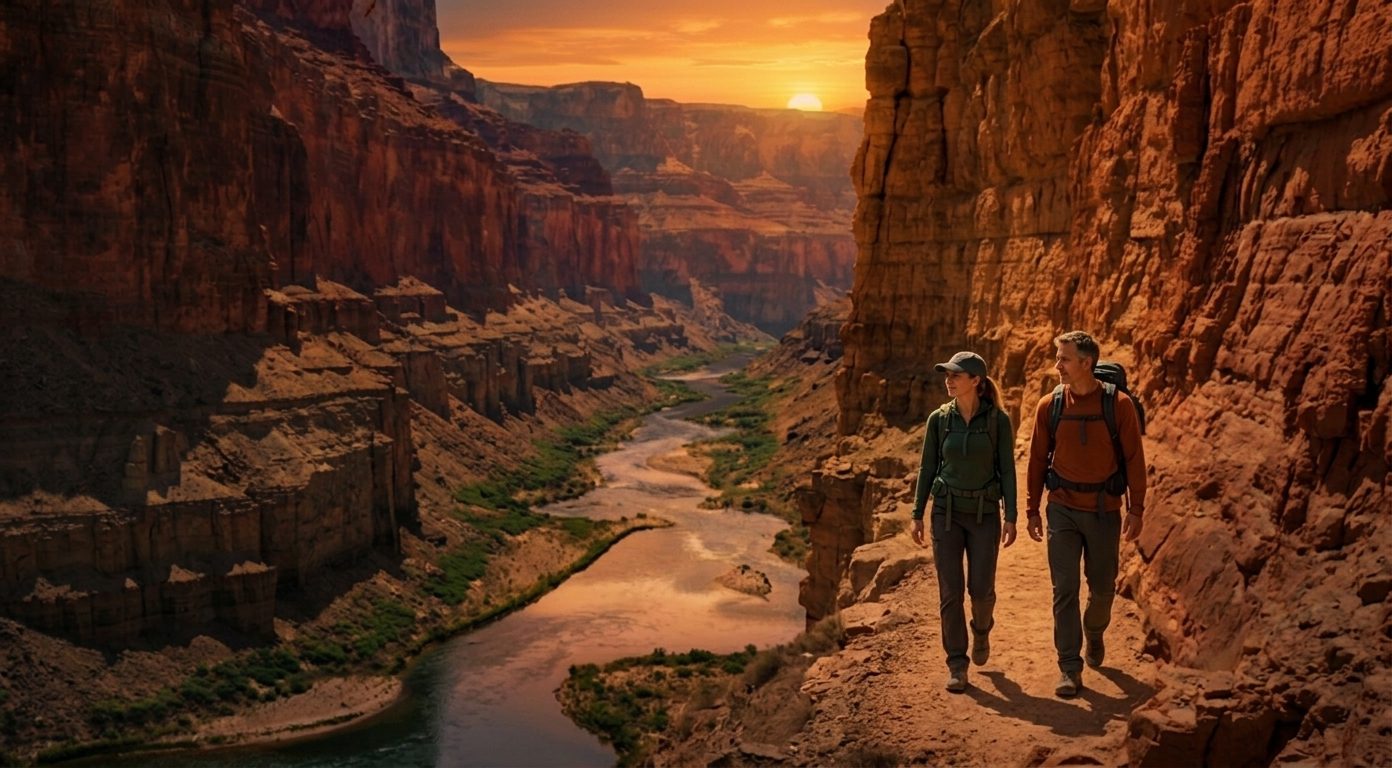
Bright Angel Trail is the most accessible and well-maintained trail dropping into the canyon from the South Rim, starting right at Grand Canyon Village — walking distance from Trailer Village and Mather Campground. Most RV travelers tackle the first 1.5 miles down to the Mile-and-a-Half Resthouse, which offers water during summer months and a genuine taste of inner canyon terrain without committing to a full descent. The trail is paved near the top, clearly marked, and manageable for most fitness levels with proper hydration.
The Rim Trail is the perfect complement — a mostly flat, paved path stretching 13 miles along the canyon edge between South Kaibab Trailhead and Hermit’s Rest. You can walk any section of it, hop on the shuttle when you’re ready to head back, and string together multiple viewpoints in a single morning. Mather Point, Yavapai Point, and Hopi Point are the standout stops along this route, each offering a dramatically different angle on the canyon’s depth and color. For those planning a longer journey, check out our RV campgrounds guide for tips on where to stay.
Sunrise and Sunset Viewpoints Worth the Early Wake-Up
One of the biggest advantages of camping inside or near the park is being able to reach the rim before sunrise without a long drive. Mather Point and Yavapai Point are the most popular sunrise spots on the South Rim — easily reachable on foot from Grand Canyon Village campgrounds. For sunset, Hopi Point on Hermit Road consistently ranks as the best vantage on the South Rim, with an unobstructed western view that turns the canyon walls shades of red, orange, and deep violet as the light fades. The shuttle runs to Hopi Point specifically timed for sunset during peak season, so you don’t need to move your RV at all.
Stargazing at One of America’s Darkest Sky Parks
Grand Canyon National Park holds Dark Sky Park designation from the International Dark-Sky Association, which means on a clear night away from the Village lights, the sky fills up in a way that genuinely stops people in their tracks. The canyon itself becomes an inky void below while the Milky Way stretches overhead — it’s one of the more surreal natural experiences available in the continental United States. For those planning to visit, consider exploring RV rental options to enhance your adventure.
The best stargazing locations on the South Rim are away from the developed Village area. Desert View, at the eastern end of the park, offers darker skies with less ambient light pollution from park facilities. The North Rim, with its lower visitor numbers and more remote feel, offers even darker conditions on clear nights. Check the moon phase before your trip — a new moon week is ideal, while a full moon, though beautiful, washes out fainter stars.
The park hosts an annual Star Party in late June, run in partnership with the Tucson Amateur Astronomy Association, where telescopes are set up along the rim for public viewing. If your trip timing aligns, it’s worth building your RV itinerary around this event.
Pro Tip: Let your eyes adjust for at least 20 minutes after leaving any lit area before judging the sky quality. Bring a red-light headlamp — white light kills your night vision instantly and disrupts other stargazers nearby. The canyon rim gets cold after dark even in summer, so a jacket pulled from your RV storage makes all the difference for a long stargazing session.
The Grand Canyon Rewards Those Who Plan Ahead
Every piece of advice in this guide points toward the same conclusion: the Grand Canyon is spectacular for RV travelers, but it doesn’t forgive poor preparation. The park’s size restrictions, limited parking, seasonal closures, and high-demand campgrounds create real friction for those who show up without a plan. But for those who do their homework, the payoff is extraordinary. For more tips on planning your trip, check out this RV travel guide.
Book your campsite the moment your six-month reservation window opens on Recreation.gov. Know your RV’s exact length before choosing between Trailer Village and Mather Campground. Plan your arrival for before 9 a.m., commit to the shuttle system once you’re parked, and build buffer days into your itinerary in case weather or road conditions shift your plans. The Grand Canyon’s scale means one trip rarely feels like enough — most RV travelers leave already thinking about coming back.
The South Rim’s year-round access means every season offers something worth chasing. Spring brings wildflowers and moderate temperatures. Summer delivers long days and full park programming. Fall turns the rim’s scrubby vegetation gold and amber. Winter strips the crowds entirely and occasionally dusts the canyon in snow that makes every photograph look unreal. There is no bad time — only better-prepared and less-prepared travelers.
Grand Canyon RV Trip Planning Checklist:
✓ Reserve Trailer Village or Mather Campground on Recreation.gov (6 months out)
✓ Confirm your RV’s total length including tow vehicle
✓ Download offline maps and the NPS Grand Canyon app before arrival
✓ Plan arrival before 9 a.m. on peak season days
✓ Check Hermit Road seasonal closure dates (closed to private vehicles March–November)
✓ Pack layers — rim temperatures drop sharply at night year-round
✓ Stock your RV with at least one full day’s water supply beyond what you expect to use
✓ Check current road conditions on the NPS website before entering the park
Frequently Asked Questions
These are the questions that come up most consistently from first-time Grand Canyon RV travelers. The answers below are based on current National Park Service guidelines and real conditions on the ground at both rims.
If something has changed since your research — road conditions, reservation windows, or seasonal closures — always verify directly with the NPS Grand Canyon website before your trip. Conditions can shift, especially at the North Rim where weather drives the operating calendar.
Can I Drive My RV Inside Grand Canyon National Park?
Yes, you can drive your RV inside Grand Canyon National Park, but with important restrictions. On the South Rim, RV access is permitted on the main park roads, but large vehicles are directed to three designated parking lots rather than individual viewpoint pullouts. Hermit Road, the western scenic drive, is closed to private vehicles from March through November and is served exclusively by the free park shuttle during that period.
Desert View Drive, the eastern scenic road connecting the South Entrance to Desert View, is generally open to RVs, though individual pullout capacity varies. Always check posted length limit signs before turning into any viewpoint area. On the North Rim, AZ-67 is accessible to RVs, but the campground and some facilities have size restrictions that vary by specific site. For more details on RV camping options, check out this guide to RV campsites.
The most important practical rule is this: if you arrive in an RV, plan to park it in a designated lot and use the shuttle system for getting around. The park roads were not engineered for continuous large vehicle traffic at every viewpoint, and attempting to drive your rig to each stop will quickly become more stressful than scenic.
- RV parking is designated to three lots on the South Rim: Visitor Center Lot 1, Market Plaza, and the Backcountry Office
- Hermit Road is closed to private vehicles March through November
- Desert View Drive is generally accessible but individual pullout limits vary
- The free shuttle system covers all major South Rim viewpoints and connects to both campgrounds
- North Rim road access is available via AZ-67 from mid-May through mid-October only
Bottom line: driving your RV into the park is straightforward as long as you commit to the designated lots early in the day and let the shuttle do the rest of the work.
What Is the Maximum RV Length Allowed at Trailer Village?
Trailer Village RV Park accepts RVs up to 50 feet in length, making it the only in-park campground capable of handling larger Class A motorhomes, fifth wheels, and diesel pushers with tow vehicles. All other campgrounds inside the park — Mather, Desert View, and North Rim — have a general 30-foot maximum, though individual site limits at the North Rim can vary. Always confirm your specific site’s restrictions when booking through Recreation.gov or the Trailer Village reservation system.
Do I Need a Reservation to Camp at the Grand Canyon?
Reservations are strongly recommended for Trailer Village and Mather Campground, especially from April through October when demand is highest. Both campgrounds book through Recreation.gov up to six months in advance, and summer weekends fill within hours of becoming available. Desert View Campground on the South Rim and some North Rim sites operate on a first-come, first-served basis, offering a last-resort option for spontaneous travelers — but availability is not guaranteed, particularly on summer weekends and holiday periods.
Is the Grand Canyon Accessible by RV in Winter?
The South Rim is open year-round and fully accessible to RVs in winter, including Trailer Village and Mather Campground. Winter brings significantly smaller crowds, lower campground rates in some cases, and the possibility of snow on the rim — a genuinely stunning visual contrast against the red canyon walls. Roads within the South Rim are maintained and plowed, but RV travelers should carry appropriate cold-weather gear, monitor weather forecasts, and be prepared for overnight temperatures that regularly drop below freezing. The North Rim, by contrast, is closed from mid-October through mid-May due to snow accumulation on AZ-67.
Are There Full Hookups Available Inside the Park?
Yes — Trailer Village RV Park is the only campground inside Grand Canyon National Park offering full hookups. Sites include 30 and 50-amp electrical service, water connections, and sewer hookups, which is an unusually complete utility package for a campground located inside a national park boundary. This makes it especially valuable for RV travelers who rely on slide-outs, air conditioning, or medical equipment that requires consistent power.
Mather Campground, Desert View Campground, and North Rim Campground do not offer any electrical, water, or sewer hookups at individual sites. Those campgrounds are dry camping environments with shared restroom and water station facilities nearby. For RVers who need full hookups, Trailer Village is the only in-park option — plan accordingly and book well in advance.
Outside the park, Tusayan and Valle both offer privately operated RV parks with full hookup options and are located within easy driving distance of the South Entrance. These serve as a practical backup when Trailer Village is fully booked and are worth having on your reservation shortlist as an alternative.
Whether you’re pulling in a 50-foot diesel pusher or a compact Class B van conversion, the Grand Canyon has a camping option that fits — and the right trip planning resource can help you match your rig to the right site, route, and experience before you ever leave your driveway.
You can remember the spectacular view of the Grand Canyon North Rim Sunset and have it at home with you too. Visit this site and get a copy for your home or office.
And check out other options to experience the wonder of the US National Parks by clicking below.